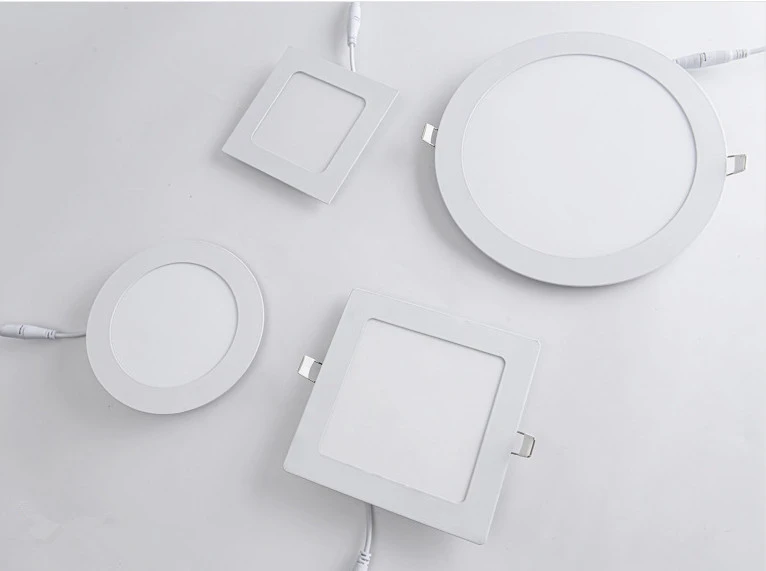

If you work in the procurement or project supply sector for LED panel lights, you have likely heard this question from clients: "Can it be any thinner?" Whether due to limited ceiling space, a preference for minimalist interior design, or constraints when retrofitting existing lighting, "ultra-thin" has become the most frequently cited selling point for panel lights. But what exactly makes a light "ultra-thin," how is this achieved, and what degree of thinness is actually reasonable? This article clarifies these questions.
Establishing a Standard: What Qualifies as "Ultra-Thin"?
There is no universally recognized international standard for the term "ultra-thin"; it is primarily a marketing term. Based on common product classifications, it can generally be understood as follows:
Traditional (thick) panel lights: Typically over 30mm thick; often feature an early-generation design with an aluminum frame and an external LED driver.
Standard (thin) panel lights: Approximately 15mm to 25mm thick.
Ultra-thin panel lights: Generally under 10mm thick, with some products reaching as thin as 5mm.
Therefore, when a client asks for an "ultra-thin" light, it is best to clarify exactly what thickness they have in mind-10mm or 5mm-to ensure that your price quotes and product samples remain aligned with their expectations.
The Core of "Ultra-Thin" Design: Edge-Lit Light Guide Plate (LGP) Structure
The key to achieving a thin profile in panel lights is the "edge-lit" (or side-lit) structure. Instead of being positioned directly behind the panel, the LED chips are arranged along the edges of the frame. Light is directed into a Light Guide Plate (LGP), where a pattern of dots (or etched structures) on the plate's surface ensures the light is distributed evenly across the emitting face.
The thickness of this structure is primarily determined by several components:
Light Guide Plate (LGP): Typically 2mm to 4mm thick, usually made of PMMA or PS.
Diffuser and Reflective Layer: Each is only a fraction of a millimeter thick.
Backplate and Frame: The thickness of the aluminum and the design of the folded edges directly influence the overall dimensions.
In contrast, "direct-lit" designs (where LED chips are placed directly behind the panel) require a specific "mixing distance" to prevent the appearance of bright spots, making it difficult to achieve a truly ultra-thin profile. Consequently, virtually all ultra-thin panel lights currently on the market utilize an edge-lit design.
The Impact of Light Sources and LED Placement
The LEDs determine the "height" of the fixture's edge. A lower-profile LED allows for a thinner light guide plate (LGP); otherwise, light cannot be effectively coupled into the plate, leading to light leakage at the edges or uneven brightness.
LED Dimensions: Ultra-thin models typically utilize small-form-factor LEDs (such as the 2835 type) or low-profile LED strips. Some extremely thin products even employ specialized side-emitting LEDs.
Arrangement: Configuring LEDs along two or four sides of the LGP ensures more uniform brightness and allows for a lower, more stable density of LEDs on any single side.
Alignment Precision: Any significant gap between the LEDs and the LGP results in a noticeable loss of light efficiency; therefore, ultra-thin designs demand higher precision in the assembly process.
The LED Driver: The Often-Overlooked "Thickness Bottleneck"
While many assume that simply thinning the light panel is sufficient, the LED driver is frequently the actual limiting factor for thickness. Traditional internal drivers have a certain height, making it nearly impossible to fit them into a housing thinner than 10mm.
Common solutions include:
External Drivers: Moving the power supply outside the light fixture-leaving only the panel itself-is the most prevalent approach for ultra-thin designs.
Ultra-Thin Driver Boards: Utilizing custom, low-profile PCB drivers, suitable for fixtures in the 8mm–12mm thickness range.
Low-Voltage Power Supply: Employing a DC low-voltage design, which allows for a more compact driver unit.
Note that an external driver introduces an additional component during installation; project-based clients should verify wiring paths and available space for the driver in advance.
Thermal Management: Balancing Thinness and Lifespan
A thinner light fixture provides less internal space, making heat dissipation more challenging. Inadequate thermal management leads to accelerated lumen depreciation, color temperature shifts, and a significantly shortened product lifespan. Ultra-thin models typically manage heat through the following methods:
Using an aluminum alloy back panel as a comprehensive heat-dissipation surface, which spreads heat over a larger area.
Limiting the power of individual LED chips and utilizing a larger number of low-power chips to distribute heat, rather than concentrating heat generation in a few high-power components.
Reducing the overall power consumption of the fixture; consequently, ultra-thin models are generally better suited for office or commercial environments where lower to moderate power output is required.
How thin can they currently be?
Based on current mass-production standards, the typical range is as follows:
6mm–8mm: The mainstream ultra-thin category; these feature mature manufacturing processes and offer a good balance between cost and stability.
4mm–5mm: Ultra-slim models; these often require external LED drivers and demand high precision for both the light-guide plate and the LED chips, resulting in a higher price point.
Below 3mm: These are typically custom-made or intended for display purposes; they present significant challenges regarding mass-production yield and heat dissipation, making them unsuitable for large-scale commercial or industrial projects.
Specific dimensions may vary depending on power, size, and the type of LED driver used; it is best to verify with a physical sample before placing an order.
Summary
The ultra-thin design of LED panel lights is achieved through a combination of side-lit light-guide plate architecture, low-profile LED chips, flat-design drivers, and well-engineered thermal management. Mainstream mass-produced models typically range from 6mm to 8mm in thickness, while ultra-slim versions are generally 4mm–5mm; anything thinner is usually a custom product. When selecting a fixture, do not focus solely on thickness-factors such as luminous efficacy, light uniformity, driver type, and thermal performance are equally critical. A truly durable ultra-thin panel light is one that achieves an optimal balance among all these elements.
If you are looking for ultra-thin LED panel lights for a project or wholesale requirements, please get in touch with us. Simply provide details regarding the required dimensions, power, color temperature, thickness, and installation method, and our team will recommend the most suitable models, along with samples and price quotes. Send us an inquiry, and we will respond as soon as possible.