Is Choosing the Wrong Wavelength a Complete Waste of Time? This Article Explains the Differences Between 365nm and 395nm UV Lamps.
In the fields of industrial curing, counterfeit detection, and specialized lighting, the 120cm (4ft) DC24V UV LED tube is a standard fixture. However, when faced with the choice between 365nm and 395nm wavelengths, many buyers and technicians find themselves at a crossroads.
While both belong to the UVA spectrum, "a slight difference in wavelength leads to a vast difference in performance." This article provides an in-depth analysis of the technical disparities and application logic between these two core wavelengths.

1. The Core Difference: Invisible Light vs. Visible Light
The wavelength of a UV tube directly determines its "energy intensity" and "visual appearance."
- 365nm (Pure UV): Known as "True UV." Its spectrum sits deeper in the ultraviolet range, emitting very little visible light. To the naked eye, it appears only as a faint pale blue or white glow. It possesses high energy density and triggers stronger photochemical reactions.
- 395nm (Near-UV/Violet): Located on the edge of the visible light spectrum. It produces a distinct, bright purple light. While its energy is slightly lower than 365nm, it is widely used due to its cost-efficiency and compatibility with specific materials.
2. Technical Parameter Comparison: 365nm vs. 395nm
The following table outlines the characteristics of these 120cm DC24V tubes for direct comparison:
| Key Features | 365nm UV Tube | 395nm UV Tube |
| Visual Appearance | Faint bluish-white (Almost no visible purple) | Distinct violet/purple light |
| Energy Intensity | Extremely High; strong fluorescence excitation | High; ideal for surface curing |
| Curing Speed | Ultra-fast (Excellent deep curing) | Fast (Ideal for thin layers/coatings) |
| Thermal Effect | Lower | Slightly higher |
| Operating Voltage | DC 24V (Constant Current/Voltage) | DC 24V (Constant Current/Voltage) |
| Primary Applications | UV glue curing, forensics, scientific research | Ink printing, screen exposure, blacklight effects |
| Market Cost | Higher (Complex chip manufacturing) | Lower (High versatility and cost-effective) |
3. In-Depth Analysis: Why Do Applications Differ?
A. Industrial UV Curing
- 365nm: This is the standard wavelength for most professional UV adhesives (UV Glue). It offers superior penetration, allowing for deep-layer curing without causing the material to yellow.
- 395nm: Primarily used for surface ink drying or coating solidification. Using 395nm on an adhesive designed for 365nm may result in "surface dry, interior liquid" issues.
B. Counterfeit Detection & Forensics
- 365nm: The professional choice for banking, jewelry appraisal, and anti-counterfeiting. Because it produces minimal visible light interference, it can clearly excite invisible fluorescent fibers in banknotes or legal documents.
- 395nm: While it can trigger some fluorescence, the intense purple background light often masks subtle details, leading to lower precision.
C. Safety and Biology
In laboratory settings, the safety of DC24V combined with the high photon energy of 365nm is often used for protein detection or photochemical synthesis. Conversely, 395nm is more commonly found in general insect traps or ambient "blacklight" decor.
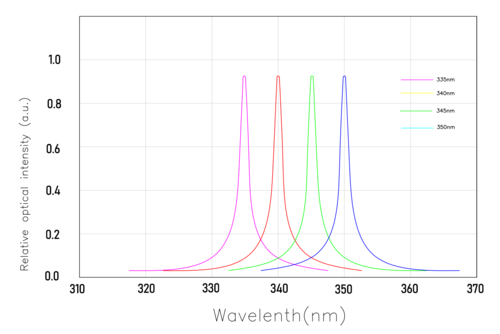
4. Procurement Tips for 120cm DC24V Specifications
For a 1.2-meter UV tube, using a DC24V low-voltage power supply offers significant advantages in safety and stability. Beyond wavelength, consider these two factors:
- Heat Dissipation: UV LEDs convert a significant amount of energy into heat. A 120cm tube must have a robust aluminum PCB or heat sink to prevent rapid "light decay" (lumen depreciation).
- Driver Matching: Ensure your power supply has at least a 20% power margin to account for voltage drops over the 1.2-meter length, ensuring consistent brightness from end to end.
- If you require precision curing, forensic appraisal, or high-end scientific use, 365nm is the essential choice.
- If you are focused on large-scale printing, stage effects, or budget-friendly solutions, 395nm is the practical way to go.
In a DC24V lighting system, choosing the right wavelength isn't just about brightness-it's about the core success of your technical process.