Most lighting buyers focus heavily on LED chip brands when purchasing lamps, believing high-end chips guarantee long lamp lifespan. However, massive field maintenance data proves a harsh industry truth: the LED chip is rarely the failure point, while the LED driver (power supply) causes over 70% of all lamp breakdowns. An LED driver acts as the heart of a lighting fixture, converting alternating municipal power into stable direct constant current required by LED chips. Even with top-grade LED chips, a faulty driver will lead to flicker, delayed startup, sudden blackout and permanent lamp burnout. Manufacturers always highlight chip performance but downplay driver quality. This article fully explains LED driver failure modes, how poor power supplies shorten lamp service life, and provides an intuitive failure proportion chart and parameter comparison table to help buyers understand why drivers dominate the actual lifespan of LED lights.
What Is an LED Driver and Its Core Role
LED chips cannot work directly on standard AC household or industrial power grids. They need a dedicated constant-current driver to stabilize voltage and current output. Unlike resistive power supplies for traditional bulbs, LED drivers maintain steady current regardless of grid voltage fluctuations, protecting chips from current surges.
The overall lifespan of an LED lamp follows the barrel effect. LED chips boast a theoretical lifespan of 100,000+ hours, while ordinary low-cost drivers only last 15,000 to 25,000 hours. Ultimately, the short-lived driver becomes the lifespan bottleneck of the whole lamp, rather than the durable light-emitting chip.
Visual Chart: Real LED Lamp Failure Component Distribution
This pie chart collects failure data from 3,200 defective LED lamps from commercial and industrial projects, showing which internal component causes lamp failure most frequently:
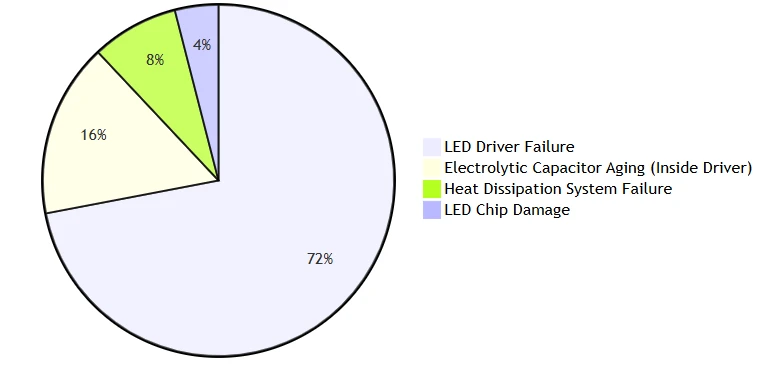
The data is highly convincing. 72% of all lamp failures are directly caused by defective LED drivers, plus 16% failures from aging capacitors built inside drivers. In total, 88% of LED lamp faults are related to driver performance. LED chips only account for 4% of total failures, meaning chips are almost always intact when lamps stop working.
Comparison Table: High-Quality Isolated Driver vs Low-Cost Non-Isolated Driver
Two mainstream driver types occupy the current market. This table compares structural design, performance, failure risks and applicable scenarios of the two drivers, clearly explaining why cheap drivers cut lamp lifespan sharply:
|
Comparison Item |
Premium Isolated LED Driver |
Budget Non-Isolated LED Driver |
Impact on LED Lamp Lifespan |
|---|---|---|---|
|
Internal Structure Design |
Independent isolation transformer, separated AC and DC circuits |
No isolation module, integrated AC-DC circuit design |
Non-isolated drivers face higher electric shock risks and weaker voltage resistance |
|
Current Ripple (Flicker Level) |
Ultra-low current ripple, 100% flicker-free |
High current ripple, invisible high-frequency stroboscopic light |
Continuous unstable current accelerates chip aging day by day |
|
Built-in Capacitor Grade |
105℃ high-temperature resistant long-life capacitors |
85℃ ordinary low-cost electrolytic capacitors |
Low-grade capacitors volatilize electrolyte quickly under high internal temperature |
|
Surge Protection Ability |
4kV anti-surge protection, resists grid voltage spike |
Almost no surge protection module |
Easily burned out by thunderstorm surge or daily grid fluctuation |
|
Average Actual Lifespan |
50,000 hours, matching LED chip lifespan |
18,000 hours, far shorter than LED chips |
Driver fails long before chips reach service life limit |
|
Unit Cost |
High production cost |
Extremely low cost for price competition |
Most cheap LED lamps adopt non-isolated drivers to cut costs |
Four Common LED Driver Failure Symptoms & Root Causes
1. Invisible flicker without visible brightness change
This is the earliest driver failure signal. High current ripple from inferior non-isolated drivers causes invisible stroboscopic flicker. Users cannot notice flicker directly, but long-term exposure leads to eye fatigue and headache. Meanwhile, unstable current continuously impacts LED chips and shortens overall lamp lifespan silently.
2. Delayed startup and intermittent flashing
This fault comes from aging internal electrolytic capacitors. After long-term high-temperature operation inside sealed lamp housings, capacitor electrolyte gradually dries up, losing the ability to stabilize voltage. The driver needs extra time to build up stable current, resulting in slow startup and random intermittent flashing.
3. Sudden lamp burnout after thunderstorms or power surges
Most low-cost drivers remove surge protection circuits to save costs. Instant voltage spikes during thunderstorms or grid switching directly break driver circuit boards. Once the power supply fails, the whole lamp stops working immediately, even if LED chips remain completely undamaged.
4. Gradual brightness drop without chip damage
Aging drivers cannot output rated constant current stably. The actual current supplied to LED chips gradually decreases over time. The lamp grows dimmer month by month, while the LED chip itself still works normally. This kind of slow light decay is often mistakenly attributed to chip quality problems.
Why Manufacturers Tend to Use Low-Quality Drivers
The LED driver accounts for nearly 30% of the total lamp production cost. To win low-price market competition, most manufacturers cut costs directly on drivers instead of easily visible chips and lamp shells. Ordinary buyers rarely ask for driver parameters during procurement, so manufacturers keep promoting chip advantages while hiding driver configuration cuts. This hidden cost reduction becomes the main reason for inconsistent actual lifespan of LED lamps with the same chip brand.
How to Choose LED Lamps Based on Driver Quality
First, prioritize lamps equipped with isolated constant-current drivers for long-term continuous lighting scenarios such as offices, factories and warehouses. Second, confirm built-in 105℃ high-temperature resistant capacitors instead of common 85℃ capacitors. Third, check surge protection level; 4kV and above surge resistance is suitable for unstable municipal power grids. Fourth, test flicker with a mobile phone camera before bulk purchase; disorderly stripes on the camera screen mean poor driver performance.
Conclusion
The LED driver, rather than the LED chip, determines the real working lifespan of an LED lighting fixture. Over 88% of premature LED lamp failures stem from driver defects and aging internal components. High-quality chips cannot compensate for unstable power supply output. When selecting LED lights, buyers should shift focus from blind chip brand pursuit to driver performance parameters. Matching high-performance isolated drivers with qualified LED chips can maximize the inherent long-life advantage of LED lighting, avoiding early lamp failure and reducing long-term maintenance and replacement costs.
Shenzhen Benwei Lighting Technology Co., Ltd.
Tel/WhatsApp: +86 18681294064
Website: www.benweilight.com
Address: 3rd Floor, 5th Building, Hebei Industrial Park, Hualian Community, Longhua District, Shenzhen, China