LED Grow Lights for Plants: How Does Light Affect Plant Growth?
Light is one of the most important factors affecting plant growth. In outdoor cultivation, plants naturally receive sunlight. But for indoor farms, greenhouses, vertical farms, and tissue culture laboratories, natural sunlight may not always be sufficient or consistent.
This is where LED grow lights come into play.
Unlike ordinary LED lighting designed mainly for human vision, LED grow lights are designed to provide light that plants can use for photosynthesis and other biological processes. Understanding how plant lighting works can help growers choose the right lighting solution for different growing environments.
1. Why Do Plants Need Special Lighting?
Plants use light as an energy source for photosynthesis. During photosynthesis, plants convert light energy into chemical energy, which supports growth and development.
However, plants do not respond to light in exactly the same way humans do.
A conventional lighting system may look bright to the human eye but still provide an unsuitable amount or spectrum of light for plants. Therefore, when selecting grow lighting, factors such as light spectrum, light intensity, photoperiod, and light distribution are more important than simply looking at how bright the lamp appears.
This is one reason why professional LED grow lights are widely used in indoor cultivation and controlled-environment agriculture.
2. What Is the Importance of Light Spectrum?
Different wavelengths of light can influence different stages of plant development.
Generally speaking, blue light is closely associated with vegetative growth and plant structure, while red light plays an important role in photosynthesis and can influence flowering and fruiting.
Other wavelengths can also contribute to plant responses, depending on the plant species and cultivation stage.
Therefore, there is no single "best" spectrum for every plant. Leafy vegetables, herbs, seedlings, flowers, and fruiting plants may have different lighting requirements.
For professional cultivation projects, the spectrum can be designed or adjusted according to the physiological characteristics of the target plants.
3. Why Are PPFD and DLI More Useful Than Lumens?
When buying conventional lighting, people often compare lumens or lux. These measurements are useful for human-oriented lighting, but they do not tell the whole story when evaluating plant lighting.
For horticultural applications, PPFD (Photosynthetic Photon Flux Density) is a more relevant measurement. It describes how many photosynthetically active photons reach a specific area of the plant canopy.
Another useful concept is DLI (Daily Light Integral), which considers the total amount of photosynthetically active light received by plants during a 24-hour period.
In simple terms:
- Spectrum tells you what kind of light the plant receives.
- PPFD tells you how much useful light reaches the plant at a given moment.
- DLI tells you how much useful light the plant receives over an entire day.
This is why professional grow-light projects should consider the plant, growing area, mounting height, lighting schedule, and light distribution rather than selecting a lamp based only on wattage.
4. Does Higher Wattage Always Mean Better Plant Growth?
Not necessarily.
A higher-power light does not automatically produce better growing results. What matters is how efficiently the electrical energy is converted into useful plant light and how evenly that light is distributed across the growing area.
For example, if the light is too concentrated, plants directly underneath the fixture may receive excessive light while plants at the edges receive much less.
A well-designed lighting system aims for an appropriate and uniform light level across the entire canopy.
Therefore, growers should consider the overall lighting layout instead of focusing only on the wattage of an individual fixture.
5. Why Is Waterproof Protection Important for Grow Lights?
Many growing environments have high humidity, water spraying, condensation, or frequent cleaning.
Greenhouses, hydroponic farms, plant factories, and other controlled growing environments can therefore be challenging environments for electrical equipment.
This makes the protection level of the lighting fixture particularly important.
For example, an IP67-rated LED grow light is designed with a high level of protection against dust and water ingress. This can make it more suitable for demanding environments where moisture is a regular part of the operation.
The IP rating is not simply a marketing term. It is an important factor to consider when selecting lighting equipment for humid or wet cultivation environments.
6. LED Grow Lights Can Support Different Growing Applications
LED technology provides growers with greater flexibility in designing controlled lighting environments.
Depending on the lighting design, LED grow lights can be used in applications such as:
- Indoor plant cultivation
- Greenhouses
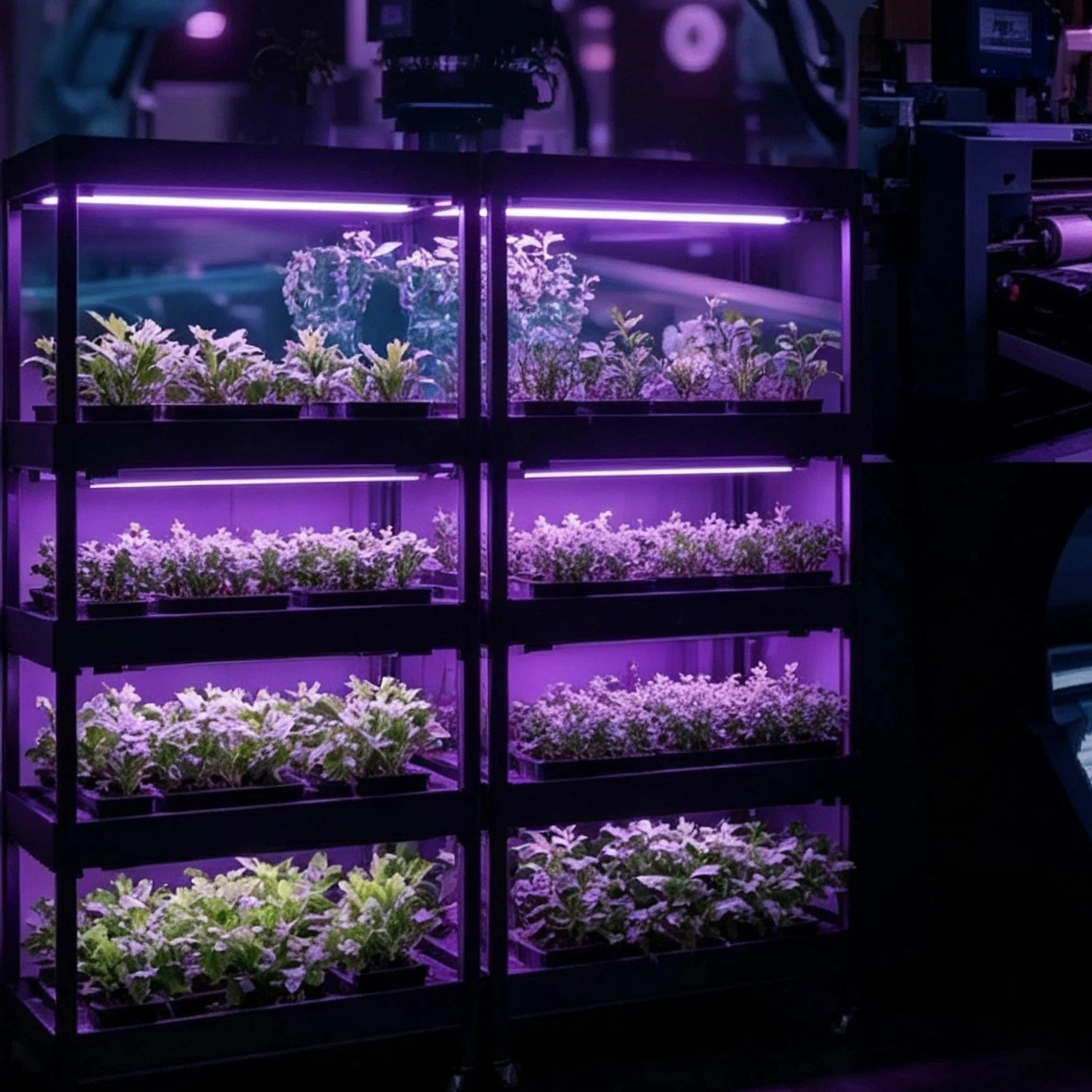
- Vertical farming
- Hydroponic systems
- Plant factories
- Seedling cultivation
- Tissue culture laboratories
- Research and controlled-environment agriculture
For different plants and growing stages, the lighting spectrum, intensity, operating time, and installation arrangement can be adjusted accordingly.

7. What Should You Consider Before Choosing an LED Grow Light?
Before purchasing a grow light, it is better to look beyond the product wattage.
Consider these questions:
What plants are you growing?
Different plants may have different lighting requirements.
What stage of growth are the plants in?
Seedlings, vegetative plants, flowering plants, and fruiting plants may require different lighting strategies.
How large is the growing area?
The number and arrangement of fixtures should be determined according to the cultivation area and required light distribution.
How high will the lights be installed?
Mounting height affects light intensity and coverage.
Is the environment humid or wet?
If the light will be exposed to moisture, condensation, or water spray, an appropriate IP protection rating should be considered.
Do you need a customized spectrum?
For professional horticultural projects, customized spectrum solutions can help match the lighting system to specific plant species and growth stages.
8. The Future of Plant Lighting
As indoor farming and controlled-environment agriculture continue to develop, lighting is becoming more than simply a source of illumination.
Modern horticultural lighting can be integrated into a complete cultivation management system, where light intensity, spectrum, operating time, and other environmental factors can be managed according to plant requirements.
The goal is not simply to make plants "brighter," but to provide the right light, in the right amount, at the right time.
For this reason, choosing an LED grow light should be considered as part of the overall cultivation strategy rather than as an isolated lighting purchase.
Choose the Right LED Grow Light for Your Application
The ideal grow light depends on your plants, growing environment, installation height, coverage area, and cultivation goals.
If you are planning an indoor farm, greenhouse, plant factory, hydroponic system, or other horticultural lighting project, contact us to discuss your application and get a customized LED grow light solution for your project.