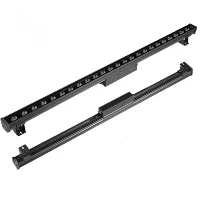
Drive through any city at night and the buildings that actually catch your eye usually aren't the biggest ones - they're the ones with light doing something interesting on the façade. That even wash of color running up a hotel entrance or across a bridge pillar is almost always coming from an LED wall washer light. It's one of those products that looks simple from the outside but solves a real problem: how do you light a large, flat surface evenly without a wall of spotlights and a mess of wiring? Here's what's actually behind that effect and why it's become a go-to fixture for architects and property owners alike.
What a Wall Washer Actually Does
A wall washer is a narrow, elongated fixture designed to throw a wide, even beam of light across a vertical surface - hence the name, since the light "washes" down or up the wall rather than pooling in one spot. Unlike a standard floodlight, which throws a cone-shaped beam and creates a bright center with fading edges, a wall washer uses a row of LEDs paired with a linear lens to spread the light out sideways.
The result is a clean sheet of light rather than a series of overlapping circles. It's a small optical difference, but it's the reason wall washers look intentional and architectural rather than like someone just pointed a spotlight at a building.
Even Coverage Without Hot Spots
Anyone who's tried lighting a large wall with regular floodlights knows the problem - you either get bright patches with dark gaps between fixtures, or you have to install so many lights that the wiring and mounting turn into a headache. Wall washers are built specifically to avoid this. The beam angle is usually wide (often 15° to 45° depending on the lens), and units are designed to be installed in a continuous row so each fixture's beam slightly overlaps the next.
Get the spacing and beam angle right, and a 20-meter wall can be lit with a single row of fixtures and no visible seams. That's the whole point of the design - light that looks like it belongs there, not like it's coming from a visible source.
Color Changing and Dynamic Effects
Most wall washers on the market today are RGB or RGBW, meaning they can shift through a full color range instead of staying fixed on white. For buildings that host events - hotels, shopping centers, entertainment venues - this matters more than it might seem. A façade can run in warm white for daily use, then switch to a brand color for a launch event, or cycle through colors for a holiday display, all without touching the fixtures themselves.
DMX-controllable versions take this further, allowing multiple fixtures to be programmed and synced for chase effects or gradual color transitions - the kind of coordinated lighting shows seen on landmark buildings during festivals.
Built for Outdoor Conditions
Since these fixtures are almost always mounted outside, weatherproofing isn't optional. Reputable wall washers carry an IP65 or higher rating, meaning they're sealed against dust and can handle direct rain without water getting into the electronics. Housings are typically die-cast aluminum, which handles heat dissipation well and holds up better than plastic against UV exposure and temperature swings over years of outdoor use.
It's worth checking this rating before buying - a wall washer rated only for indoor or covered use will fail fast once it's actually exposed to weather.
Energy Costs for Large-Scale Lighting
Lighting an entire building façade sounds like it should be expensive to run, but LED wall washers use a fraction of the power that older metal halide or halogen floodlights needed for the same coverage. A single fixture typically draws somewhere between 18W and 50W depending on length and brightness, and because LEDs are directional by nature, less light is wasted compared to older technology that scattered light in every direction.
For a property running façade lighting every night for hours, that efficiency difference shows up clearly on the electric bill over a year, not just in theory.
Where They Get Used
While architectural façades are the most visible use case, wall washers show up in plenty of other settings - retail storefronts trying to stand out on a busy street, museum and gallery walls where even light matters for how art is viewed, bridges and monuments as part of city lighting projects, and landscape features like garden walls or fences. The common thread is always the same: a flat surface that needs consistent light without visible fixtures dominating the view.
Final
An LED wall washer light isn't a flashy product on its own, but it solves a specific lighting problem well: even, controllable, weatherproof light across large vertical surfaces. Between the color-changing options, low running costs, and outdoor durability, it's become the standard choice over older floodlight setups for anything from a small storefront to a full building façade. The details that matter most when choosing one are the IP rating, beam angle, and whether DMX control is needed - get those right and the rest of the install tends to go smoothly.
If you are looking for a reliable supplier of LED wall washers for building facades, commercial spaces, or landscape lighting projects-whether for standard products or customized lighting solutions-please feel free to contact us. We can provide quotations, technical specifications, and samples tailored to your project requirements.