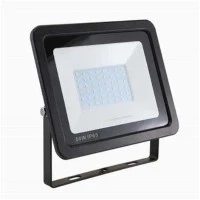
LED light strip physical lighting analysis
Where does the light in your house come from? Chances are it comes from many different types of light sources, but more and more people are bathed in soothing balms produced by light-emitting diodes (LEDs). This new light source is rapidly replacing incandescent and fluorescent lamps as the main treatment for darkness. The main reason for the rise of LED lights is the triad of consumer goods: cost, efficiency and reliability. Due to recent developments, the price of LED lights is falling - almost as low as old bulbs in some parts of the United States. They are also cheaper to run and last longer. All of this is thanks to the work of an army of scientists and engineers who have turned a 100-year-old scientific quirk into a multibillion-dollar business.
LED lights with physical lighting resolution 1, single frequency
Inside the LED bulb is a small semiconductor chip, which is the light-emitting part. It is made of two layers of crystalline materials, such as GaAs, that have been contaminated with different materials (what chemists call doping). This contamination means that one layer has lots of high-energy electrons it wants to release, while the other layer has room for electrons it does want to fill with lower energy levels. In the technical language of electronics, one layer is n-type (one is discarded) and the other is p-type. This combination forms what is called a PN junction.
LED lights with physical lighting resolution 2, apply voltage
For electrons, the knot is like a waterfall: push them in a certain way and they fall off, but they can't come back. Electrons tend to flow between the two layers if a voltage is applied so that the negative electrode of the circuit lies on the n-type layer. If you apply the voltage in any other way, you will block the flow. These layers form a diode (from the ancient Greek di, meaning two, and ODE, meaning path or path). Like a waterfall, the flow of water can run its course, but not its course.
LED lights with physical lighting resolution 3, white light, no heat
The blue LEDs that their process allows are the holy grail of LEDs because blue light can pass through phosphors, which absorb light and then convert it to other colors at different higher frequencies of chemicals emitted. There are many phosphors that can convert blue light to green and red, so if you combine blue LEDs with some of these phosphors, you get white light and white LEDs.
LED lights with physical lighting resolution 4, lighting efficiency
The result is that bulbs are much more efficient than older incandescent bulbs. While an incandescent bulb may consume 60 watts of energy to light an entire room, an LED bulb produces less than 10 watts. And they last longer, thanks to filaments that don't require heating or uncommon gases. LEDs do fail over time (as the doped material migrates and the crystal gradually breaks down), but this takes longer than incandescent bulbs.

LED lights with physical lighting resolution 5, cheaper and cleaner
As a result, LED bulbs are more efficient than incandescent bulbs. Now that manufacturers have figured out how to make these bulbs quickly and cheaply, they can replace them, ushering in a new era of cheaper, cleaner, and more efficient home lighting.
The above is the sharing about the LED light strip physical lighting analysis, I believe that after reading above summary, we have had a certain understanding of this knowledge, want to know more about the LED light strip information, you can go to the customer service for consultation.
Shenzhen Benwei Lighting Technology Co., Ltd is a professional manufacturer in producing LED lighting products, Our main products T8 T5 LED Tube, LED Grow Light,Poultry LED Light,Tri-proof LED Light,LED Flood Light, LED Panel, LED Stadium Light, LED High Bay, LED Strip light, If you want to purchase a high-quality LED lighting products or have a more in-depth understanding of the application of LED lighting, please contact send us inquiry.