Led Stadium Lights 2026: The Essential Guide to Uniformity and Standards
1. Why is Uniformity the Key to Stadium Lighting Selection?
When we talk about sports lighting, the most common question is "is it bright enough?" – meaning the horizontal illuminance value. But the core parameters that truly determine athlete performance, broadcast quality and spectator experience are illuminance uniformity and glare control.
A typical example: a provincial sports centre before retrofit used traditional metal halide lamps. Although the average illuminance reached 800 lx, the centre was bright while the edges were dark, and vertical illuminance varied sharply. That not only caused visual fatigue for players, but also made high‑speed camera footage suffer from frequent brightness bands and shadow flicker.
In recent years, driven by global "dual‑carbon" goals and substantially upgraded energy efficiency standards for sports lighting, LED has become the absolute mainstream for stadium lighting. The global sports lighting market was valued at approximately US2.19billionin2025andisprojectedtoreachUS2.19billionin2025andisprojectedtoreachUS4.82 billion by 2035, with a compound annual growth rate (CAGR) of 8.2%. However, as the technology spreads, engineering problems where illuminance meets the standards but uniformity is poor have become common. Therefore, this article focuses on "illuminance and uniformity" to provide a practical guide from standards to selection.
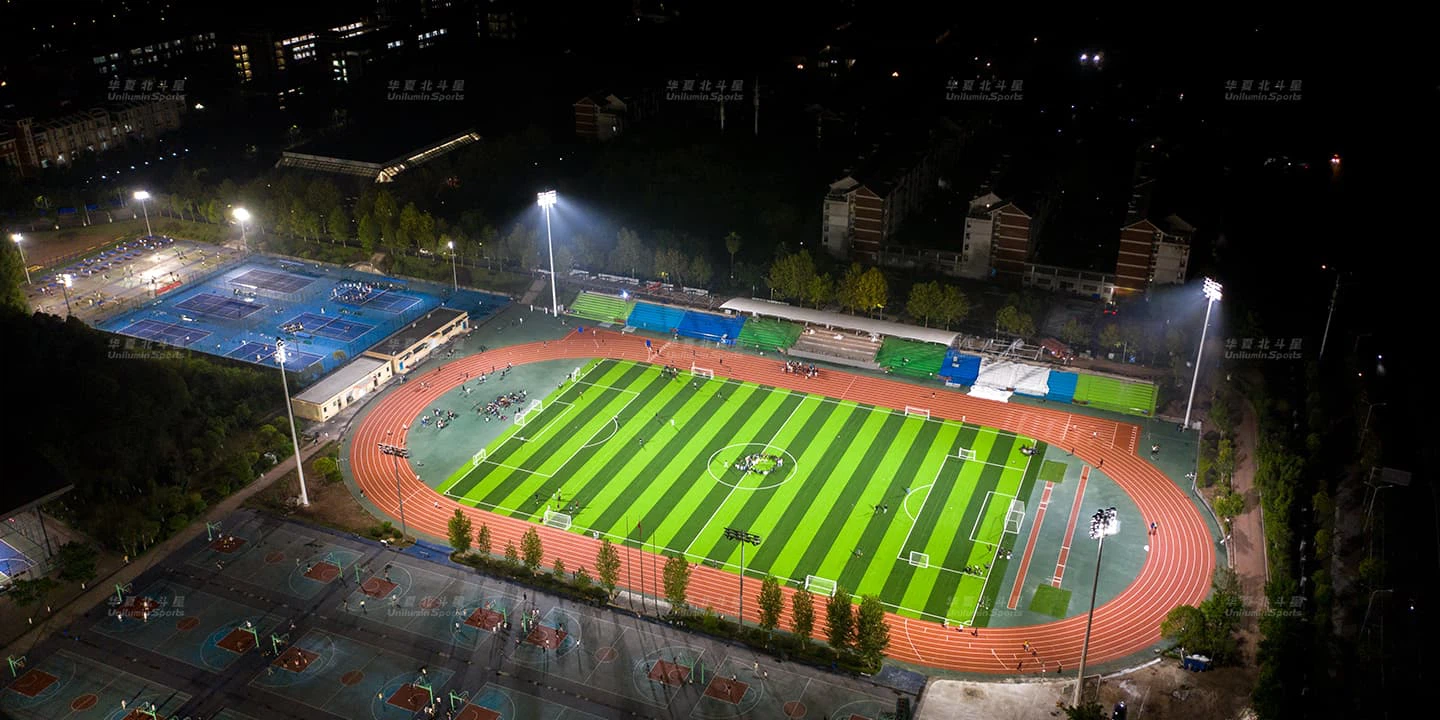
2. Understanding the Standards: How Much Illuminance Do Different Grades of Stadiums Need?
Sports lighting standards mainly come from two sources: international standards with global influence, such as those from the International Commission on Illumination and various international sports organisations (FIFA, IAAF, etc.), and local specifications of each country/region.
In China, GB/T 38539-2020 Technical requirements for application of LED sports lighting officially came into effect on October 1, 2020. It is the most important national standard for LED sports lighting in China, overseen by the Ministry of Housing and Urban‑Rural Development. It defines six lighting classes by usage function, specifying key indicators such as horizontal illuminance, vertical illuminance, uniformity, colour rendering index, and colour temperature.
In North America, the IES RP‑6 series published by the Illuminating Engineering Society is the core foundational document. Based on competition level and spectator capacity, it classifies stadiums into four classes: Class I to Class IV.
Comparison of Illuminance Requirements by Event Grade (Based on IES RP‑6 & 2026 Industry Procurement Data)
| Event Grade / Venue Type | Recommended Horizontal Illuminance (lx) | Recommended Vertical Illuminance (lx) | Description / Typical Use |
|---|---|---|---|
| Training & Recreation (Class IV) | 200 – 300 | 100 – 150 | Suitable for low‑intensity training, school matches, community sports events |
| Amateur Events (Class III) | 300 – 500 | 150 – 250 | Regional amateur competitions, local league games, club training grounds |
| University / Professional (Class II) | 500 – 750 | 300 – 500 | Current mainstream design level; meets university league and some professional broadcast requirements |
| Top / International Broadcast (Class I) | ≥ 1000 | ≥ 700 | Compliant with FIFA/IAAF broadcast requirements; supports HDTV/UHDTV |
| 2026 Football Tender Example | 500 – 800 | 300 – 480 | Based on 2026 football field lighting tender technical specifications |
3. Technical Deconstruction: What Are the Key Parameters of LED Stadium Lights?
Key Parameter Comparison Table for High‑Power LED Stadium Lights
| Parameter | Traditional Reference | 2026 Market Minimum | 2026 Industry Recommended | Importance |
|---|---|---|---|---|
| Luminous Efficacy (lm/W) | 90 – 130 | 130 | 150 – 180 | 2026 minimum threshold: <130 lm/W considered obsolete |
| Correlated Colour Temperature (CCT) | 4000K – 5000K | ≥ 5000K | 5000K – 5700K | Professional broadcast requirement; FIFA recommends 5000K‑5600K |
| Colour Rendering Index (CRI) | Ra ≥ 70 | Ra ≥ 80 | Ra ≥ 90 | High Ra ensures true colour reproduction of athletes, jerseys and advertising boards |
| R9 Value | No requirement | R9 > 0 | R9 ≥ 20 | Ensures correct reproduction of warm colours like red – critical for broadcasting |
| Ingress Protection (IP) | IP54 | IP65 | IP66 / IP67 | Outdoor stadiums must be dust‑ and water‑tight; IP65 is the minimum |
| Surge Protection | 6 kV | 10 kV | ≥ 10 kV | Guarantees safe operation during thunderstorms and unstable grid conditions |
| Total Harmonic Distortion (THD) | < 20% | < 20% | < 15% | Ensures power quality and reduces interference with other electronic devices |
| Rated Life (L70/B50) | 50,000 hours | 50,000 hours | 75,000 – 100,000 hours | Total operating time until luminous flux declines to 70% of initial value |
4. Focusing on the Core: How Important is Uniformity?
Uniformity is commonly measured by two indices: U1 (min. illuminance / average illuminance) and U2 (min. illuminance / max. illuminance) . U2 is more stringent and better reflects actual lighting quality.
Here is a real example: a university baseball field decided to upgrade from a traditional 1500W metal halide system (approx. 80 lm/W) to a 1200W LED system (approx. 150 lm/W). Before the upgrade, illuminance was relatively high but uniformity was extremely poor – the centre of the field was too bright while the foul lines were severely underlit, causing noticeable brightness fluctuations in slow‑motion replays.
After switching to an LED system with multi‑angle asymmetric optical lenses, the horizontal uniformity U2 improved from 0.43 to 0.71, meeting the requirements of IES RP‑6 Class II events.
Impact of Uniformity on Game Experience and TV Broadcast
| Dimension | Good Uniformity (U2 ≥ 0.7) | Poor Uniformity (U2 < 0.5) |
|---|---|---|
| Athlete's vision | Clear throughout the field, low visual fatigue | Flickering bright/dark areas, misjudgment of distances, increased injury risk |
| TV broadcast quality | Stable, continuous picture; smooth camera transitions | Frequent auto‑exposure changes; visible brightness bands |
| Slow‑motion replay | Clear details, no flicker disturbance | Flicker or trailing – poor replay quality |
| Spectator experience | Comfortable viewing; bright and even seats | Visual fatigue; some zones insufficiently lit |
FIFA's requirements for HDTV broadcasts are even stricter: horizontal uniformity ≥ 0.7, vertical uniformity ≥ 0.6, and the ratio of average horizontal to average vertical illuminance between 0.5 and 2.0.
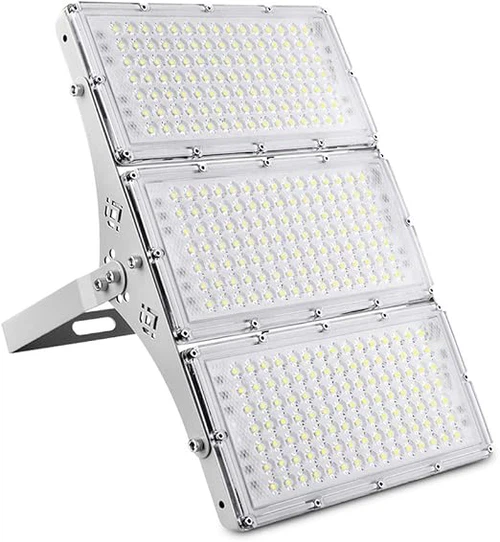

5. Four Factors Affecting Uniformity – Beam Distribution is Key
Beam distribution is the most critical factor determining uniformity. NEMA (National Electrical Manufacturers Association) classifies beam angles into seven types, from Type I to Type VII. Stadium lights commonly use asymmetric Type II to Type V distributions to achieve either "long‑distance projection" (e.g., NEMA 2‑3) or "wide coverage" (e.g., NEMA 4‑5).
Four key control points:
- Optic lens selection: Narrow beams for long‑distance projection to the central field; medium‑wide beams for near‑field areas.
- Pole height and layout: Poles should not be too low. Higher poles and more poles create more cross‑lighting overlap, improving overall uniformity. Lighting simulation is generally required to determine the minimum pole height, number of poles, and optimal luminaire positions on each pole.
- Asymmetric optics: For poles along the sidelines or corners, use asymmetric lenses to direct more light forward and reduce off‑field spill light.
- Reasonable illuminance headroom: Luminous flux declines as luminaires age. Design should include at least 20% initial illuminance headroom to ensure that the minimum illuminance standard is met throughout the luminaire's entire life.
6. Mega Trend: The Global Sports Lighting Market is Accelerating in 2026
Data show that stadiums worldwide are undergoing large‑scale LED retrofits and intelligent upgrades. According to industry reports: the global stadium lighting market was valued at about
US813.3millionin2025andisexpectedtogrowataCAGRof10.9813.3millionin2025andisexpectedtogrowataCAGRof10.92.18 billion by 2035.
In China, various regions are also intensively promoting LED retrofits of sports venues. In the first quarter of 2026, multiple retrofit projects were launched. For example, Shangrao Sports Centre fully replaced its old lighting, requiring energy‑efficient designs that support multiple modes (training, competition, etc.). Zunyi Olympic Sports Centre Gymnasium specified luminaire efficacy ≥150 lm/W, CCT ≥5500K, and CRI (Ra) ≥80.
At the same time, the "dual‑carbon" goal is accelerating the green transition of the sports building sector. LED stadium lighting system efficiency is at least 50‑70% better than traditional metal halide systems, and gradually implemented energy‑saving retrofit subsidies further lower the investment threshold for venue upgrades.
8. Selection Guide: How to Choose the Right LED Stadium Light Step by Step
✅ Step 1: Determine venue use and required standard class
- Training / school: Class III or IV – horizontal illuminance 200–500 lx, efficacy ≥130 lm/W
- Amateur / local events: Class II or III – horizontal illuminance ≥500 lx, efficacy ≥150 lm/W
- Professional / international broadcast: Class I – horizontal illuminance ≥1000 lx, efficacy ≥160 lm/W, Ra ≥90
✅ Step 2: Determine colour temperature and colour rendering
- Broadcast‑grade events: recommend 5000K–5700K, Ra ≥90
- General events: 4000K–5000K can be acceptable, but verify against standards
✅ Step 3: Determine luminaire beam distribution type
- Long‑distance projection (centre of field) → NEMA 2‑3 or narrow‑beam optics
- Wide coverage (near field / infield) → NEMA 4‑5 or medium‑wide distribution
- Sideline / corner positions → asymmetric distribution to reduce off‑field spill and light pollution
✅ Step 4: Determine ingress protection and reliability
- Outdoor stadiums: must choose IP66 or higher
- Coastal areas: extra attention to corrosion resistance (salt spray test ≥1000 hours)
- Surge protection ≥10 kV, THD ≤15%
✅ Step 5: Control and dimming options (2026 upgrade)
- Scene control: using 0‑10V, DALI‑2 or DMX/RDM protocols to achieve one‑touch switching between match, training, maintenance, off and other scenes.
- Smart features: support for Constant Lumen Output (CLO) , Smart Time Dimming (STD) and dynamic RGBW full colour to save energy on demand and create audio‑video‑lighting synergy during major events.
- Remote management: choose luminaires that support networked lighting control (NLC) for centralised management, energy monitoring and remote maintenance.

9. Conclusion
LED retrofit of a stadium is far more than simply "buying lights and replacing them". It is a comprehensive engineering task involving optics, structure and electrical control. Success stories from internationally renowned venues repeatedly prove that meeting "illuminance alone" is not enough – the true determinants of event quality and broadcast experience are illuminance uniformity (U1/U2) and glare control.
With the rebound of global sports events, the "dual‑carbon" policy driving old venue retrofits, and the continuous refinement of sports lighting standards, 2026 is the best window for venue operators and lighting engineers to embrace technological upgrades and deploy high‑quality sports lighting. From understanding the basic framework of IES RP‑6 or GB/T 38539‑2020, to precisely selecting LED efficacy, colour temperature and beam distribution, and finally to achieving the optimal design through lighting simulation software – only by embodying all the above points in a selection strategy can one truly build a modern LED sports lighting project.
End of article
📌 One‑sentence summary: First‑class sports lighting starts with precise calculation of illuminance uniformity, followed by beam distribution and control matched to event grade and broadcast needs, and finally systematic IP protection and intelligent management – only when every indicator meets the standard can you achieve true "full coverage, shadow‑free competition".
Should you have any demands for bulk purchase or customized lighting solutions, feel free to contact us for a detailed quote.