Lighting for Layers: The Hidden Factor That Can Make or Break Your Egg Production
Walk into a commercial layer house, and you will find thousands of hens housed in a highly controlled environment-temperature, humidity, ventilation, feed, and water are all meticulously managed. Yet one critical variable is often overlooked or underspecified: lighting.
For laying hens, light is not merely illumination. It is a hormonal trigger, a behavioral regulator, and a direct driver of egg output. The right lighting program can extend peak production, improve egg quality, and reduce flock stress. The wrong lighting-or worse, inconsistent lighting-will suppress egg production, increase mortality, and erode your bottom line.

Birds See a Different World: Why Poultry Lighting Is Not Like Human Lighting
Before designing any lighting solution for layers, one fact must be understood: chickens do not see the same world we see.
Humans have trichromatic vision, sensitive to red, green, and blue wavelengths. Chickens, however, are tetrachromatic-their retinas contain four types of cone cells, allowing them to perceive ultraviolet (UV) light in addition to red, green, and blue. This means poultry can see light spectra completely invisible to human eyes.
Furthermore, chickens have a significantly higher flicker fusion frequency than humans. Humans perceive flicker up to about 60 Hz; beyond that, we see steady light. Chickens perceive flicker up to over 100 Hz. A light source that appears perfectly steady to a farmer may be strobing at 100 Hz, causing birds to experience stress, nervousness, reduced feeding time, and even increased aggression. This is why flicker-free drivers are not optional-they are essential for poultry welfare.
A lighting system designed for human convenience-standard LED tubes with high flicker, narrow spectrum, and abrupt on/off switching-is fundamentally unsuitable for layers. The birds themselves will tell you this through lower production, higher mortality, and behavior problems.
The Science of Photoperiod: How Light Triggers Egg Production
The single most powerful lighting tool for egg production is photoperiod management-controlling the number of hours of light hens receive each day.
Hens are photosensitive. Light entering the eye stimulates the hypothalamus, which triggers the release of gonadotropin-releasing hormone (GnRH). This cascade eventually stimulates the ovary to produce and release eggs. Without sufficient light, the reproductive axis remains suppressed. Conversely, once sexual maturity is reached, longer day lengths signal the hen's body that conditions are favorable for reproduction.
The established protocol for mature laying hens is 16 hours of continuous light per day, which simulates the long days of summer when egg production naturally peaks. Research shows that providing hens with a consistent 14–16 hours of light daily helps maintain egg production without depleting their reproductive system.
However, exceeding 16 hours can backfire. Too long a photoperiod causes chronic stress in chickens, leading to behavioral problems and reduced productivity. The dark period is equally important: hens require an uninterrupted dark period to rest, reset their circadian rhythms, and maintain a healthy stress response.
For winter months when natural daylight is short, artificial lighting is essential to maintain production. Timers should be used to ensure consistent day length year-round, with intensity gradually increased as birds transition from rearing to laying.
Spectrum: Wavelengths That Speak Directly to the Reproductive System
Photoperiod alone tells the hen how long the day is. Spectrum tells the hen what kind of day it is.
Research has shown that different wavelengths of light affect poultry in distinct ways. The most critical finding for layers: Red and orange wavelengths promote reproductive hormones, stimulating ovarian activity and maximizing egg production. Long-wavelength (red) light modulates egg production and the onset of sexual maturity in hens during the laying period. Red-spectrum LED lighting has the potential to improve ovarian function and feed efficiency. A spectrum with higher emissions at long wavelengths appears to be more favorable for laying hens than conventional lighting.
In contrast, blue and green wavelengths are associated with growth and muscle development rather than reproduction. During the pullet (rearing) phase, cooler light (5000K) is recommended to support growth. For laying hens, however, warmer light comprising more of the red spectrum (2700K–3000K) is optimal-this is the spectrum that stimulates hormone production for egg production.
The practical implication is clear: a layer house should use LED lighting with a warm correlated color temperature (2700–3300K), rich in red wavelengths. Using cool white or daylight spectrum (5000K+) in a layer house is biologically counterproductive-it signals the birds' bodies to grow, not to lay.
Recent studies have confirmed these effects with hard data. One study found that hens under red LED lamps showed greater egg production per bird per day, higher average egg weight, greater egg mass, and improved shell thickness compared to hens under other spectra. Another study observed that lighting designed specifically for laying hens-with higher emissions at long wavelengths-resulted in eggs with greater weight, shell strength, and yolk quality. Furthermore, a spectrum with higher emissions at shorter wavelengths (blue-heavy) appears to impair the productive performance of laying hens.
Even more striking: a poultry-specific LED light encourages secretion of hormones that control egg production, with some operations reporting production increases of 20–30% after switching from conventional lighting.

Intensity: More Is Not Always Better
A common mistake in layer house lighting is assuming that brighter is better. This is not the case.
The recommended light intensity for laying houses is surprisingly low: 10–20 lux at bird eye level. This is roughly equivalent to a well-lit office hallway, not a bright retail space. Excessive light intensity can induce stress, causing behavioral issues such as feather pecking and cannibalism, and may actually reduce egg production.
Very dim light (as low as 0.05 lux) can still be perceived by hens and may alter their internal clocks, but it is insufficient to stimulate the reproductive axis. The physiological threshold for response to changes in photoperiod is approximately 2 lux. For practical purposes, maintaining a uniform 10–20 lux across the entire layer house-without bright spots or dark shadows-provides the optimal balance between stimulating egg production and avoiding stress.
Flicker and Dimming: The Gradual Transition That Reduces Stress
Perhaps one of the most underappreciated aspects of poultry lighting is the transition between light and dark.
In nature, sunrise and sunset are gradual processes. Light intensity increases slowly over minutes or hours, and decreases just as slowly. Birds have evolved to expect these gradual transitions. An abrupt on/off at 5:00 AM-the common result of a simple timer connected to standard LED lights-causes a cortisol spike. The flock panics, feeding is temporarily disrupted, and stress-related behaviors increase.
Research has demonstrated that smooth switching of lights on and off-taking as little as 3 minutes-significantly improves the productivity and viability of laying hens compared to abrupt switching. This is why dimming capability is not a luxury; it is a biological requirement.
A professional poultry lighting system should support:
- Smooth dimming from 0% to 100% without flicker
- Sunrise simulation-gradually increasing light intensity over 15–30 minutes
- Sunset simulation-gradually decreasing intensity before dark period
- Deep dimming capability down to as low as 0.2–1% for nighttime observation without disturbing the flock
The sunset transition may be especially important. A gradual fade from light to dark gives hens time to settle onto perches and find comfortable positions before complete darkness. This reduces night-time panic, prevents injuries from birds flying off perches in the dark, and improves overall welfare.
Flicker-free operation is equally critical. As noted earlier, chickens perceive flicker at frequencies well above human perception. A light that appears steady to a farmer may be causing constant low-level stress in the flock, reducing feed intake, suppressing immune function, and lowering egg production. Flicker-free drivers that deliver truly stable light output eliminate this hidden stressor.
The Barn Environment Destroys Ordinary Lights-Here Is What Survives
A poultry house is one of the harshest environments for any electrical device. Ammonia from decomposing litter, high humidity, dust, temperature extremes, and daily high-pressure washdowns with chemical disinfectants will destroy standard commercial lighting within months.
Ammonia is particularly aggressive. In poultry environments, ammonia levels ideally should not exceed 25 ppm to protect bird productivity. At levels above 20 ppm, producers must implement additional practices to reduce it. But ammonia does not just harm birds-it aggressively corrodes electronic components. Copper traces oxidize, solder joints weaken, and plastic housings become brittle and crack.
Moisture is a second major threat. Poultry houses are washed down regularly with high-pressure hoses. A light fixture rated for indoor use (typically IP20) will fail immediately under such conditions.
For a poultry house lighting fixture to survive and perform long-term, it must meet at least IP65, preferably IP66 or IP67, ensuring complete dust-tight protection and resistance to powerful water jets or even temporary submersion. The ideal construction combines:
- An aluminum heat sink body-for robust thermal management and corrosion resistance
- A polycarbonate (PC) cover-impact-resistant, chemically resistant, and lightweight
- Sealed driver compartment-preventing moisture and ammonia ingress
- Smooth external surfaces-easy to clean without traps for dust and bacteria
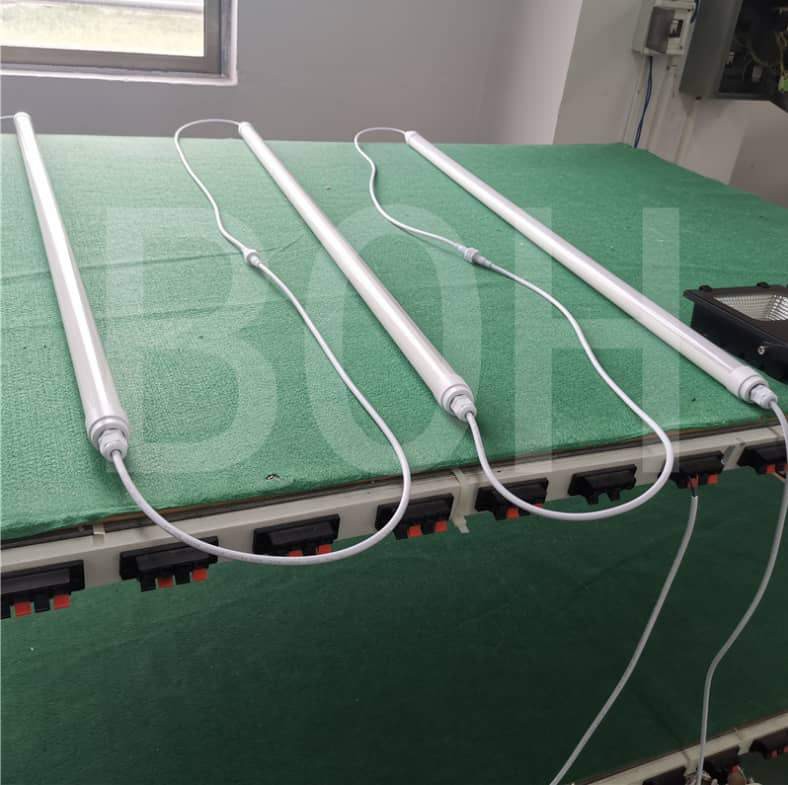
The Benwei light for chickens to lay eggs embodies these requirements with its aluminum+PC construction, IP67 waterproof rating, and robust sealing. This level of environmental protection is not a feature upgrade; it is the baseline for any lighting product intended to survive in a commercial poultry operation.
Rearing vs. Laying: Two Phases, Two Lighting Strategies
A common oversight in poultry lighting is treating the entire production cycle with a single lighting approach. In reality, pullets (young hens before lay) and laying hens have opposite lighting requirements.
During the rearing phase (0–16 weeks), the goal is to delay sexual maturation until the bird has reached proper body weight and skeletal development. Pullets are typically kept under short day lengths (8–10 hours) and relatively low light intensities (5–10 lux). Cooler light (4000K–5000K) is recommended during this phase to support growth and delay the onset of lay.
At approximately 16–18 weeks of age, as birds approach sexual maturity, the lighting program shifts dramatically. Day length is increased to 14–16 hours, intensity is raised to 10–20 lux, and spectrum is switched to warmer light (2700–3000K) rich in red wavelengths. This sudden increase in day length triggers the reproductive axis, signaling the hen's body that conditions are favorable for egg production.
A lighting system that cannot accommodate two distinct programs-different in duration, intensity, and spectrum-forces the farmer to compromise. Professional poultry LED fixtures with dimming capability and selectable color temperature allow a seamless transition from rearing to laying without replacing hardware.
Uniformity: The Unsung Hero of Layer House Lighting
Imagine a feeding line running the length of a 100-meter layer house. At one end, light intensity is 30 lux; at the far end, it is 5 lux. The hens in the bright end may be stressed; the hens in the dim end may not be stimulated enough to lay. The result is uneven production across the house, with some sections underperforming and others experiencing behavior problems.
Uniform light distribution is essential for consistent flock performance. A wide beam angle (120°–180°) ensures that light spreads evenly across the floor and through multiple tiers of cages or aviary systems. Narrow-beam fixtures create hot spots and shadows, leading hens to avoid certain areas-including feeding and nesting zones.
Poor uniformity can even encourage floor eggs. A study found that standard LED fixtures at a 90° angle created pronounced shaded areas along feeding lines, which encouraged egg-laying outside nests and worsened sanitary indices. After adjusting lighting to improve uniformity, floor eggs were reduced to just 2.3% over eight weeks, approaching the industry standard of 1.5%.
For multi-tier aviary systems, ensuring that light penetrates to lower tiers is an additional challenge. Fixtures must be positioned and angled so that birds on every level receive adequate, uniform illumination. Wide beam angles and proper spacing are essential.
The Financial Case: Lighting as a Profit Center
For a commercial egg operation, lighting should be viewed not as a utility expense but as a production input with measurable ROI.
Consider a typical layer house with 50,000 hens. At peak production, a 1% difference in lay rate represents 500 eggs per day-approximately 15,000 eggs per month. Over a year, that is 180,000 eggs. At commercial egg prices, the revenue difference is substantial.
A properly implemented LED lighting program delivers benefits across multiple lines:
- Increased egg production-Research indicates that red-enriched spectrum lighting increases egg production and extends the peak production period
- Improved egg quality-Studies have shown that spectrum specifically designed for layers results in eggs with greater weight, shell strength, and yolk quality
- Reduced mortality-Lower stress from smooth dimming and proper photoperiod reduces cannibalism and feather pecking, common causes of mortality in large flocks
- Lower electricity costs-LED fixtures consume 50–80% less energy than fluorescent or incandescent alternatives
- Reduced maintenance-A 50,000-hour rated life (approximately 5–6 years of continuous operation) eliminates most fixture replacement labor for the life of the investment
- Healthier flocks-Improved lighting supports immune function and reduces disease susceptibility
The upfront cost of professional poultry-specific LED lighting may be higher than commodity lighting. However, the total cost of ownership-including energy, maintenance, production impact, and flock health-overwhelmingly favors dedicated poultry LED solutions.
Conclusion: Light Is Feed for the Reproductive System
The poultry industry has long recognized that feed formulation, water quality, and ventilation are critical to layer performance. Lighting deserves a place alongside these fundamentals.
A hen's reproductive system is directly influenced by the light she receives. Photoperiod tells her how long the day is. Spectrum tells her what kind of day it is. Dimming transitions tell her when to rest and when to wake. Uniformity ensures she has equal access to resources across the entire house. Environmental protection ensures the lighting system itself survives long enough to deliver consistent performance.
When your lighting works with your birds' biology rather than against it, the results show up in the egg basket. Day after day. Flock after flock. Year after year.