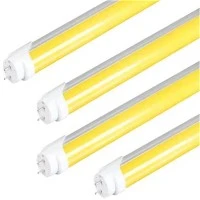
In photolithography workshops, paint-mixing rooms, and adhesive production lines, many factories encounter the same frustrating issue: materials-despite still being within their shelf life-undergo premature curing, discoloration, or degradation. Investigations often reveal the culprit to be something easily overlooked: the overhead lighting. Standard white LED tubes emit small amounts of ultraviolet (UV) light and high-energy blue light; prolonged exposure can inadvertently "trigger" photosensitive materials. T8 yellow UV-blocking LED tubes are specialized lighting solutions designed specifically for such environments. This guide explores the underlying principles, selection criteria, and applications of these products.
What are T8 yellow UV-blocking LED tubes?
These tubes share the same form factor as standard T8 tubes-featuring a 26mm diameter and common lengths of 0.6m, 0.9m, 1.2m, and 1.5m-allowing them to serve as direct replacements for traditional T8 fluorescent lamps. The key difference lies in their spectral output: through the use of specialized LED chips and a yellow light-filtering cover, they effectively block light with wavelengths below approximately 500nm (encompassing UV and most blue light), allowing only yellow visible light to pass through.
This ensures that personnel can clearly see their working environment without triggering photochemical reactions in the materials.
Why are photosensitive materials sensitive to UV and blue light?
Photosensitive materials contain photoinitiators or light-sensitive functional groups within their molecular structure. When exposed to light of specific wavelengths, these components can undergo cross-linking, decomposition, or oxidation.
Ultraviolet (UV) light (100–400nm): Possesses the highest energy and is the most likely to trigger such reactions.
Short-wavelength blue light (400–500nm): Many photoinitiators also absorb light in this range-a factor frequently overlooked.
Consequences: Premature exposure of photoresists, localized curing of UV-curable adhesives, discoloration of coatings, and the degradation of chemicals or reagents-all of which directly lead to reduced yields and the waste of raw materials. Many people assume that "the absence of a UV lamp means it's safe." In reality, standard white-light fluorescent or LED tubes also emit energy in the ultraviolet range; while the intensity is low, cumulative exposure over time can still have an impact.
How do "yellow-light" tubes achieve UV protection?
This is accomplished through a combination of two factors:
Light source: Utilizing LED chips with low blue-light output to reduce short-wavelength components at the source.
Light cover: Employing a yellow polycarbonate (PC) or polyethylene terephthalate (PET) filter cover, which further absorbs light with wavelengths below 500nm.
In a high-quality product, the spectral cutoff wavelength is typically around 500nm, rendering ultraviolet radiation virtually undetectable. This is fundamentally different from a tube that is merely "coated yellow"-the latter may appear yellow to the human eye, but it may still allow blue light to leak through in its spectrum.
Industries and scenarios with the greatest need
Semiconductor and PCB industries: Yellow-light environments are standard requirements for photolithography, exposure, and development processes.
Coatings and inks: Facilities where UV-curable products are formulated or stored.
Adhesives and encapsulation materials: Areas used for the storage and dispensing of UV-curable adhesives and photosensitive resins.
Pharmaceuticals and laboratories: Spaces for handling or temporarily storing light-sensitive reagents, medications, and samples.
Printing and plate-making: Areas where photosensitive printing plates are processed.
Key parameters to consider when purchasing
Cutoff wavelength: Ensure it is clearly specified-ideally above 500nm-and request a spectral test report.
Power and luminous efficacy: Common ratings include 9W and 18W; balance brightness with heat generation to prevent high temperatures from affecting sensitive materials.
Cover material: Materials that are resistant to yellowing and aging offer greater stability and a longer service life.
Driver type: Options include internal or external power supplies; verify the wiring configuration when retrofitting existing fixtures.
Certifications: Standards such as CE and RoHS are essential requirements, especially for projects involving exports.
Installation and usage considerations
The entire workspace should be converted; replacing only some of the lights will leave remaining white-light tubes, which will continue to cause "light contamination." Windows and other sources of incoming light should also be addressed; for instance, they can be covered with yellow UV-blocking film.
Ensure that the surfaces of the LED tubes remain free from dust or oil, as these can compromise spectral consistency.
Periodically inspect light covers for signs of aging or discoloration, and replace them when necessary.
Conclusion
The core value of T8 yellow UV-blocking LED tubes lies in their ability to block ultraviolet (UV) radiation and short-wavelength blue light-using yellow visible light that has virtually no impact on operational tasks-thereby preventing light-sensitive materials from being inadvertently "activated." When selecting these products, focus on the spectral profile and the cut-off wavelength rather than just the color. Furthermore, ensuring uniform lighting across the entire area during installation is essential for achieving the intended protective effect.
We specialize in the R&D and manufacturing of LED lighting products. We offer T8 yellow UV-blocking LED tubes in various lengths, power ratings, and cut-off wavelengths, with full support for OEM/ODM customization. If you are seeking an appropriate lighting solution for a photolithography workshop, paint manufacturing facility, or laboratory, please reach out via message or email to describe your specific application. Our engineers will recommend the ideal model and provide samples along with a price quote.