Introduction: Why Does Light Color Matter for Plant Growth?
Imagine growing two batches of seedlings indoors. Both receive the same water, nutrients and temperature, but one batch develops compact, healthy leaves while the other becomes weak, stretched or uneven.
What could explain the difference?
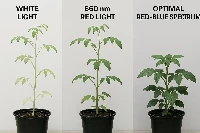
One important factor is light. Plants need more than visible brightness to grow well. They respond to the wavelengths of light they receive, the intensity at leaf level and the number of hours they are illuminated each day.
This is why red and blue LED grow lights are widely used in indoor gardening. Blue light is particularly important for normal leaf development and plant form, while red light plays a major role in photosynthesis and can influence flowering and other developmental processes.
For growers with limited space, a T5 LED grow light tube can provide a practical way to illuminate seedlings, herbs, vegetables and ornamental plants on shelves, windowsills or inside grow tents.
But is red light better than blue light? Does a red-blue grow light count as full spectrum? And how should you choose the right lighting arrangement for your plants?
Let's explore the science and practical considerations behind red-blue LED grow lighting.
1. What Is the Difference Between Red Light and Blue Light for Plants?
Light is electromagnetic radiation, and different wavelengths can affect plants in different ways. In horticultural lighting, wavelength is commonly measured in nanometers (nm).
Red and blue light are both relevant to photosynthesis, but they also influence plant development through different photoreceptors and biological responses.
| Light Type | Approximate Wavelength | Main Roles in Plant Lighting | Common Applications |
|---|---|---|---|
| Blue light | 400–500 nm | Supports photosynthesis, leaf development and regulation of plant form | Seedlings, leafy greens, herbs and vegetative growth |
| Red light | 600–700 nm | Supports photosynthesis and influences flowering and developmental responses | Leafy crops, flowering plants and fruiting crops |
| Green light | 500–600 nm | Contributes to photosynthesis and can penetrate deeper into plant canopies | Dense foliage and layered growing arrangements |
| Far-red light | Approximately 700–750 nm | Influences shade responses, flowering and plant architecture in some species | Specialized growth and flowering strategies |
These ranges are approximate and describe useful horticultural categories rather than strict biological boundaries.
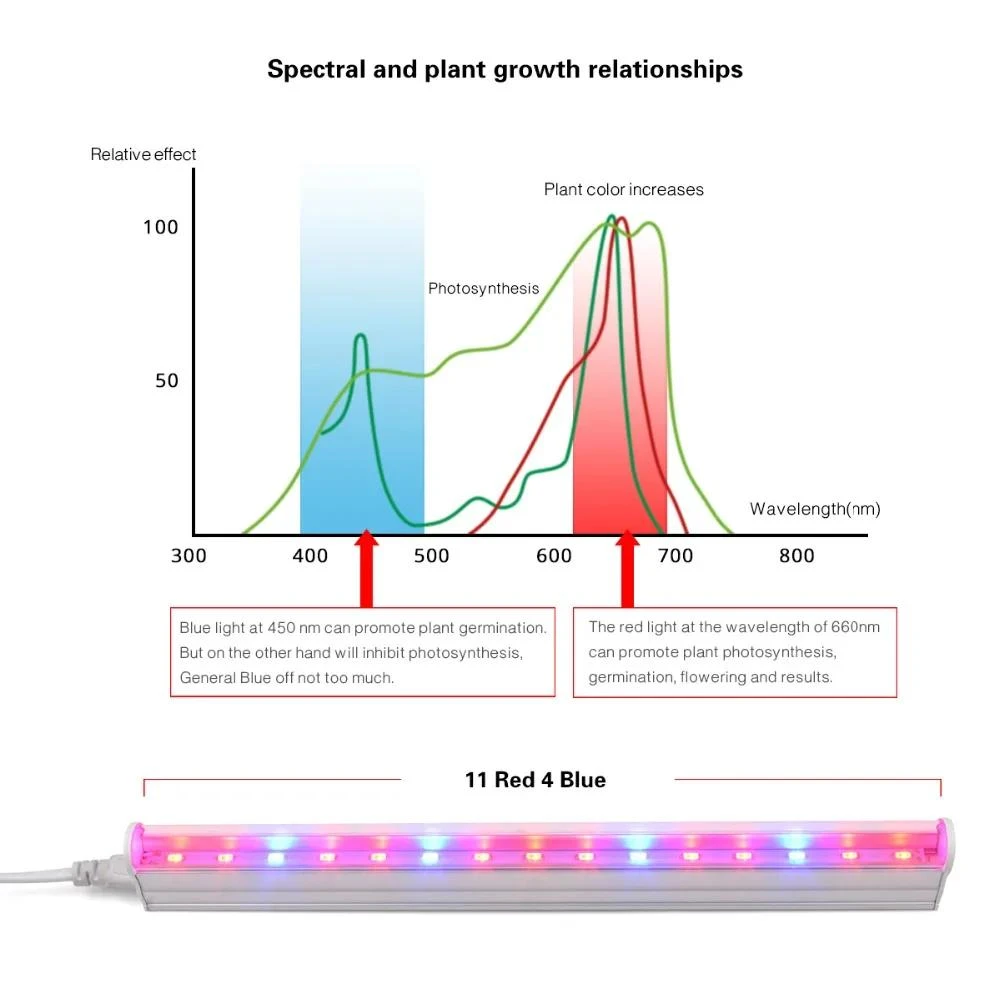
The Benwei T5 LED Grow Light Tube Full Spectrum Red Blue product page describes blue output in the 400–520 nm range and red output in the 610–720 nm range. These are the manufacturer's stated wavelength bands, not a guarantee that every wavelength within those bands is emitted equally.
Why is blue light important?
Blue light activates photoreceptors that help regulate plant development. Depending on the crop and growing conditions, it can influence leaf expansion, stomatal behavior, chlorophyll development and stem elongation.
For indoor growers, an appropriate blue-light contribution can help support compact growth and healthy foliage. However, too much blue light is not automatically better. The right balance depends on the species, light intensity and growth stage.
Why is red light important?
Red light is efficiently absorbed by photosynthetic pigments and contributes to the conversion of light energy into chemical energy.
Red light also interacts with the phytochrome system, which helps plants respond to their light environment. Its effects on flowering, stem growth and other developmental processes depend on the plant species, photoperiod and overall spectrum.
In practice, red and blue light are best understood as complementary components of a lighting strategy rather than competing choices.
2. Is a Red-Blue LED Grow Light Really Full Spectrum?
The term "full spectrum" is widely used in plant-lighting marketing, but it does not always mean the same thing across manufacturers.
A broad-spectrum grow light distributes its output across a relatively wide range of wavelengths. A red-blue grow light, by contrast, concentrates much of its output in selected red and blue bands.
A red-blue fixture can support plant growth, but its label alone does not establish that it reproduces the full visible spectrum or provides the optimal spectrum for every crop.
| Feature | Red-Blue LED Grow Light | Broad-Spectrum White LED Grow Light |
|---|---|---|
| Spectral distribution | Concentrated in selected red and blue bands | Spans a wider range of visible wavelengths |
| Appearance to human eyes | Often pink, purple or magenta | Usually white or daylight-like |
| Visual inspection of plants | Natural leaf and flower colors may be harder to judge | Often makes plant appearance easier to inspect |
| Growing applications | Specialized indoor growing and supplemental lighting | Home growing, propagation and many commercial applications |
| Important selection criteria | Spectral distribution, PPFD, crop response | Spectral distribution, PPFD, crop response and visual needs |
Neither type is universally superior. A red-blue fixture may be useful where targeted spectral output is desired, while a broad-spectrum white fixture can make it easier to inspect plants and work in the growing area.
Buyer tip: Ask for the actual spectral power distribution chart rather than relying only on the words "full spectrum." The chart reveals how the fixture distributes its light across wavelengths.
For background on plant-lighting terminology, see the U.S. Department of Energy's overview of LED lighting.

3. Which Plants Benefit From Red-Blue LED Grow Lighting?
The suitability of a grow light depends on the crop's light requirements, growing environment and production goals. Red-blue lighting can be useful for a range of indoor plants, but performance should be evaluated for the intended species and growth stage.
Seedlings and propagation
Young plants need sufficient light to develop healthy leaves and avoid excessive stem elongation. A suitable combination of blue and red light can contribute to photosynthesis and normal development.
However, seedlings can be sensitive to excessive light intensity. Start with the manufacturer's guidance, observe plant responses and adjust the fixture height or intensity where possible.
Herbs and leafy vegetables
Basil, lettuce and many other leafy crops are commonly grown indoors under LED lighting. Both red and blue wavelengths contribute to photosynthesis, while their proportions can influence plant form and leaf characteristics.
For these crops, the amount of light reaching the canopy is usually more important than choosing a lamp based solely on its color.
Flowering and fruiting plants
Red light is an important component of many flowering and fruiting crop-lighting strategies. Nevertheless, flowering is also affected by plant genetics, day length, temperature and other environmental conditions.
A red-blue lamp should not be assumed to trigger flowering in every species or to increase yield without suitable growing conditions.
Ornamental plants and succulents
Compact LED grow tubes can be useful for small indoor plant collections, propagation shelves and decorative growing setups. The correct lighting schedule and intensity vary considerably between species.
| Plant Group | What to Consider | Practical Starting Point |
|---|---|---|
| Seedlings | Avoid insufficient light and excessive intensity | Begin with a moderate intensity and monitor stem and leaf development |
| Leafy greens | Maintain suitable canopy-level light and consistent coverage | Prioritize uniformity across the growing tray |
| Herbs | Balance growth, flavor, leaf development and available space | Adjust lighting based on the species and observed response |
| Flowering plants | Consider photoperiod and species-specific flowering requirements | Confirm whether the plant is day-length sensitive |
| Succulents | Account for species-specific light tolerance and growth habits | Monitor for stretching, discoloration or signs of excessive light |
These are general recommendations, not guaranteed outcomes. Different cultivars can respond differently even under similar lighting conditions.

4. How Much Light Do Indoor Plants Need?
A grow light's wattage tells you how much electrical power it consumes. It does not directly tell you how much photosynthetically useful light reaches the plant canopy.
Two fixtures with the same wattage can deliver different amounts of useful light because of differences in LED efficiency, optics, spectral distribution and installation geometry.
Three measurements are especially useful:
PPF (Photosynthetic Photon Flux): The amount of photosynthetically active photons emitted by a fixture each second, measured in micromoles per second (µmol/s).
PPFD (Photosynthetic Photon Flux Density): The amount of photosynthetically active photons reaching a unit area each second, measured in µmol/m²/s.
DLI (Daily Light Integral): The total photosynthetically active light received per square meter over a day, measured in mol/m²/day.
The conventional PAR range is 400–700 nm. Some plant-lighting strategies also consider far-red wavelengths separately.
Example PPFD ranges for planning
The following are broad illustrative ranges for initial planning, not universal requirements or a substitute for crop-specific guidance.
| Growing Situation | Illustrative PPFD Range | Main Consideration |
|---|---|---|
| Low-light indoor foliage plants | 30–100 µmol/m²/s | Species tolerance and avoiding excessive light |
| Seedlings and propagation | 100–250 µmol/m²/s | Preventing stretching while avoiding light stress |
| Many leafy greens and herbs | 150–350 µmol/m²/s | Crop variety, growth stage and daily lighting duration |
| Higher-light crops | 300–600+ µmol/m²/s | Crop-specific requirements, temperature and CO₂ availability |
The appropriate value can fall outside these ranges depending on species, cultivar, growth stage and environmental conditions. For commercial production, use reliable crop-specific recommendations and measure PPFD at the canopy.
How does PPFD relate to daily light integral?
If PPFD remains constant during the lighting period, DLI can be estimated with this formula:
DLI = PPFD × lighting hours × 3,600 ÷ 1,000,000
For example, if the average PPFD at the canopy is 200 µmol/m²/s and the light runs for 14 hours:
DLI = 200 × 14 × 3,600 ÷ 1,000,000 = 10.08 mol/m²/day
This calculation helps growers compare different combinations of light intensity and duration. It assumes a constant PPFD throughout the lighting period and does not include sunlight or other light sources.
5. How Long Should You Run a T5 LED Grow Light Each Day?
There is no single lighting schedule suitable for every plant. Some plants respond strongly to day length, and many species need a consistent dark period for normal development.
A practical schedule should account for species, growth stage, light intensity, ambient daylight and the desired daily light integral.
| Plant Situation | Example Daily Lighting Window | Important Note |
|---|---|---|
| Seedlings | Often 12–16 hours | Adjust intensity and duration to prevent stretching or light stress |
| Leafy greens | Often 12–16 hours | Confirm the target DLI for the crop and production stage |
| Herbs | Often 12–16 hours | Species and cultivar requirements differ |
| Flowering plants | Crop-dependent | Some species require specific day-length conditions |
These windows are starting points for consideration, not universal prescriptions. More hours are not always better. Continuous illumination or an unsuitable photoperiod can disrupt plant development in some species.
A timer can make the schedule consistent and reduce the need for manual switching. For projects with multiple connected lamps, follow the manufacturer's electrical and connection instructions.
6. How Far Should You Install a T5 LED Grow Light From Plants?
Installation distance affects how much light reaches the canopy and how evenly that light is distributed.
Placing a lamp closer to the plants can increase PPFD at the center of the illuminated area, but it may also create hotspots and uneven coverage. Raising the lamp can improve uniformity while reducing the intensity reaching the leaves.
The Benwei product page suggests a distance of approximately 6–12 inches (15–30 cm) above the canopy as an initial reference. Actual placement should be adjusted according to the fixture's output, crop sensitivity and measured PPFD.
A practical installation process
Install the fixture securely using the supplied or approved mounting accessories.
Begin with the manufacturer's recommended distance.
Measure PPFD at several points across the growing area, if a suitable meter is available.
Compare the measurements with the target range for the crop.
Adjust mounting height or spacing to reduce unevenness.
Monitor the plants for stretching, leaf discoloration, bleaching or other signs of stress.
A single measurement directly beneath the center of a lamp is not enough to establish uniform coverage. For shelves or grow trays, check the corners and edges as well.
7. Why Does a Linkable T5 LED Grow Light Help With Indoor Growing?
Space is often limited in indoor growing environments. Plants may be arranged on multiple shelves, propagation benches or narrow racks, making compact lighting a useful option.
A linkable T5 grow light can help extend lighting coverage across a longer shelf or growing area without requiring a separate wall outlet for every fixture, provided the product is designed and rated for the intended connection arrangement.
The Benwei T5 LED Grow Light Tube Full Spectrum Red Blue is described as having a slim aluminum housing, mounting accessories, a power cord with an ON/OFF switch and a linkable design.
Potential advantages of a linkable lighting layout
Expandable coverage: Multiple compatible fixtures can illuminate a longer shelf or growing area.
Simplified installation: Mounting clips and brackets can make setup easier.
Compact form factor: Tube-style fixtures can fit beneath shelves or in grow tents.
Flexible placement: Fixtures can be arranged to suit different growing layouts.
The product page recommends linking no more than four to six units. Treat this as a manufacturer recommendation for the described product, not a universal limit for all T5 fixtures. Always verify the exact model's maximum connection count, electrical rating and installation instructions before expanding the system.

8. What Should You Check Before Buying a T5 LED Grow Light?
For home growers, distributors and commercial buyers, the right purchasing decision should combine product compatibility with plant-lighting performance.
| Selection Factor | What to Verify | Why It Matters |
|---|---|---|
| Spectrum | Spectral power distribution chart and wavelength information | Shows which wavelengths the fixture emits |
| PPF and efficacy | Measured PPF and photon efficacy, where available | Helps compare useful photon output and energy efficiency |
| PPFD coverage | PPFD map at the intended installation height | Helps evaluate canopy intensity and uniformity |
| Power consumption | Rated input wattage | Supports electricity-cost estimates |
| Connection limit | Maximum permitted linked fixtures | Helps prevent electrical overload |
| Installation | Mounting hardware, fixture dimensions and cable arrangement | Ensures the fixture fits the growing setup |
| Operating environment | Temperature, humidity and any relevant protection rating | Helps establish whether the fixture is suitable for the location |
| Warranty and documentation | Warranty terms, test reports and installation instructions | Supports procurement and maintenance planning |
For commercial or research-oriented growing, ask the supplier for the actual model's spectrum chart, PPF, efficacy, electrical specifications and photometric data. These details provide a stronger basis for comparison than marketing terminology alone.
Summary: Is a Red-Blue T5 LED Grow Light Right for Your Plants?
Red and blue wavelengths both play important roles in plant growth. Blue light helps regulate leaf development and plant form, while red light contributes to photosynthesis and influences several developmental processes.
A red-blue T5 LED grow light can be a practical option for indoor seedlings, herbs, leafy vegetables and ornamental plants, especially where a compact, linkable lighting arrangement is useful. However, successful growing depends on more than spectrum alone. Light intensity, daily light integral, photoperiod, installation distance and crop requirements all matter.
The best approach is to choose a fixture based on the needs of your plants and the size of your growing area, then verify that the installed system delivers suitable and reasonably uniform light at canopy level.
Planning an indoor gardening, propagation or horticultural lighting project? Contact Benwei with your plant type, growing area, installation requirements and preferred lighting schedule. Our team can help you evaluate suitable T5 LED grow light options and request a quotation for your project.