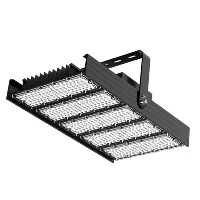
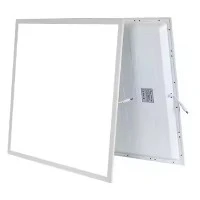
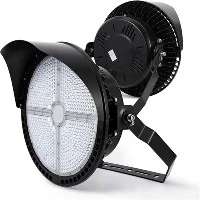
When working on sports lighting projects, the question clients ask most frequently is: "What is the actual difference between 500W, 1000W, and 1500W lights? Should I just go for the most powerful ones?"
To be honest, this is a common line of thinking, but it isn't necessarily correct. If the wattage is too low, the venue will be too dim, creating an uncomfortable experience for both athletes and spectators. If the wattage is too high, costs-including the price of the fixtures and poles, electricity consumption, and ongoing maintenance-will all increase; furthermore, excessive brightness can lead to glare. This article breaks down the differences between these three power levels from a practical selection perspective, helping you avoid common pitfalls.
Luminous Flux and Brightness: How Do They Differ?
Wattage simply indicates power consumption; what truly determines brightness is luminous flux (measured in lumens). Most mainstream LED sports lights offer an efficacy of approximately 130–170 lm/W. Based on this, we can estimate:
500W: Luminous flux of approximately 65,000–85,000 lm
1000W: Luminous flux of approximately 130,000–170,000 lm
1500W: Luminous flux of approximately 195,000–250,000 lm
It is worth noting that even among lights nominally rated at 1000W, the actual luminous flux can vary by more than 20% depending on the quality of the LED chips, the driver, and the thermal management (heat dissipation) design. Therefore, do not rely solely on wattage when making comparisons; ask your supplier to provide efficacy data backed by IES files or third-party test reports.
Mounting Height: Matching Wattage to Pole Height
The higher the light source is positioned, the greater the light loss before it reaches the ground. Consequently, higher-wattage fixtures are better suited for installation at greater heights. 500W: Suitable for 8–12 meter light poles; commonly used for smaller venues.
1000W: Suitable for 12–20 meter poles; the most common height range for medium-sized venues.
1500W: Suitable for poles over 20 meters; typically used for high-mast lighting and large-scale sports facilities.
These figures are merely general guidelines based on experience. If you were to install a 1500W light on an 8-meter pole, the ground-level illumination would be highly uneven-excessively bright nearby and too dim further away-while also creating significant glare. Conversely, installing a 500W light on a 25-meter pole would likely result in illumination levels that fail to meet even basic training standards.
Applicable Venues: Matching Power Ratings to Facilities
500W is suitable for:
Tennis courts, badminton courts, and outdoor basketball courts.
School playgrounds and community sports courts.
Small-sided soccer fields (5-a-side or 7-a-side).
1000W is suitable for:
Standard 11-a-side soccer fields (amateur and training levels).
Baseball and softball fields.
Track and field facilities, and rugby training grounds.
1500W is suitable for:
Professional or semi-professional soccer fields and stadiums.
Venues requiring lighting standards suitable for television broadcasting.
High-mast lighting for large, multi-functional sports centers.
The intended level of use for a venue is also a critical factor. For the same soccer field, the required illumination-and consequently the power and number of light fixtures needed-can vary several-fold depending on whether it is used for amateur training versus matches intended for television broadcast.
Coverage Area and Number of Fixtures: Calculate Carefully Before Ordering
This is the area where miscalculations occur most frequently. Higher-wattage lights do not necessarily translate to cost savings; the total number of fixtures required for the entire venue must be taken into account. Take a common example: to achieve an illuminance level of approximately 200 lux-standard for sports field training-you might need a dozen 1000W fixtures. If you switch to 1500W fixtures, you could use fewer units; however, this increases the load (weight) and wind resistance on each light pole, which in turn raises the cost of both the poles and their foundations.
Therefore, it is best to work backward from the total luminous flux required:
First, determine the area of the field and the target illuminance level.
Next, estimate the total required luminous flux based on the utilization factor.
Finally, compare the total costs of the two approaches: using a larger number of 500W fixtures versus a smaller number of 1500W fixtures.
Generally speaking, smaller fields benefit from a distributed layout using 500W fixtures, which provides better uniformity. For larger fields, 1000W or 1500W fixtures are often preferred to reduce the number of poles, simplifying both installation and maintenance.
Electrical and Structural Requirements: Often-Overlooked Details
Current and Cabling: At 230V, a 500W fixture draws approximately 2.2A, a 1000W fixture about 4.3A, and a 1500W fixture about 6.5A. Higher wattage necessitates larger-gauge wiring, more robust distribution boxes, and higher-rated circuit breakers. For long-distance cable runs, voltage drop must also be taken into account.
Weight and Wind Load: Higher-wattage fixtures require larger heat sinks, making them heavier and increasing their surface area exposed to the wind. Before installing 1500W fixtures, the structural integrity of the light poles must be verified-this is especially critical in coastal or high-wind regions.
Heat Dissipation and Lifespan: Designing effective heat dissipation for high-wattage fixtures is more challenging. When purchasing, inquire about the heat dissipation structure, whether the LED driver is external, and the controlled junction temperature; these factors directly determine the fixture's service life.
Control Systems: Large sports venues often require dimming capabilities or zoned lighting control. Opting for fixtures that support DALI or 0-10V dimming protocols will make it much easier to implement energy-saving measures or switch between different lighting modes for various events.
Conclusion
If you are planning a lighting project for a stadium or sports field and are unsure whether to use 500W, 1000W, or 1500W fixtures, please send us the following information:
Type and dimensions of the facility
Planned height and number of light poles
Target illuminance standards (for training, competition, or broadcast)
Our engineers will provide a complimentary lighting simulation and a tailored lighting layout, along with price quotes and test reports for the recommended models. Simply click the "Inquiry" button on the page or email us directly; we typically respond within 24 hours.