Introduction: The Financial Reality of Industrial Lighting
The Escalating Cost of Energy
Utility rates are climbing, and with them, the operational budget of every manufacturing plant and warehouse. In large-scale industrial facilities, lighting can account for 20% to 30% of total electricity consumption. Upgrading to LED technology is widely recognized as the most immediate and impactful method for reducing this expense. However, the market response to this demand has been a race to the bottom on initial purchase price, resulting in a proliferation of substandard products that fail to deliver the promised energy savings.
The Illusion of the "Cheap" LED Fixture
When a facility purchases a budget high bay fixture, they are often unaware of the hidden financial penalties. These fixtures frequently utilize cheap LED chips and low-grade drivers. To prevent these inferior components from failing catastrophically within months, manufacturers employ a practice known as power derating. A fixture labeled as "150W" might only output 100W of actual power to the LEDs.
This creates a false economy. The facility pays for 150 watts of electricity but receives the illumination of a 100-watt fixture. Because the room remains dim, the facility is forced to install more fixtures or run them longer, completely erasing the expected energy savings.
The Paradigm Shift: Full-Wattage Efficiency
To achieve genuine energy conservation, the luminaire must operate at True Full-Wattage Brightness. This means the fixture draws exactly the power it claims and drives the LED chips at their optimal, designed current. This requires a holistic engineering approach-a robust driver to manage the electrical load, an advanced optical design to distribute the light, and a superior thermal architecture to dissipate the resulting heat. This UFO High Bay Light is engineered precisely to this standard, ensuring that every kilowatt-hour consumed is converted into maximum lumens.
The Anatomy of Energy Waste in Legacy and Budget Fixtures
The Inefficiency of Legacy Metal Halide and Fluorescent Systems
Legacy systems are inherently inefficient. A standard 400W metal halide fixture includes a magnetic ballast that draws an additional 10% to 15% of power while generating immense heat. Furthermore, metal halide lamps suffer from severe lumen depreciation, losing up to 40% of their light output halfway through their rated life. This means the facility is paying full price for electricity while receiving a rapidly diminishing return in illumination.
The Deception of Power Derating in Cheap LEDs
The modern equivalent of this waste is power derating. When a manufacturer under-drives a cheap LED array to keep it from overheating, the luminous efficacy (lumens per watt, or lm/W) plummets. A well-engineered LED fixture should achieve an efficacy of 130-150 lm/W. A derated budget fixture often struggles to reach 80-100 lm/W.
In practical terms, if a facility needs 30,000 lumens to properly light a specific aisle, they might need to buy two or three derated fixtures, consuming far more total kilowatt-hours than a single, properly driven, high-efficiency unit.
Power Factor and Total Harmonic Distortion: The Hidden Grid Penalties
Energy efficiency is not just about the watts consumed by the fixture; it is about the quality of the power drawn from the facility's grid. Cheap drivers often have a low Power Factor (PF) and high Total Harmonic Distortion (THD).
Low PF: Indicates that the fixture is drawing "reactive power," which does no useful work but overloads the facility's transformers and wiring. Utilities frequently impose financial penalties on facilities with low PF.
High THD: Harmonic distortion pollutes the electrical network, causing transformers to run hotter and reducing the lifespan of other sensitive equipment.
The Full-Wattage Advantage: True Lumens = True Savings
Defining Full-Wattage Operation
This UFO High Bay Light is built to deliver True Full-Wattage Brightness. If the fixture is specified at 150W, it draws 150W and drives the high-efficiency LED chips at their maximum rated capacity. This guarantees that the luminous flux (lumens) delivered to the factory floor strictly matches the advertised specifications. There is no hidden derating, no under-driving, and no compromise on safety or productivity.
The Circular LED Array: Maximizing Optical Efficiency
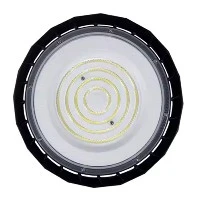
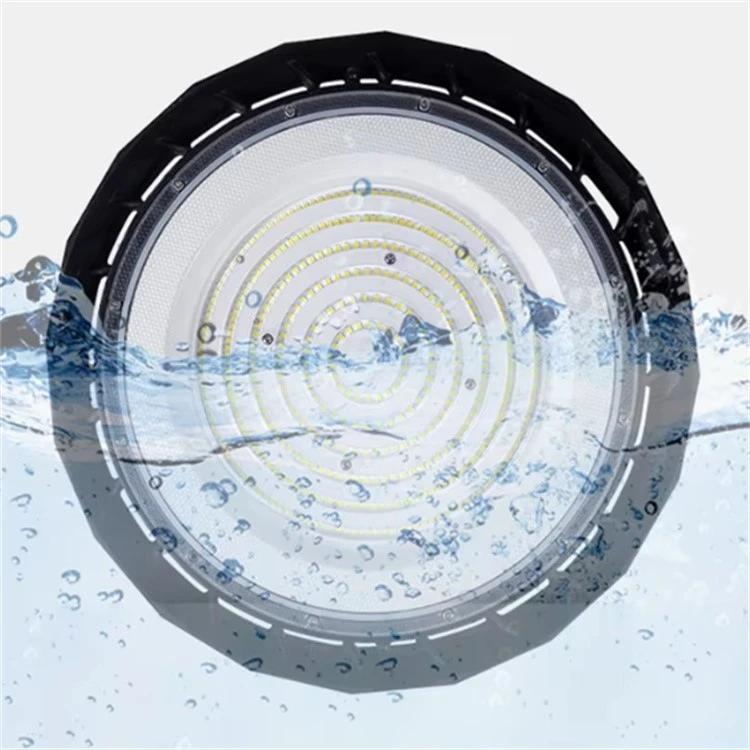
To manage the intense heat and optical demands of full-wattage operation, this fixture utilizes a Circular LED Chip Array. The chips are arranged in multiple concentric rings, spreading the light output over a massive surface area.
This optical geometry transforms the fixture from a harsh "point source" into a uniform "surface emitter." The light is distributed evenly, eliminating the dark spots and harsh glare common in clustered LED designs. Because the light is distributed more efficiently, fewer fixtures are required to achieve the target illuminance (lux) levels, directly reducing the total connected load (total wattage) of the facility. This is the ultimate energy-saving multiplier: fewer fixtures, lower wattage, superior lighting.
The Physics of Luminous Efficacy (lm/W)
Luminous efficacy is the ultimate metric of energy conservation. It is the ratio of luminous flux (lumens) to power (watts). By utilizing premium LED chips driven at full wattage, coupled with a high-transmittance PC Lens, this fixture achieves an efficacy of 130-140 lm/W.
When compared to a legacy 400W metal halide system (which delivers roughly 60-90 lm/W) or a derated budget LED (80-100 lm/W), the difference is staggering. Upgrading to this full-wattage UFO High Bay reduces the wattage required per square meter by more than half, delivering an immediate 50% to 70% reduction in lighting-related energy costs.
The Philips Driver: The Engine of Energy Conservation
High Power Factor (PF) and Low THD
At the heart of this luminaire is a Genuine Philips Drive Power Supply. Philips drivers are engineered for maximum electrical efficiency, featuring a Power Factor (PF) of ≥ 0.95 and a Total Harmonic Distortion (THD) of < 20%.
This means that 95% or more of the AC power supplied to the fixture is converted into usable work, with minimal reactive power wasted. By maintaining a high PF, the facility avoids utility penalties and reduces the strain on its electrical infrastructure.
Surge Protection and Electrical Longevity
Industrial electrical grids are volatile. Voltage spikes caused by heavy machinery switching on or off can destroy cheap drivers, leading to unexpected downtime and costly replacements. The Philips driver features built-in surge protection rated at 4 kV to 6 kV. It absorbs these transients, protecting the fixture and ensuring uninterrupted operation.
Programmable Thermal Derating
A key feature of the Philips driver is its intelligent thermal management. If the ambient temperature inside the fixture reaches a critical threshold, the driver does not simply burn out. Instead, it activates programmable thermal derating (DTL), gently reducing the output current to protect the system. This ensures the light stays on-maintaining safety and operational continuity-while preventing catastrophic failure.
Thermal Engineering: Protecting the Investment
Integrated Die-Cast Aluminum: The Thermal Backbone
Full-wattage operation generates immense heat. If this heat is not dissipated, the LEDs will rapidly degrade (lumen depreciation), and the driver will fail. To prevent this, the fixture utilizes an Integrated Die-Cast Aluminum Shell.
With a thermal conductivity of approximately 96-120 W/m·K, aluminum is an exceptional heat conductor. Crucially, the "integrated" design means the LED board, the housing, and the exterior fins are molded as a single continuous piece. This eliminates the interfacial thermal resistance (air gaps) found in bolted-together fixtures, ensuring heat flows seamlessly from the LED junction to the exterior environment.
The Chimney Effect: Passive Air Convection Cooling
To dissipate the heat without relying on dust-clogging fans, the fixture employs a Hollow Radial Fin architecture that leverages Air Convection Cooling. As the fixture operates, the air inside the hollow central cavity heats up and rises rapidly, escaping through the top (the Chimney Effect). This creates a negative pressure zone that forcefully draws cool ambient air inward across the deep radial fins.
This passive, self-sustaining thermal loop ensures the LED junction temperatures remain exceptionally low. This is critical: every 10°C reduction in operating temperature can double the lifespan of the electronic components. By keeping the system cool, the fixture maintains its full-wattage brightness and efficiency for over 50,000 hours (L70/L80 rating).
Calculating the ROI: The Financial Impact of Full-Wattage LEDs
Direct Energy Savings (kWh)
The most immediate financial benefit is the reduction in kilowatt-hour (kWh) consumption. Consider a facility replacing 100 legacy 400W metal halide fixtures with 150W full-wattage UFO High Bays:
Legacy System: 100 fixtures × 440W (including ballast) = 44,000W (44 kW).
Premium LED System: 100 fixtures × 150W = 15,000W (15 kW).
Energy Reduction: 29 kW per hour.
If the facility operates for 12 hours a day, 300 days a year, the annual energy savings are 104,400 kWh. At an average industrial rate of $0.12 per kWh, this translates to **$12,528 in annual savings**-simply from the reduced wattage.
Maintenance and Replacement Cost Avoidance
The savings from energy efficiency are only part of the equation. The second major financial benefit is the elimination of maintenance costs. High-bay fixtures are mounted at heights of 12 to 15 meters. Replacing a failed unit requires a scissor lift, certified electricians, and the disruption of adjacent production lines. The cost of a single replacement event often exceeds $300 to $500.
Cheap, derated fixtures fail every 2 to 3 years. This full-wattage UFO High Bay, with its >100,000-hour MTBF Philips driver and robust die-cast aluminum housing, is designed to operate maintenance-free for a decade or more. Over a 10-year period, avoiding just one replacement event per fixture saves the facility tens of thousands of dollars in labor, equipment, and downtime.
The Total Cost of Ownership (TCO) Model
When evaluating the investment, buyers must look beyond the initial invoice price and calculate the 10-year TCO:
Purchase Price: The initial capital outlay.
Energy Costs: The total kWh consumed over 10 years.
Maintenance Costs: Lift rentals, labor, and replacement parts.
A premium full-wattage fixture will cost more upfront, but it will deliver a payback period of 1.5 to 2.5 years. After that, it generates pure profit for the business. A cheap, derated fixture will have a lower purchase price but a significantly higher TCO due to high energy consumption and frequent replacement costs.
Conclusion: Every Kilowatt-Hour is a Dollar Saved
In the modern industrial economy, energy efficiency is no longer just a sustainability initiative; it is a financial imperative. The decision to upgrade to LED lighting should not be driven by the lowest initial bid, but by the promise of maximum luminous efficacy and long-term reliability.
This Full-Wattage UFO High Bay Light represents the pinnacle of energy-efficient industrial lighting. By rejecting the deceptive practice of power derating, and instead integrating a Genuine Philips Driver, a Circular LED Array, and an Integrated Die-Cast Aluminum Housing, it delivers uncompromised brightness, exceptional thermal resilience, and unparalleled electrical stability.
Every kilowatt-hour saved by this fixture is money that stays in your business. By investing in this technology, you are securing a decade of brilliant, uniform illumination while significantly reducing your operational overhead. Saving power is saving money-and this UFO High Bay is engineered to save you the maximum amount possible.
How To Cooperate With Us?
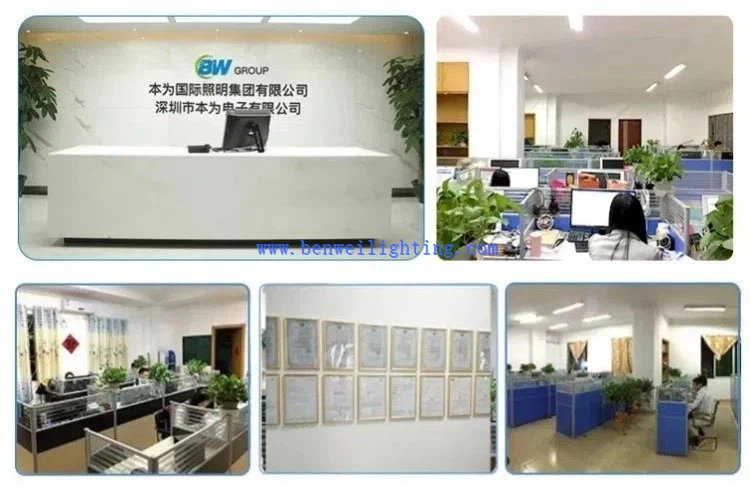
We are happy to have total control over the manufacturing process and the calibre of our products since we have our own facilities. Since we are producers rather than just brokers, we are dedicated to providing our customers with the best pricing. Since we are certain that the price and quality of our products are clear, we invite customers to see our samples first. Our commitment to quality and customer satisfaction drives us to continuously provide top-notch goods.
Our address
3rd Floor, 5th Building, Hebei Industrial Park, Hualian Community, Longhua District, Shenzhen, China