Smart switches or smart bulbs? How to choose the right smart lighting for your home
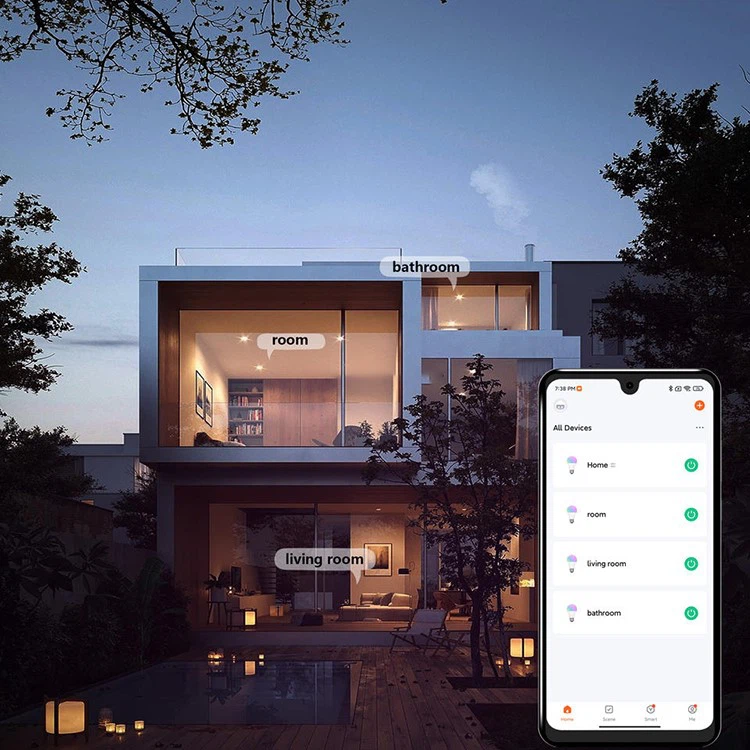
Smart lighting can be complex with its variety of switches, bulbs, plugs, remote controls, bridges, and hubs. We'll aid in your resolution.
Since the development of the lightbulb, smart lighting has been the most significant advancement in illumination. It elevates the idea of lighting our houses beyond just the utilitarian, adding a great deal of functionality to such a significant aspect of our lives.
You must, however, use smart illumination to fully appreciate its advantages. Many people find it to be far too difficult to install compared to simply screwing in a "dumb" lightbulb because it is difficult, costly, and fiddly. Here, I'll discuss the benefits of smart lighting, how to get started, when to choose between smart switches and smart bulbs, and some excellent choices for each.
advantages of intelligent illumination
Smart lighting is when your lights can be controlled wirelessly and through a smartphone program from a distance. Your lights can be put on timers, and you can set up schedules or routines to turn them on and off at particular times or in response to certain events. You have the option to manage groups of lights on multiple circuits at once, dim or change the color of your lights, and have lights switch on and off automatically in response to motion and/or occupancy. You can also sync your lights with sunrise and sunset. The lights can also be controlled by vocal commands, programmable wireless buttons, and remote controls.
Feeling more energised can be achieved by synchronizing your lights to the hue of the sun.
Here are just a few of the fantastic applications for smart lighting:
Security and safety — Turn lights on at random while you're gone to fend off burglars, and never again return home to a dark house. Without any wiring, use motion sensors to turn on exterior lighting at night.
Convenience — The bedside lamp may turn off on its own if you frequently fall asleep with it on. Everything can be turned off at night by a simple command or schedule and turned back on in the morning. When you enter a room, motion sensors instantly turn on the lights. When you leave, they turn the lights off.
Getting up to a gradually brightening light rather than an alert is healthier and more effective. It has been demonstrated that matching the hue of your lights to the sun's rays throughout the day will help you feel more energised when you need to and begin to wind down when it's time. Color-changing lights are entertaining for celebrations and events, but they can also serve as a warning.
The difference between smart switches and smart lights
Smart switches and smart bulbs are the two types of smart illumination. It's not necessary to choose one over the other. Although it's not a good idea to use smart bulbs on a smart switch (more on that below), the most efficient smart lighting setup in a house will probably be a combination of smart switches and bulbs. The problem in this situation is that not many businesses provide both. Therefore, you should use a smart home platform such as Google Home, Apple HomeKit, Samsung SmartThings, or Amazon Alexa to control all of your lighting rather than opening three separate apps to do so.
A smart house platform and a protocol must be chosen.
The good news is that you won't have to worry about which smart home platform a light is compatible with or which technology it uses to communicate due to a new smart home standard called Matter that promises cross-platform compatibility. (Wi-Fi, Zigbee, Bluetooth, or other). If a lightbulb or switch is Matter-certified, it will function on any network that supports Matter and with every other Matter device.
The bad news is that Matter won't be available until later this year, so before you begin your path toward smart lighting, you will need to choose a platform and a protocol. For more information on this, see "How to choose a protocol" below. If all of that seems overwhelming, don't worry. You can start with just one brand, get familiar with its app for control, and expand into a larger smart lighting system as you become more at ease with the technology and how it meets your requirements.
When to choose smart lights and why
Smart LED bulbs are the most widely used kind of smart lighting, largely due to how simple they are to put and configure. A connected, smart LED bulb can now be purchased for as little as $5, whereas they were previously very costly. Although that costs twice as much as an equivalent adjustable LED, prices today are much lower than they were a few years ago.
White, full-color spectrum, and tunable white lighting are the three kinds of smart bulbs that can be dimmed, though not all of them. (where you can adjust the color temperature from cool to warm, which is how circadian rhythm lighting works).
Standard white smart bulbs are primarily helpful if you want to give each bulb in a multi-bulb fixture or on a single electrical circuit its own unique control. As an illustration, my chamber has eight ceiling-mounted can lights. I can only turn on two smart lights at a time now. With a smart switch, that is not feasible.
If you want the option to use tunable white lighting and/or alter colors, that is another reason to choose smart bulbs. Although these are more expensive, smart switches also lack this feature. Lamps, small fixtures, and other decorative illumination such as wall sconces can all benefit from smart bulbs.
Feature
● Cap type: BC-B22d
● Power Consumption: 8.5W
● Equivalent: 60W Traditional GLS
● Colour Output: Warm White + RGB
● Dimensions: Diameter=60mm Height=107mm
Specification
| Equivalent | 60W |
| Technology | LED |
| Colour | Warm White + RGB |
| Voltage | 240V |
| Power Consumption | 8.5W |
| Color Temperature | 3000K |