When selecting outdoor LED lighting, most buyers confuse two critical terms: waterproof and weatherproof. Many mistakenly treat weatherproof LED lights as fully waterproof fixtures, leading to lamp short circuits, water ingress and premature failure after heavy rain, flooding or long-term outdoor exposure. In fact, weatherproof and waterproof serve completely different outdoor environments, and their performance gaps are clearly defined by official IP ingress protection ratings. Weatherproof LED lights are designed to resist general outdoor weather including rain splash, dust, UV rays and temperature changes, while true waterproof LED lights support complete water submersion. This article clarifies the core differences between waterproof and weatherproof LED fixtures, decodes practical IP rating meanings for outdoor lighting, and comes with an environment adaptation diagram and detailed IP comparison table to help specifiers pick correct outdoor lights for all scenarios.
Core Definition: Weatherproof vs Waterproof LED Lights
Weatherproof LED lights are built for outdoor atmospheric exposure. They can withstand splashing rain, wind, dust, sunlight UV radiation and extreme temperature fluctuation, but cannot resist continuous water pressure or full water immersion. These fixtures focus on anti-aging, dustproof and splashproof performance to adapt daily outdoor weather changes.
Waterproof LED lights are designed for direct water contact and submersion. Apart from basic weather resistance, they adopt fully sealed seamless structures with no breathable holes, enabling them to withstand continuous water pressure, heavy rainstorm impact and even long-term underwater working conditions. Simply put: all waterproof LED lights are weatherproof, but weatherproof lights are never fully waterproof.
Visual Diagram: Environment Adaptation for Weatherproof & Waterproof LEDs
This intuitive flowchart shows applicable environments and forbidden usage scenarios for the two types of outdoor LED lights:
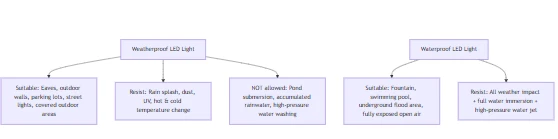
The diagram clearly illustrates the usage boundary. Weatherproof LEDs handle routine outdoor weather perfectly, but fail once facing accumulated water or full submersion. Only genuine waterproof LEDs work safely in harsh water-rich environments.
IP Rating Full Comparison Table for Outdoor LED Lights
All outdoor LED performance differences are reflected in standard IP ratings. The table below matches each common IP code with weatherproof/waterproof classification, protection capability and accurate installation scenarios, eliminating all selection confusion:
|
IP Rating |
Category |
Dust Protection |
Water Protection Capability |
Typical Application Scenarios |
|---|---|---|---|---|
|
IP54 |
Basic Weatherproof |
Limited dust protection |
Resist splashing water from all directions |
Courtyard lights, balcony lighting, covered outdoor lamps |
|
IP65 |
Standard Weatherproof |
100% dust-tight |
Resist low-pressure water jet and heavy rain splash |
Street lights, outdoor floodlights, parking lot lighting |
|
IP66 |
Enhanced Weatherproof |
100% dust-tight |
Resist powerful high-pressure water jet and storm |
Open-air factory lights, seaside outdoor lighting |
|
IP67 |
Short-term Waterproof |
100% dust-tight |
Temporary submersion in 1m water for 30 minutes |
Low-lying flood-prone areas, buried ground lights |
|
IP68 |
Permanent Waterproof |
100% dust-tight |
Long-term deep water submersion under rated depth |
Pool lights, fountain underwater lights, seabed landscape lights |
Why Weatherproof LEDs Cannot Work Underwater
Most standard weatherproof LED lights (IP65/IP66) reserve tiny breathable holes for thermal balance. LED fixtures generate heat during long-hour operation; breathable holes balance internal and external air pressure to avoid lens fogging and internal heat accumulation. However, these necessary vents become fatal weaknesses underwater. Once submerged, continuous water pressure will push water into the lamp interior through breathing holes, burning out drivers and circuit boards quickly.
In contrast, true waterproof LED lights (IP67/IP68) cancel all breathable holes and adopt fully vacuum-sealed housing. They sacrifice partial heat dissipation efficiency in exchange for complete pressure resistance, adapting to long-term underwater environments without water ingress.
Common Project Mistakes Caused by Mixing Up Two Terms
The most frequent engineering error is installing IP65 weatherproof lights for fountain or pool lighting. Contractors choose lower-cost weatherproof LEDs to cut budgets, leading to mass lamp failure within one rainy season. Another common mistake is using IP65 lights in low-lying outdoor zones prone to rainwater accumulation; static accumulated water will penetrate the lamps and cause short circuits gradually.
Besides water resistance, weatherproof LEDs also focus on anti-UV shell material to prevent shell yellowing and aging under long-term sunlight exposure, which is also a key feature different from ordinary indoor waterproof lights.
Quick Selection Guide for Outdoor LED Projects
For general outdoor lighting with no accumulated water and no submersion risk, IP65 weatherproof LEDs are the most cost-effective choice, balancing heat dissipation performance and weather resistance. For open-air seaside sites with strong wind and heavy rain, upgrade to IP66 enhanced weatherproof models. For areas with occasional water flooding, select IP67 short-term waterproof lights. For all underwater landscape lighting, only IP68 full waterproof LEDs are qualified and safe.
Conclusion
Weatherproof and waterproof are not interchangeable terms for outdoor LED lights. Weatherproof LEDs resist wind, rain splash, dust and sunlight, suitable for most conventional outdoor scenarios, but cannot withstand water submersion. Waterproof LEDs feature full sealing structure for direct underwater use. IP ratings clearly mark the actual protection capability, rather than vague marketing words like outdoor-proof or rainproof. Understanding this difference helps buyers avoid costly installation errors, match suitable LED lights according to actual site conditions, and guarantee long-term stable operation of outdoor lighting systems.
Shenzhen Benwei Lighting Technology Co., Ltd.
Tel/WhatsApp: +86 18681294064
Website: www.benweilight.com
Address: 3rd Floor, 5th Building, Hebei Industrial Park, Hualian Community, Longhua District, Shenzhen, China