Note that in the above figure, the maximum sensitivity of the cone cell is in the yellow region of the visible light spectrum, while the punctuated cell represented by the dotted line is more sensitive and the peak is in the blue-green region. In contrast, cone cells are highly efficient for green, while rod cells are more efficient for blue light.
What is their efficiency in the middle vision?
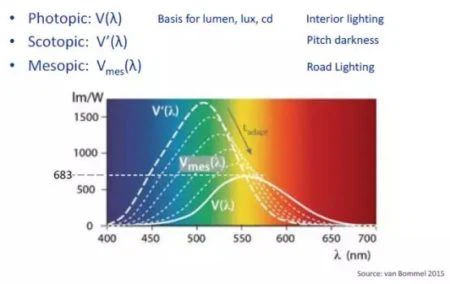
The dotted line in the figure represents the change in the efficiency of the intermediate vision. It can be seen that the more neutral the light is, the higher the intermediate visual efficiency is. It was then suggested that the use of blue-rich light is more efficient and energy-efficient than warm white light!
From a theoretical point of view, this point of view is indeed feasible. The 2017CIE report also made this clear. Using blue and white light can save about 2%-8% of light. But in reality, this practice is not necessary and may even cause new problems.
First, for example, a brightness of 0.3 cd/m 2 , if blue-white lighting is used, the lighting level can be reduced by 8%, 0.3 cd/m 2 by 8%, and the brightness can be reduced to 0.28 cd/m 2 . If you use blue light for indoor lighting, you can save 2%. In a few cases where the lighting level is already low, you can save about 8%. However, whether it is road lighting or indoor lighting, this light is simply not worth mentioning. You can even ignore this point of view.
In addition, if blue-white light is used, it will cause more scattering in the eyeball and the atmosphere, resulting in more light pollution. (As we mentioned earlier, Blu-ray will make the glare more serious.)
And, in order to save the brightness that is not worth mentioning at all, there will be a very bad visual experience for the elderly. Here we will talk about the lighting needs of the elderly.
What kind of lighting is more friendly to older people?
As you age, the lens of your eyes turns yellow. The yellow light can easily pass through the yellow lens, and the yellowish green can also penetrate. Even the orange and reddish can easily penetrate the yellowed lens. However, in the spectrum, blue is far from yellow and blue cannot easily pass through the lens of the elderly. Therefore, if the use of blue and white light is only to save 2% of light, or 8% of light, it may not matter to young people, but it is for the elderly to suffer!
In addition, if you want to design excellent lighting for the elderly, you can’t simply increase the light, because it may produce more glare. Therefore, to be very careful design, you must understand a lot of knowledge in this area. For example, blue light is bad for the elderly, while yellow light and warm white light are more friendly.