One interesting point is that blue light-sensitive cone cells only exist in the peripheral area of the fovea, so it takes more attention to see the blue, which is why blue can attract more attention. . So the trademark with blue is a good choice.
But it also means a bad fact: Blu-ray produces more glare.
While driving, we usually look at the road ahead. The road lighting fixtures image the surrounding area of the eyeball. In the peripheral area of the eyeball, there are more blue-sensitive cells.
In the past, road lighting fixtures had only one large light source, a large light source with uniform brightness and glare, and the visual cells only needed to transmit an edge message to the brain. Now using LED light sources, assuming that the road lighting conditions remain the same, but there are many small light spots on the luminaires, with a lot of edge information, which may be the reason why LEDs produce more glare than traditional light sources.
Road lighting
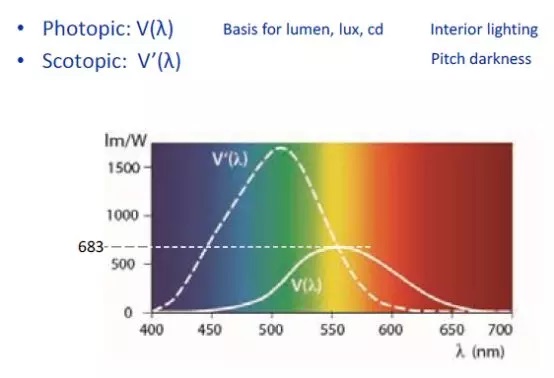
In general, the typical brightness range of road lighting is between 0.3-3 cd/m2. The brightness greater than 3 cd/m2 is the brightness category of indoor lighting or natural light lighting.
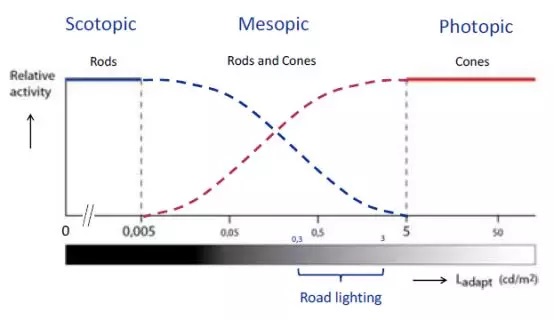
From the figure we can see that cone cells are active under high brightness conditions, while the rod cells are basically inactive. Until the brightness dropped to about 5 cd/m2, as the brightness became darker, the activity of the cone cells gradually decreased, and the activity of the rod cells gradually increased.
In the middle area where both types of cells are active, we call it intermediate vision. The road lighting is in this visual range, when the cone cells are more active than rod cells, but both are working.