The Spectral Code of Cleanroom Lighting: Safeguarding Photochemical Processes with Amber LEDs
In the micron and nano-scale realms of semiconductor manufacturing, biopharmaceuticals, and precision chemical engineering, the stringency of environmental control is a given. However, a frequently overlooked yet critical environmental variable is light. The ultraviolet and short-wavelength blue light inherent in traditional white lighting acts as an invisible "contaminant" and process killer for photochemically sensitive materials such as photoresists, certain biological reagents, and photosensitive compounds. To counter this, modern high-grade cleanrooms have adopted a key optical strategy: amber LED lighting. This is not for ambiance but an engineered protection scheme based on precise wavelength management.
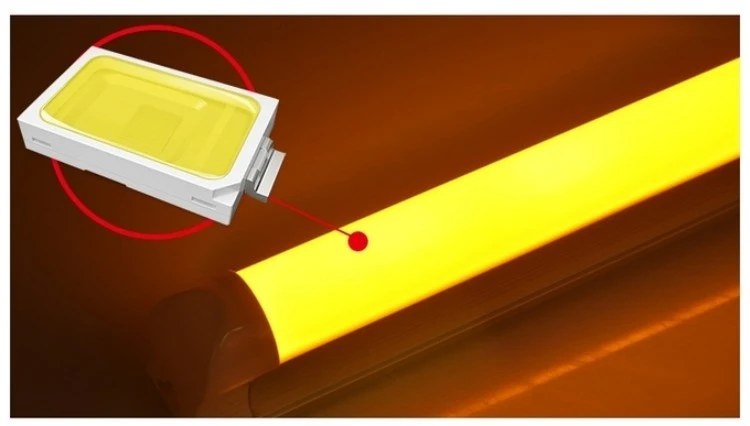
Comparative Analysis: Cleanroom Lighting Spectrum Strategies
To clearly understand the necessity of amber LED lighting, the table below compares the performance of different lighting solutions in cleanroom environments involving light-sensitive materials.
| Lighting Type | Typical Spectral Profile | Primary Risk to Photochemically Sensitive Materials (e.g., Photoresist) | Impact on Personnel | Overall Assessment & Suitable Applications |
|---|---|---|---|---|
| Traditional Fluorescent/Metal Halide | Broad, continuous spectrum rich in ultraviolet (UV) and blue-violet light. | Very High Risk. UV (<400nm) carries high energy, capable of directly triggering unintended polymerization or decomposition of photoresist. Blue light (400-500nm) may also activate certain photo-initiators, causing material performance drift or failure. | Perceptible flicker and glare, contributing to visual fatigue over long shifts. | Not suitable for photolithography areas. UV leakage and broad spectrum pose definitive process risks. |
| Standard White LED | Spectrum features a sharp peak in the blue region (~450nm), converted to white via phosphors; minimal UV emission. | Medium to High Risk. While virtually UV-free, the high-energy blue peak may still affect photoresists sensitive to specific wavelengths, presenting an uncertain risk. | Light is concentrated; glare control depends on fixture design. Low-quality products may raise blue light hazard concerns. | Suitable for light-insensitive areas: assembly, inspection, packaging. Requires rigorous spectral compatibility validation before use in lithography bays. |
| Amber LED (e.g., 590nm) | Narrow spectrum, peak centered in 580-600nm yellow-amber region, virtually filtering all light below 500nm (blue, violet, UV). | Very Low Risk. Its lower photon energy is insufficient to trigger photochemical reactions in most photoresists and sensitive materials, providing a safe "optical window." | Soft light, significantly reduces glare and retinal blue light exposure, lowering visual load during extended tasks. | Core Application: Photolithography bays, photoresist coating/storage areas, biological photosensitive labs, precision chemical synthesis zones. The standard solution for protecting photochemically sensitive materials. |
| Tunable Spectrum LED System | Programmable switching between white and amber light, or across a wider gamut. | Controlled Risk. Allows dynamic adjustment per process needs: high-CRI white for visual tasks in non-sensitive phases; instant switch to safe amber mode for sensitive operations. | Maximum flexibility, optimizes human factors for diverse tasks. | Forward-looking solution. Ideal for R&D centers or flexible manufacturing lines with multiple process flows, balancing safety and efficiency. |
*Note: Photoresists have varying spectral sensitivity curves (e.g., g-line, i-line, KrF, ArF corresponding to different UV bands) but are universally sensitive to short-wavelength light. The ~590nm peak of amber LEDs is an engineered compromise to maximally avoid common activation bands while providing adequate visual illumination.*
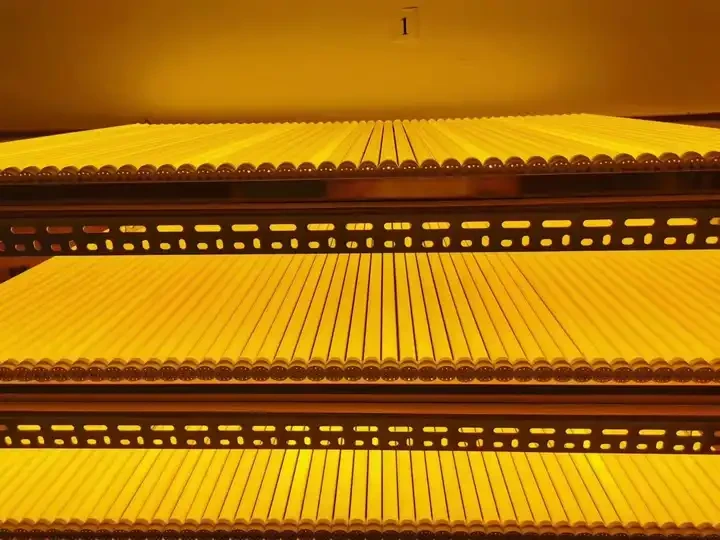
Technical Analysis: How Amber LEDs Create an "Optical Barrier"
The Physics of Wavelength Filtering
Photochemical reactions are initiated by photon energy (E=hc/λ). UV and blue light have short wavelengths and high energy, sufficient to break or form chemical bonds in photosensitive materials (e.g., photo-acid generators in photoresist). Photons emitted by amber LEDs at around 590nm have energy of about 2.1eV, far below the threshold (typically >3.0eV) required to activate most photoresists, physically preventing accidental exposure. This essentially creates a wavelength-specific safety barrier for photochemically sensitive materials within the cleanroom.
The Inherent Advantages of LED Technology
As a cleanroom lighting source, LEDs offer innate benefits:
Pure, Controllable Spectrum: Precise semiconductor materials and phosphor technology yield a narrow amber spectrum with no UV or IR radiation.
Low Thermal Radiation: High photoelectric conversion efficiency means far less radiant heat than metal halide lamps, reducing the risk of workpiece temperature fluctuation or material thermal degradation.
Long Life & Stability: Lifespan exceeding 50,000 hours minimizes contamination risks from frequent fixture replacement that could breach cleanroom integrity.
Cleanroom-Adaptive Design
Dedicated cleanroom LED fixtures (e.g., recessed troffers, sealed downlights) are not just light sources but part of contamination control:
Sealed Construction: Rated IP65 or higher, preventing particle release from internal components and allowing for rigorous cleaning.
Smooth, Cleanable Surfaces: Surfaces are seamless and resistant to chemical disinfectants.
Flush Mounting: Installed level with T-bar grid ceilings to prevent dust accumulation and air turbulence.

Implementation Considerations & Best Practices
When planning an amber LED cleanroom lighting system, a holistic approach is required:
Illuminance & Uniformity: Must comply with standards (e.g., cleanroom design codes), ensuring sufficient and even illuminance (typically 300-500 lux) on work planes for precision tasks.
Emergency Lighting Integration: Safety-mandated emergency lighting must be independently designed, also using non-interfering wavelengths.
Dimming & Scene Control: In tunable spectrum cleanroom lighting systems, access controls should prevent unauthorized switching to unsafe spectral modes in sensitive areas.

FAQ
Q1: Are all photoresists only sensitive to UV light? Is 590nm amber light absolutely safe?
A1: No. Most photoresists are designed for specific UV bands (e.g., 365nm i-line, 248nm KrF). However, some advanced materials or specialty chemicals may have sensitivity extending into the visible blue-green range. Therefore, 590nm LED is a universal strategy for significantly mitigating risk. For specific processes, consult the material supplier and conduct spectral compatibility testing.
Q2: Does working long-term under amber light affect an operator's color judgment?
A2: Yes. Accurate color discrimination is impossible under monochromatic amber light. Solutions typically involve:
Zoning: Restrict pure amber light to critical material-handling areas only.
Localized White Light: Use tunable spectrum LED fixtures or dedicated high-CRI white task lighting at inspection stations, ensuring sensitive materials are shielded during use.
Tunable Systems: Employ a primary amber ambient system with activatable high-CRI white LED task lights.
Q3: What's the difference between amber LED lighting and "yellow lamps"?
A3: Traditional "yellow lamps" (e.g., sodium vapor or lamps with yellow filters) may have impure spectra with residual harmful short-wavelength emission, lower efficiency, and poor color rendering. Modern amber LEDs are solid-state with precisely engineered spectra, ensuring no energy leakage outside the target wavelength (e.g., 590nm). They offer higher efficacy, reliability, and are engineered products for high-standard environments like semiconductor fabrication facilities.
Q4: How do we verify a cleanroom lighting system meets photochemical safety requirements?
A4: Two key measurements are essential:
Spectral Radiance Measurement: Use a spectrometer to measure the Spectral Power Distribution at the work plane, confirming irradiance in the material's sensitive bands (e.g., <500nm) is below its safety threshold.
Ambient Light Leak Check: Ensure no external light of different spectra (e.g., daylight from windows, white light from adjacent areas) leaks into the sensitive zone, typically managed through proper enclosures and airlocks.
Q5: Are there compromise solutions for retrofitting existing cleanrooms with white LED lighting?
A5: If full fixture replacement is not feasible, consider these risk-mitigation steps:
Add Optical Filters: Install long-pass filters (e.g., 500nm cut-on) over existing fixtures, though this reduces efficacy and may affect thermal management.
Process Shielding: Implement strict light-tight shielding for all sensitive material containers and exposed process steps.
Zoning & Scheduling: Concentrate light-sensitive operations in specific areas/times, using portable amber lighting equipment.
However, for long-term process stability and compliance, installing a dedicated amber LED cleanroom lighting system remains the most reliable and fundamental solution.

Notes & Sources
Photoresist spectral sensitivity data references technical datasheets from major suppliers (e.g., JSR, TOK, Shin-Etsu).
Cleanroom lighting design standards reference requirements in codes such as Cleanroom Design Standards and relevant SEMI (Semiconductor Equipment and Materials International) standards.
LED spectral characteristics and photobiological safety data reference IEC 62471 and relevant IESNA technical documents.
The principle of short-wavelength light affecting photochemical materials is based on fundamental photochemistry laws (e.g., Stark-Einstein law) and research on photo-induced polymerization mechanisms.
Cleanroom fixture structural requirements are based on a review of design specifications from specialized cleanroom lighting manufacturers (e.g., Luft, Terra Universal).