What Are RGB Lights and What Should You Know Before Buying?
RGB lighting has become popular in homes, retail spaces, hospitality venues, entertainment environments, and architectural installations. With the right system, one light source can create vibrant colors, subtle accents, dynamic effects, and coordinated visual experiences.
However, not every RGB product delivers the same results. Differences in LED configuration, control systems, white-light quality, power requirements, weather resistance, and installation method can significantly affect performance.
In this guide, you will learn what RGB lighting is, how it works, how RGB compares with RGBW and RGBWW, and what to check before choosing a product for your project.
Table of Contents
What Are RGB Lights and How Do They Work?
RGB vs. RGBW vs. RGBWW: Understanding the Variants
Key Factors to Consider Before Buying RGB Lights
Best Applications: From Smart Homes to Commercial Installations
Safety, Installation, and Maintenance Tips
Conclusion and Next Steps
What Are RGB Lights and How Do They Work?
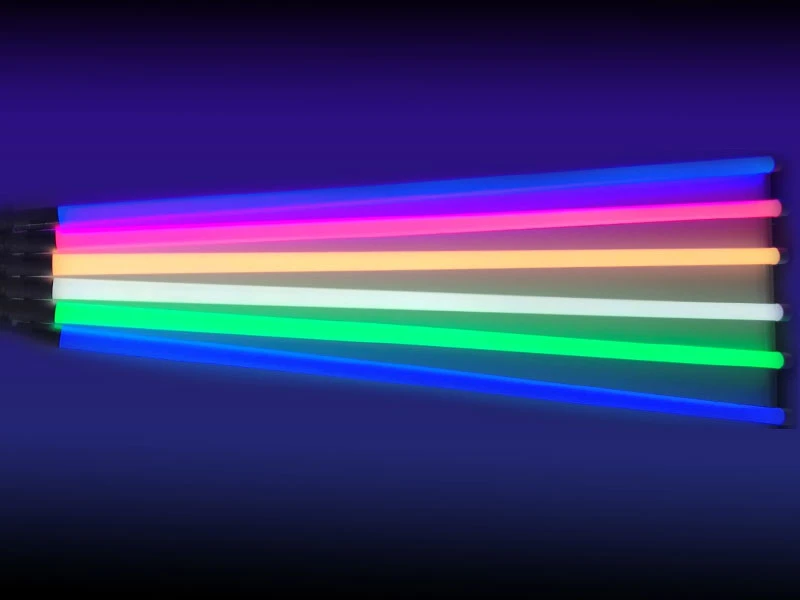
RGB lights are LED lighting products that combine red, green, and blue light to produce a broad range of colors. RGB stands for Red, Green, and Blue-the three primary channels used in an additive color model.
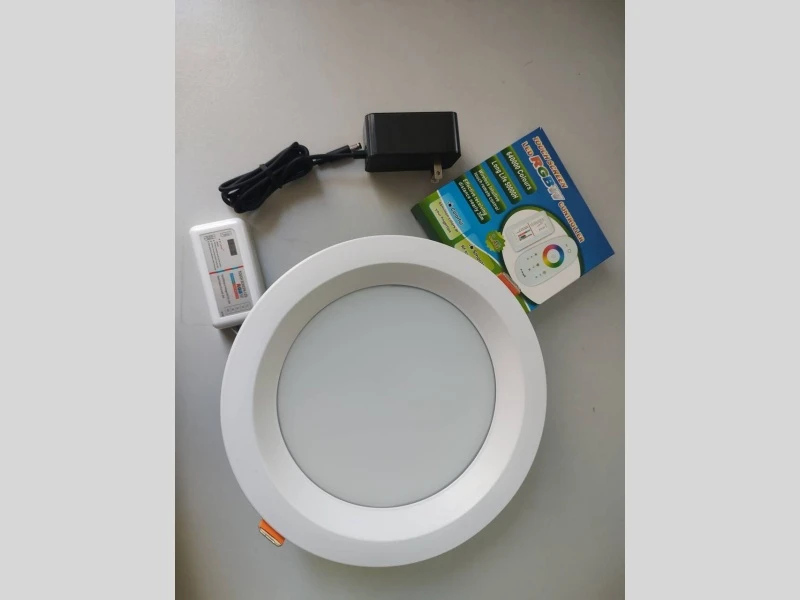
Instead of using a single LED chip that emits every color, an RGB product typically combines red, green, and blue LED diodes in one package, module, strip, or fixture. By adjusting the intensity of each channel, the controller creates different visual colors.
For example:
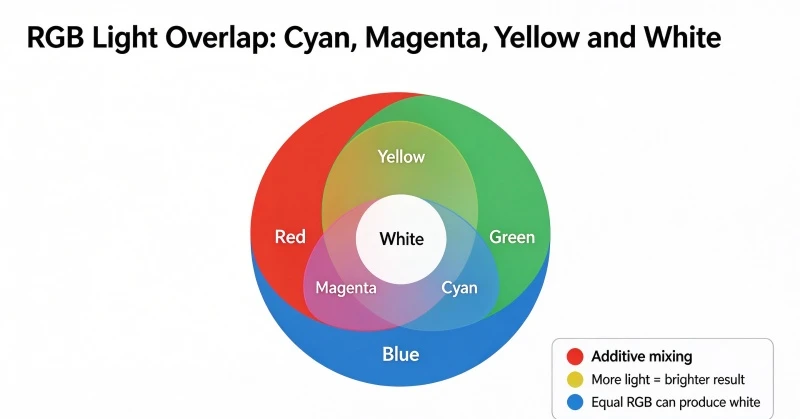
Red plus green can create yellow or amber tones.
Green plus blue can create cyan.
Red plus blue can create magenta.
Equal output from red, green, and blue can produce a white-like appearance.
Lower intensity across all three channels can create dimmer versions of the color.
This process is known as additive color mixing. You can learn more about the principles of physicsclassroom.com through educational resources on the physics of light.
How RGB LED color mixing works
An RGB LED usually contains three individually controllable emitters. The lighting controller sends separate signals to the red, green, and blue channels. By varying the electrical current or pulse-width modulation assigned to each channel, the system changes the apparent color.
A simplified example might look like this:
| Red channel | Green channel | Blue channel |
Approximate result |
|---|---|---|---|
| High | Low | Low | Red |
| Low | High | Low | Green |
| Low | Low | High | Blue |
| High | High | Low | Yellow |
| High | Low | High | Magenta |
| Low | High | High | Cyan |
| High | High | High | White-like light |
The actual color depends on the LED's wavelength, optical design, channel balance, diffuser, controller resolution, and surrounding surfaces. Two products may both display "red" in an app but produce noticeably different results in person.
Many modern controllers use 8-bit or higher control for each channel. With three channels and 256 intensity levels per channel, a basic system can theoretically create more than 16 million color combinations:
$$256 \times 256 \times 256 = 16,777,216$$
The number of available combinations does not guarantee that every color will look equally accurate. LED quality, calibration, optical mixing, and controller performance remain important.
RGB color versus color temperature
RGB color control and color temperature are related to lighting design, but they are not the same thing.
RGB control changes the balance between red, green, and blue channels to create colored light.
Color temperature describes the visual warmth or coolness of white light, usually expressed in Kelvin.
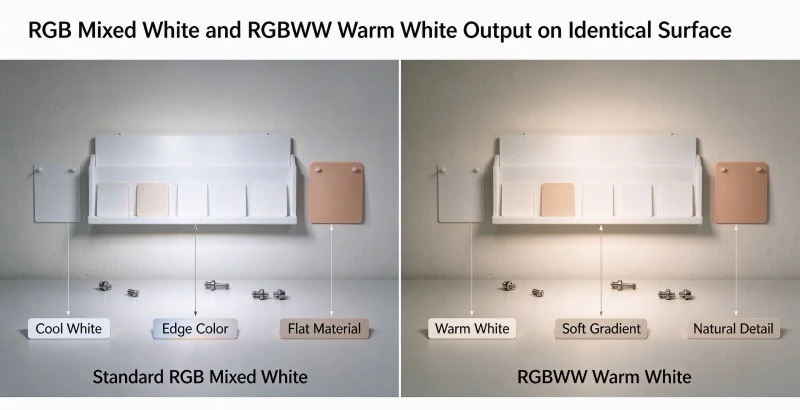
A warm-white lamp may appear yellowish or cozy, while a cool-white lamp may appear bluish and energetic. Standard RGB lighting can create a white-like output, but it may not produce the same natural or comfortable white light as a dedicated white LED.
This distinction is especially important in spaces that require both decorative color and reliable everyday illumination. For those applications, RGBW or RGBWW may be more suitable than standard RGB.
If your project requires custom colors, architectural integration, or coordinated controls, you can consult Benwei.
RGB vs. RGBW vs. RGBWW: Understanding the Variants
When comparing RGB vs. RGBW vs. RGBWW, the key difference is the addition of dedicated white-light channels.
A standard RGB product uses red, green, and blue emitters. RGBW adds a separate white emitter, while RGBWW adds a warm-white emitter. Some advanced products include additional channels, such as cool white, amber, or tunable-white LEDs.
Standard RGB
Standard RGB is designed primarily for color effects. It is often a good choice when the main purpose is:
Decorative accent lighting
Entertainment and event effects
Gaming or media-room lighting
Color-changing signage
Architectural color washes
Short-duration visual displays
RGB can create a white-like color by activating all three channels, but this output may look less natural than light from a dedicated white LED. It may also have lower color quality for everyday tasks.
RGBW
RGBW combines red, green, blue, and a dedicated white LED. The white channel can produce a cleaner and more useful white output than mixing the three color channels.
RGBW may be suitable for:
Retail displays
Hospitality interiors
Restaurants and bars
Residential accent lighting
Exhibition spaces
Architectural installations requiring both color and white light
The dedicated white chip can improve visual comfort and provide more practical illumination. However, the quality of the white light still depends on the LED's color rendering, color temperature, optical design, and power balance.
RGBWW
RGBWW adds a warm-white channel rather than-or in some products in addition to-a standard cool or neutral white channel. Warm white is often preferred in residential, hospitality, leisure, and premium interior environments.
RGBWW can help create:
Relaxed evening atmospheres
Warm architectural accents
Comfortable restaurant lighting
Hotel and lounge environments
Decorative residential scenes
Color effects combined with warm illumination
Some products use "RGBWW" to describe red, green, blue, and warm-white channels. Others may use the term for systems that provide RGB plus a tunable warm-white range. Always check the product datasheet to confirm the channel arrangement.
RGB, RGBW, and RGBWW comparison
| Type | Capabilities | Best use case |
Color and white-light performance |
|---|---|---|---|
| RGB | Red, green, and blue color mixing | Decorative effects, entertainment, signage | Strong color effects; white may appear less natural |
| RGBW | RGB plus dedicated white LED | Retail, hospitality, homes, and architectural lighting | Better white output and more practical illumination |
| RGBWW | RGB plus warm-white LED | Hotels, restaurants, lounges, and residential interiors | Warm, comfortable white combined with color effects |
| RGB plus tunable white | RGB with adjustable white channel | Premium commercial and smart lighting systems | More flexible control over color and white appearance |
The right choice depends on how the light will be used. If you only need colorful effects, standard RGB may be sufficient. If the product must provide attractive white light for extended periods, RGBW or RGBWW is usually worth considering.
Key Factors to Consider Before Buying RGB Lights
Knowing how to choose RGB lights for a room requires more than selecting a preferred color or brightness level. The product should match the room, control system, installation environment, operating schedule, and maintenance expectations.
1. Controller compatibility
The controller determines how the RGB system is operated. Common control methods include:
Infrared or radio-frequency remote controls
Wall-mounted controllers
Smartphone applications
Wi-Fi or Bluetooth gateways
DMX512 control systems
DALI or other building-management interfaces
Smart-home platforms and automation systems
Before purchasing, confirm that the controller supports the required number of channels and the intended installation length. A simple three-channel RGB strip may need a different controller from an RGBW fixture with four independent channels.
A common installation problem is choosing a controller based only on its maximum advertised wattage. The controller must also match the system voltage, channel arrangement, current capacity, communication protocol, and power-supply configuration.
For larger commercial projects, specify the control architecture before selecting the fixtures. This avoids installing products that cannot integrate with the building-management or show-control system.
2. Brightness and optical performance
Brightness should be evaluated using suitable specifications rather than marketing language alone. Depending on the product type, review:
Lumens or luminous output
Power consumption
Beam angle
LED density
Optical lens design
Distance from the illuminated surface
Light distribution and uniformity
An LED strip with widely spaced diodes may create visible bright spots when installed in a shallow profile. A higher-density strip or diffused channel may provide a smoother appearance.
For architectural applications, also consider the viewing angle and the surface being illuminated. Glossy, textured, dark, and highly reflective surfaces can all affect the final visual result.
3. Color quality and CRI
Standard RGB is optimized for color effects, so conventional CRI figures may not fully describe its performance in saturated colors. If the lighting will also be used as general illumination, pay close attention to the specifications of the dedicated white channel.
Look for:
CRI or Ra value
R9 performance where relevant
Color consistency
MacAdam-step information
White-channel color temperature
Lumen output in white mode
Low-cost products may show inconsistent color from one section to another. They may also have noticeable differences between batches, especially when LED binning and calibration are poorly controlled.
For broader lighting-quality information, consult the energystar.gov and compare the manufacturer's technical documentation rather than relying only on product photographs.
4. Indoor or outdoor installation
The installation environment determines the required enclosure and protection level.
For indoor applications, consider dust, moisture, cleaning procedures, heat buildup, and accidental contact. For outdoor installations, the product may require protection from rain, condensation, ultraviolet exposure, temperature changes, and physical impact.
Check the product's IP rating and confirm that the rating applies to the complete installation-not only to the LED strip before cutting, connecting, or sealing it.
A waterproof product can still fail if:
Connectors are not sealed correctly.
Cable entries allow water penetration.
The power supply is installed in an unsuitable location.
The strip is cut without resealing the end.
Condensation forms inside an enclosure.
5. Power supply and system capacity
The power supply must match the system voltage and total load. A basic calculation is:
$$\text{Required power} = \text{Power per meter} \times \text{Installed length}$$
Add an appropriate design margin rather than operating the power supply continuously at its maximum rated output. The required margin depends on the product, installation conditions, control method, and manufacturer guidance.
Also verify whether the power supply is compatible with dimming, wireless control, or building automation equipment.
You can browse benweilight.com when comparing specifications, control options, and project requirements.
Best Applications: From Smart Homes to Commercial Installations
The best RGB lighting solutions are those that combine the right LED configuration with appropriate controls, optics, power supplies, and installation details. RGB technology is flexible, but different applications have different performance requirements.
Residential RGB lighting
In homes, RGB products are commonly used for:
TV and media-room backlighting
Gaming setups
Kitchen or cabinet accents
Bedrooms and living rooms
Stair and shelf illumination
Entertainment areas
Seasonal or decorative scenes
A residential system should be easy to operate and quiet during normal use. App-based control can be convenient, but users should also consider whether the system continues to work if the internet connection fails.
RGBW or RGBWW may be preferable when the same installation needs to provide both colorful effects and comfortable everyday lighting.
Retail and hospitality
Retailers, restaurants, hotels, and entertainment venues often use RGB lighting to influence atmosphere and attract attention. Typical applications include:
Storefront accents
Bar and restaurant interiors
Hotel lobbies
Product displays
Feature walls
Signage and brand environments
Event and entertainment spaces
In these settings, the system should be selected for reliability, scheduling, serviceability, and control integration-not only for color variety. A visually impressive installation that is difficult to maintain can become expensive over time.
Architectural and commercial installations
Architectural RGB systems can highlight building façades, bridges, public spaces, ceilings, columns, and landscape features. Commercial installations may use DMX or another centralized protocol to coordinate scenes across multiple fixtures.
Before specifying a system, evaluate:
Required brightness at the target surface
Viewing distance
Fixture spacing
Weather exposure
Cable routing
Access for maintenance
Control-system integration
Required scene changes
Operating hours
For a commercial project, request a lighting layout, sample, mock-up, or photometric review before final approval. A small-scale test can reveal color uniformity, glare, shadowing, and surface-reflection issues that are difficult to predict from a datasheet.
Energy efficiency considerations
LEDs are generally efficient compared with many older lighting technologies, but actual energy performance depends on how the system is operated. A full-power RGB scene using all channels may consume more energy than a simple single-color scene.
To improve efficiency:
Use scheduled scenes.
Dim the output when full brightness is unnecessary.
Select the right wattage for the visual task.
Avoid oversizing the installation.
Use occupancy or daylight controls where appropriate.
Compare total system input power, including drivers and controllers.
Safety, Installation, and Maintenance Tips
This RGB LED light installation guide focuses on the issues that most often affect safety, performance, and service life.
Use the correct power supply
Never connect an RGB product to a power supply with the wrong voltage. Confirm whether the system operates at 5 V, 12 V, 24 V, or another specified voltage.
The power supply should also provide sufficient current for the complete installation. Undersizing can cause overheating, flickering, unexpected shutdowns, or premature failure.
Plan for voltage drop
Voltage drop is a common problem in long LED-strip runs. As current travels through the conductors, the voltage can gradually decrease. The far end of the strip may then appear dimmer or show inconsistent color compared with the beginning.
Possible solutions include:
Using a higher-voltage system where appropriate
Reducing the length of each continuous run
Feeding power from multiple points
Using appropriately sized conductors
Following the manufacturer's maximum-run guidance
Separating long installations into independently powered zones
Power injection points must be designed carefully. Incorrect connections can damage the strip, controller, or power supply.
Provide heat dissipation
LEDs produce less heat than many traditional light sources, but they still generate heat. Excessive operating temperature can reduce brightness, accelerate color shift, and shorten product life.
For LED strips, install the product on a suitable aluminum profile or heat-conductive surface where specified. Avoid placing high-output strips inside enclosed spaces without adequate heat management.
Do not cover a high-power LED product with insulation, tape, or an unsuitable diffuser unless the manufacturer approves the configuration.
Consider whether RGB lights are safe for eyes
Many readers ask, are RGB lights safe for eyes? In normal use, quality RGB products are generally intended to be viewed indirectly or as part of an illuminated environment. However, safety depends on brightness, distance, exposure time, optical design, and installation.
Good practice includes:
Avoiding direct viewing of high-intensity LEDs.
Using diffusers for close-view applications.
Reducing brightness when the light is near eye level.
Avoiding rapid flashing effects in sensitive environments.
Following the manufacturer's installation and operating guidance.
Selecting products designed and tested for the intended application.
The risk is not determined by the word "RGB" alone. It depends on the complete fixture, optical system, drive current, environment, and use pattern.
Inspect and maintain the system
Maintenance procedures should include:
Checking connectors for heat or discoloration
Inspecting waterproof seals outdoors
Cleaning diffusers and lenses
Confirming that cooling paths remain clear
Checking power-supply ventilation
Reviewing controller connections
Replacing damaged sections with compatible components
Conclusion and Next Steps
RGB lighting offers a flexible way to create color, atmosphere, branding effects, and architectural emphasis. Its performance depends on more than the number of colors listed on the package.
Before buying, consider:
Whether standard RGB, RGBW, or RGBWW is appropriate
The quality and brightness of the LED system
Controller and smart-home compatibility
Power-supply capacity and voltage drop
Indoor or outdoor protection requirements
Heat dissipation and maintenance access
White-light quality and color consistency
Integration with existing commercial controls
Standard RGB is effective for decorative color effects. RGBW is often a stronger all-purpose choice when clean white light is also required. RGBWW can provide a warmer, more comfortable atmosphere for residential, hospitality, and premium interior applications.
Our Products