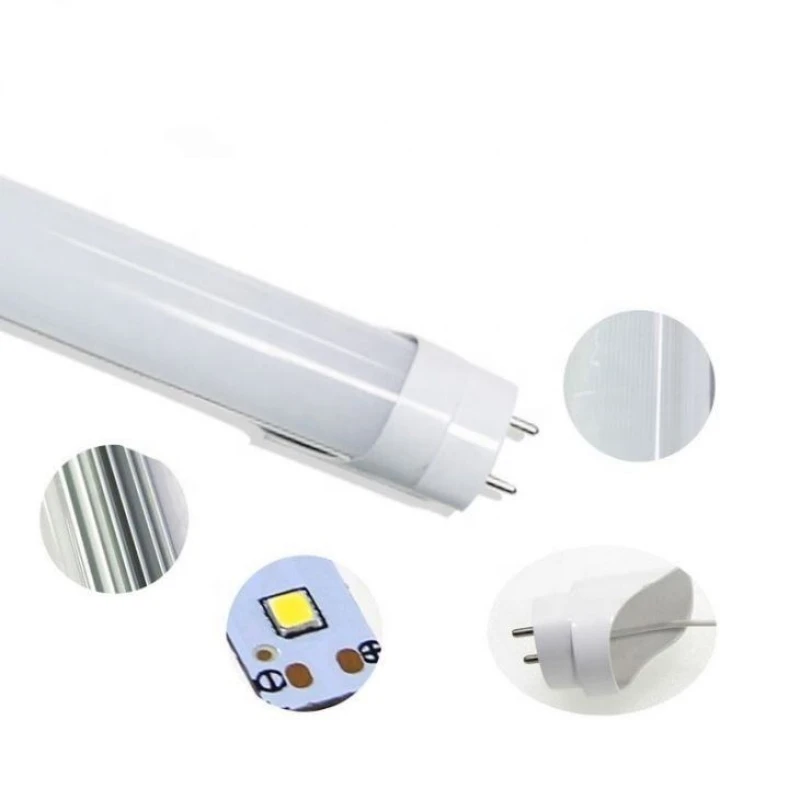
When purchasing LED tubes, many clients notice that even among T8 tubes, specifications list two distinct tiers for the Color Rendering Index (Ra/CRI)-80Ra and 95Ra-with a significant price difference between them. So, what exactly sets them apart? Is a higher Ra always better? This article clarifies the differences by examining principles, luminous efficacy, costs, and application scenarios, helping you make the right choice without unnecessary guesswork.
What is Ra (Color Rendering Index)?
Ra measures a light source's ability to accurately render the true colors of objects. The maximum score is 100; the closer the value is to 100, the more the object's appearance under the light resembles its appearance in natural daylight.
It is important to note that Ra is calculated based on the average of eight pastel color samples (R1–R8) and does not include more vivid colors like R9 (saturated red). This distinction is crucial when comparing 95Ra options later.
Key Differences Between 80Ra and 95Ra
Color Rendering Accuracy
80Ra meets general requirements for color recognition, though slight deviations may occur with reds, skin tones, and dark shades. Colors rendered at 95Ra appear richer and more natural, with differences from daylight that are virtually imperceptible to the naked eye.
R9 Value
80Ra tubes typically have a very low-or even negative-R9 value, causing reds to appear dull or dark. 95Ra tubes generally achieve an R9 value of 50 or higher, resulting in more vibrant reds. If your clients are sensitive to red tones (e.g., in food, clothing, or skin tones), this metric is even more important to consider than the general Ra rating.
Phosphor and Chip Formulation
Achieving 95Ra requires a wider variety of phosphors to fill in the spectrum-particularly the red component-resulting in a more continuous spectrum that closely mimics natural light. In contrast, 80Ra tubes have a relatively simpler spectrum with less red light content.
Comparison of Luminous Efficacy and Energy Consumption
High color rendering comes at the cost of some luminous efficacy. Phosphors used to boost red light output absorb and dissipate some energy; consequently, for the same power rating, a 95Ra lamp typically produces 10%–20% less luminous flux than an 80Ra lamp.
For example: an 18W T8 lamp might achieve around 2000lm in the 80Ra version, whereas the 95Ra version might only yield 1600–1700lm. To achieve the same brightness, a 95Ra setup might require installing more lamps or choosing higher-wattage models.
Cost and Price Differences
The production cost of 95Ra lamps is significantly higher than that of 80Ra lamps, primarily due to three factors:
More complex phosphor formulations and higher material costs
Stricter requirements for LED chip screening and binning, resulting in lower yields
Reduced luminous efficacy, requiring more chips or higher power to achieve the same brightness
Generally, the ex-factory price of a 95Ra lamp is considerably higher than that of an 80Ra lamp of the same specification. For large-scale projects, this price difference can add up significantly, so budgets should be calculated in advance.
Suitable Applications
80Ra is suitable for:
Warehouses, garages, and parking lots
General work areas in factory workshops
Corridors, stairwells, and equipment rooms
Cost-sensitive locations where color accuracy is not a priority
95Ra is suitable for:
Clothing stores, jewelry stores, and cosmetics shops
Display cases for fresh produce, meat, and baked goods
Art museums, galleries, and photography studios
Color-matching areas in printing plants and textile inspection zones
High-end offices and medical examination rooms
How to Choose
When selecting the right product, consider the following questions:
Will the client be closely examining colors? If color assessment directly impacts sales or quality control, choose 95Ra.
How tight is the budget? If the budget is limited and only basic lighting is required, 80Ra is more cost-effective.
Are there high brightness requirements? For locations requiring high illuminance levels, it is easier to meet standards with fewer lamps using the 80Ra option. Is there a middle-ground solution? You might also consider 90Ra products, which strike a balance between cost and color rendering.
Summary
The fundamental difference between 80Ra and 95Ra lies in the level of color rendering accuracy. 80Ra offers high luminous efficacy and a lower price point, making it suitable for most general lighting applications. In contrast, 95Ra provides superior color rendering and a more complete spectrum but comes with lower efficacy and higher costs; it is ideal for settings where color accuracy is critical.
There is no absolute "best" choice-only the right fit for your needs. Selecting the appropriate Color Rendering Index (CRI) ensures you avoid paying for unnecessary performance while preventing business issues caused by color distortion.
We offer LED tubes with various CRI ratings-including 80Ra, 90Ra, and 95Ra-and support customization for wattage, color temperature, and length. We also provide samples for testing and detailed spectral reports.
If you are selecting products for a project or are unsure which CRI is best for your clients, please contact our team. Simply let us know your application scenario and required quantities, and we will recommend the right solution and provide a quote.
https://www.benweilight.com/lighting-tube-bulb/special-t8-led-tube/high-cri-t8-led-97ra-95ra.html