When a sudden power outage plunges a factory workshop into darkness, dozens of people may find themselves struggling to navigate toward an exit amidst heavy machinery and storage racks. In such a moment, a small, often-overlooked light overhead can become a critical lifeline.
Industrial emergency exit lights are designed specifically for scenarios like this. Many buyers jump straight to asking about prices and technical specifications without fully understanding the core problem these lights solve or where they should be installed. This article clarifies their purpose to help you make the right choice and avoid common pitfalls during the selection process.
Indicating the Escape Route During a Power Outage
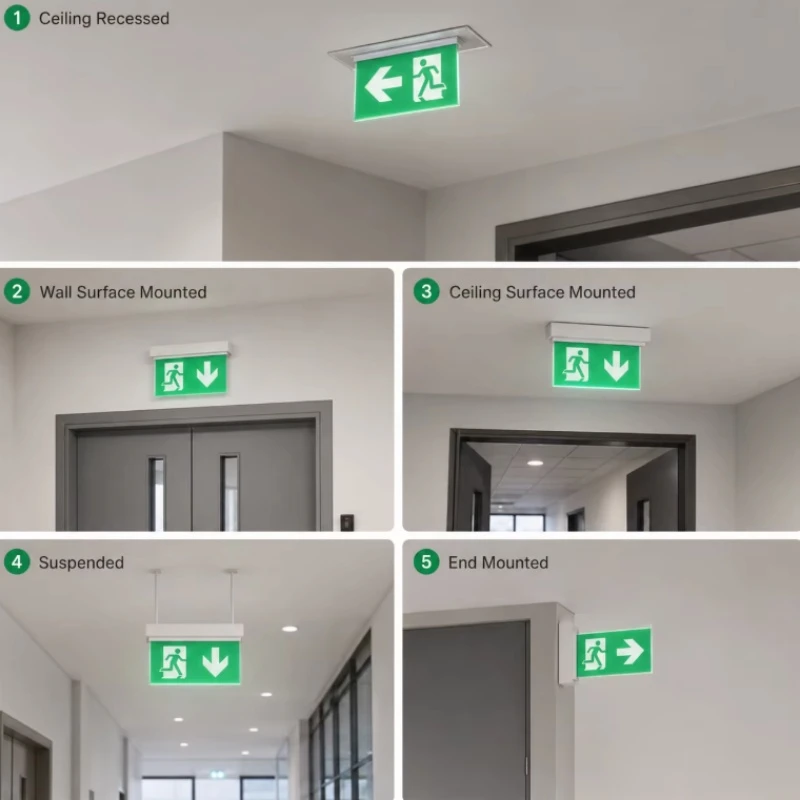
The primary function of an emergency exit light is to show people exactly which way to go when the main power supply fails. Most units feature exit signage-such as the universal "running man" icon paired with an arrow-making the direction of escape immediately clear.
In large industrial facilities with complex, winding passageways, new employees and visitors can easily become disoriented. Clear, illuminated signage ensures that, during an evacuation, people don't end up wandering aimlessly in circles.
Providing Basic Illumination in the Dark
Signage alone isn't enough; people also need to be able to see the path beneath their feet. Emergency exit lights contain built-in backup batteries that activate automatically during a power failure, providing illumination for a set duration. Since requirements for battery runtime vary by region, it is advisable to verify local regulatory standards before making a purchase.
This lighting is not intended for continuing work, but rather to help individuals avoid obstacles and reach an exit safely.
Factory Workshops and Production Lines
Workshops are the most common setting for emergency exit lights. With dense machinery, narrow aisles, and potential hazards like cables or pipes on the floor, a sudden loss of light creates a high risk of collisions or trips and falls.
These lights are typically installed above exits, at corners along passageways, and throughout primary evacuation routes. Because workshops are prone to vibrations and accidental impacts, the fixtures themselves must be robust and durable.
Warehouses and Logistics Centers
Warehouses are characterized by high storage racks, long aisles, and obstructed sightlines. If you are standing deep within an array of shelving, you might not be able to see an exit located far away. In such facilities, emergency exit lights serve as a "relay" guidance system: they are positioned at intervals along passageways, ensuring that occupants can always see the next directional indicator. In areas where forklifts operate, careful attention must be paid to the installation height to prevent the units from being struck.
Humid, Dusty, or Corrosive Environments
In settings such as car washes, food processing plants, wastewater treatment facilities, cold storage units, or semi-open outdoor industrial areas, lighting fixtures are exposed to moisture, dust, and even mild corrosive agents. Standard indoor-grade lights would quickly succumb to water ingress or rust.
Industrial-grade emergency exit lights are typically designed to be dustproof and waterproof; simply check the IP (Ingress Protection) rating when selecting a model. If the facility is classified as a hazardous area (flammable or explosive), you must use products with specific explosion-proof certification-standard ABS emergency lights are not suitable substitutes.
Why ABS Housings Are Preferred for Industrial Settings
ABS is an engineering plastic that offers several practical advantages for emergency lighting:
High impact resistance: It does not crack easily upon minor impact.
Resistance to common acids, alkalis, and moisture: Unlike metal, it is not prone to rusting.
Lightweight: This makes installation easier and less labor-intensive.
Ease of molding: It allows for effective waterproof structural design and a polished appearance.
Cost-effectiveness: It is an economical choice for bulk procurement.
A note of caution: ABS may age and turn yellow if exposed to prolonged, direct sunlight. If the lights are to be installed in areas with high UV exposure, verify whether the units have been treated for UV resistance.
Summary
The purpose of ABS industrial emergency exit lights can be distilled into two functions: indicating exit routes during a power failure and providing sufficient emergency illumination. They are widely used in industrial settings such as workshops and warehouses, proving particularly well-suited for environments that are humid, dusty, or prone to physical impact. When selecting a unit, focus on its protection rating, battery life, certifications, and mounting method, while considering the specific conditions of your site.
If you are sourcing ABS emergency exit lights for a project, a factory, or a distribution business, please feel free to contact us directly. Simply share your intended application, target market, and required quantity; our team will recommend the most suitable models-along with price quotes and sample support-within 24 hours.