What is CRI? A Professional's Guide to Color Rendering Index, R9, and Beyond
For your meat display case, you spent more for "high-CRI" LED strips. CRI 95 was stated on the specification sheet. However, the steak appears pale and unappealing, and patrons pass by without pausing. The CRI score is not the issue. The issue is that the image you are viewing is not full. Only a portion of the tale is revealed by the overall CRI number, which is officially known as Ra. Deep red is a crucial colour that it overlooks. This is when a statistic known as R9 enters the picture and explains why your pricey lighting isn't working.
You will go beyond the fundamental CRI number with this guide. You'll discover what CRI really measures, where it falls short, and what other measurements experts use to assess colour quality. By the time you're done, you'll have a useful framework for designing lighting that works in practical settings.
The True Meaning of CRI
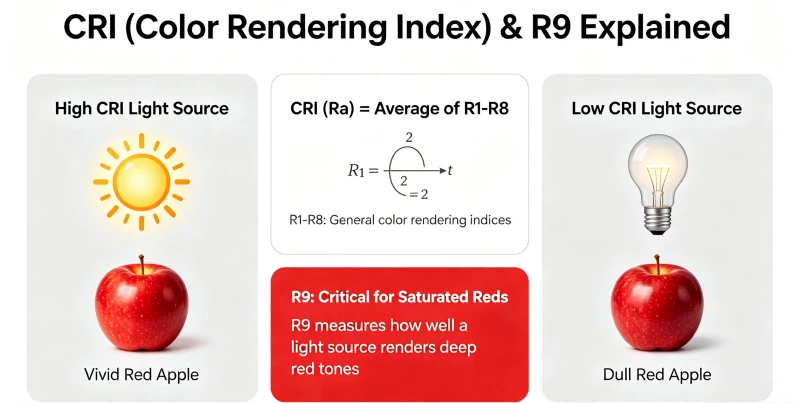
Colour Rendering Index is referred to as CRI. The idea is simple: it gauges how well an object's colour is revealed by a light source in comparison to a reference light, often sunshine. The scale has a range of 0 to 100. A score of 100 indicates that the light's colour rendering is identical to that of the reference.
Imagine a crimson apple in the sun. Its skin is a beautiful, deep red. The identical apple should now be placed beneath a low-CRI LED. The crimson becomes washed out, muddy, or brownish. The apple indicates that something is absent from the spectrum, even though the light itself may appear white to your eyes. This difference is measured by a CRI score.
How the Score Is Determined
Testing how a light source produces eight standard pastel colour samples, often known as Test Colour Samples or TCS, yields the general CRI score, or Ra. A unique score, designated R1 through R8, is assigned to each sample. Ra is just the mean of those eight scores.
The test procedure contrasts how each sample is rendered by the relevant light source with how it is rendered by a reference light with the same colour temperature. A higher score is indicated by a smaller difference. Although this makes sense, there are three major blind spots in the system.
First, there is no saturated red in any of the eight pastel samples. Since red is never checked in the overall result, a lamp with a score of 90 Ra can depict deep reds horribly.
Second, manufacturers can manipulate the system by using the averaging process. They can adjust a light's spectrum so that it performs well on the eight test colours while ignoring additional colours that are important in practical situations.
Third, saturation is not measured by CRI; only colour accuracy is. A light source may be precise but appear flat, devoid of the vitality that gives colours life.
R9: The Business-Related Metric
The individual CRI score for TCS 9, a saturated red sample, is R9. A light with 95 Ra can nonetheless make a steak appear grey because it is not part of the Ra average.
R9 is non-negotiable for any firm that involves people, food, or high-end products.
The bright red that denotes freshness is lost when a butcher counter is lighted with high-Ra but low-R9 LEDs. Even when the meat is completely fresh, consumers think it is older or of poorer quality. The similar issue arises in fancy dining establishments: food appears less appetising when the lights go out on red.
Warm tones in paintings fall flat, which hurts museums and art galleries. Without strong R9, the shine of a sunset in a landscape and the skin tones in a portrait lose their power.
Hospitality environments are also impacted. Flattering light is essential in high-end retail settings and hotel lobbies. Guests' skin tones appear sickly in low-R9 lighting. Gold jewellery, wood furniture, and red clothing become less opulent. The entire area's perceived quality declines.
Setting a minimum R9 value is equally crucial for these applications as setting Ra. It's a good idea to require a R9 above 50 for any area where people, food, or goods are being displayed. R9 above 90 is the norm for essential applications such as galleries, hospitals, and upscale shopping.
TM-30: An Up-to-Date Instrument for Tough Projects
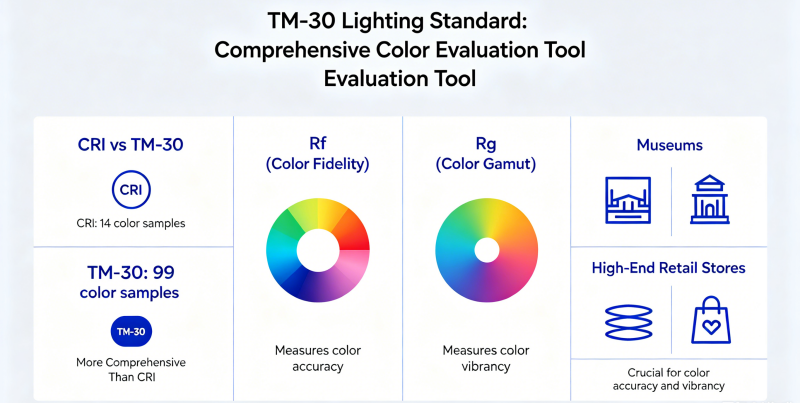
TM-30 is a more complete system that goes beyond CRI and R9. The Illuminating Engineering Society developed TM-30, which used 99 colour samples as opposed to CRI's 8 to 15. It assesses two things: Gamut (Rg), which gauges saturation, and Fidelity (Rf), which is more strict than CRI.
A high CRI Ra plus a high R9 value is adequate for the majority of commercial applications. A typical office or home kitchen does not require TM-30. However, TM-30 offers a more comprehensive image for a museum lighting installation, a flagship store, or any area where colour nuance directly affects business outcomes. It indicates whether colours feel vivid as well as if they are realistic.
A Useful Guide to Specifications
Common applications must meet the minimum parameters listed below.
Aim for a minimum CRI of 80 with R9 above 20 for domestic living areas and bedrooms. Raise the goal to CRI 90 with R9 above 50 for home kitchens and bathrooms where grooming and food preparation take place.
Offices ought to set a minimum CRI of 80. Extreme colour fidelity is not necessary because the work includes reading and using a screen.
What you sell determines the retail environment. Boutiques and clothing retailers require R9 above 50 and CRI 90. Supermarkets require the same CRI 90 but R9 above 70, particularly in the meat and vegetable areas. Jewellery and luxury retail should seek CRI 95, with R9 exceeding 90.
Museums and galleries must have a minimum CRI of 95 and a R9 of at least 90. Some initiatives also justify the need for TM-30 data.
Exam rooms and surgery suites are examples of healthcare facilities that require CRI 95 with R9 over 90. To evaluate skin, tissue, and other clinical indicators, medical personnel depend on precise colour.
A minimum of CRI 95 and a R9 over 90 are required for photography and video studios. Any change in colour balance necessitates hours of later repair effort.
How to Check Performance
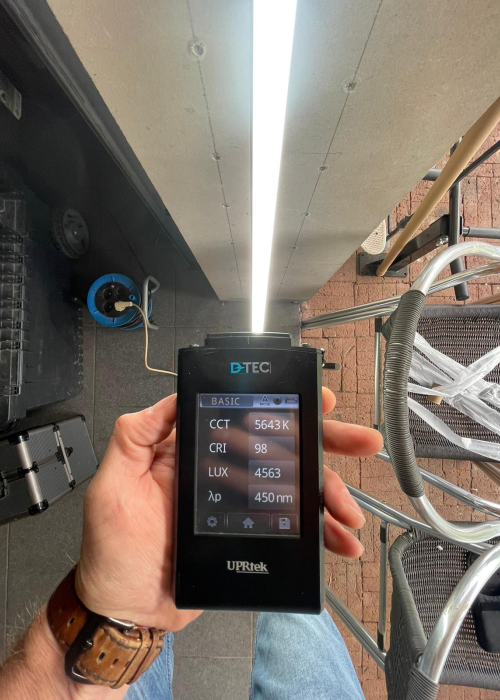
A marketing headline's figures don't really mean anything. You must review the real specification document. Instead of focusing only on the Ra number, look for the individual R values. Look for R9 on that list. Consider it a warning sign if a manufacturer fails to reveal specific R values. Reputable vendors freely offer this information. When comparing two goods that both claim to be "CRI 90," the one with a published R9 above 50 will perform better.
Making the Correct Decision
It's not a guessing game to assess light quality. There should be three steps on your specification checklist. Depending on the application, set your Ra baseline. Ask for and confirm the R9 value on the specification sheet. Enquire about TM-30 data for flagship or museum-grade projects. These tools allow you to precisely specify colour quality and obtain the desired outcome.
BW-Ra>95