The Number Everyone Quotes, Almost Nobody Understands
"50,000 hours" has become the default lifetime promise of modern LED lighting. It sounds impressive, it appears in catalogs and tenders worldwide, and it is repeated by suppliers who may never have measured a single fixture for 50,000 hours. The uncomfortable truth is that no manufacturer actually runs a luminaire for 50,000 hours before selling it - that would take nearly six years of continuous testing. Instead, the number is measured on a small LED package for a few thousand hours and then mathematically projected forward.
That projection is L70. And whether your downlight genuinely delivers 50,000 hours of useful light, or dims to a disappointing 55% by year four, depends almost entirely on how the fixture is engineered around that projection.
Why This Matters To A Buyer
For a homeowner, an overstated lifespan means a room that slowly darkens and an early replacement. For a commercial project - a retail chain, a hotel, an office tower - it means maintenance crews on ladders, relamping budgets, uneven lighting that hurts the customer experience, and call-back costs. Understanding L70 is therefore not an academic exercise; it is the difference between a lighting asset that pays itself back and a lighting liability.
What This Article Covers
We will define lumen maintenance and the L70 / L80 / L90 scale, explain the physics of LED degradation and the temperature effect that controls it, walk through how LM-80 and TM-21 produce the 50,000-hour figure, expose the most common ways that number is stretched, and finish with a concrete checklist for qualifying a real long-life COB recessed downlight.

What Lumen Maintenance Actually Measures
Initial Lumens And The Maintenance Factor
When a new LED downlight is switched on for the first time, it produces a rated amount of light - its initial lumens. Over years of operation, every LED loses some of that output. Lumen maintenance is the percentage of the original light the fixture still produces at any given moment. A brand-new fixture sits at 100%. A well-engineered one might still read 95% after 20,000 hours; a poor one might already have fallen to 80%.
Lighting designers plan projects around this decay. They deliberately over-specify initial lumens by a "maintenance factor" so that, even after years of dimming, the space still meets its required illuminance. Underestimating lumen decay is exactly why so many buildings look dim long before their lights physically break.
The L-Scale: L70, L80 And L90
The industry names a lumen-maintenance milestone by the percentage of light that remains. L70 means the point at which output has dropped to 70% of initial. L80 is the 80% mark, and L90 the 90% mark. Because decay accelerates, these milestones are reached at very different times.
|
Rating |
Meaning |
Buyer Interpretation |
|---|---|---|
|
L90 |
Time to fall to 90% of initial lumens |
Premium, high-demand spaces; the light still looks essentially new |
|
L80 |
Time to fall to 80% of initial lumens |
Good commercial benchmark; barely noticeable dimming |
|
L70 |
Time to fall to 70% of initial lumens |
The industry's formal "end of useful life" threshold |
Why 70% Is The Official End
Why does the industry choose 70% as the retirement line rather than 50%? Below roughly 70% loss, the eye begins to perceive a clear drop in brightness, the remaining light becomes noticeably uneven across a space, and the cost of additional lighting to compensate outweighs the cost of relamping. L70 is therefore the accepted definition of "useful life" for solid-state lighting - the moment a reasonable operator would budget for replacement.
The Science Behind The Number
How An LED Ages
LEDs do not burn out like incandescent bulbs. They fade gradually through several parallel mechanisms:
Phosphor degradation. The yellow phosphor layer that converts the blue die into white light darkens and shifts under sustained heat, causing yellowing and color drift.
Semiconductor efficiency droop and material fatigue. Internal quantum efficiency slowly declines as the chip operates.
Die-attach and bond-wire fatigue. Thermal cycling weakens internal connections, eventually causing abrupt failures rather than smooth dimming.
Optical aging. Reflectors and lenses can yellow, further reducing the light that actually reaches the room.
Junction Temperature: The Master Variable
All of these mechanisms accelerate with heat. The single most important number in LED longevity is the junction temperature (Tj) - the microscopic temperature right at the light-emitting die. The industry's well-established rule of thumb: every 10 °C reduction in junction temperature roughly doubles the time the LED takes to reach L70. The same chip held at 85 °C can last many times longer than the identical chip run at 105 °C.
This is especially punishing for recessed downlights. Sealed inside an insulated ceiling void, with no free air to convect against, they trap their own waste heat. A chip that would run cool in an open track light can easily exceed its safe junction temperature in a cheap recessed housing - which is why cheap downlights fade fastest despite carrying the same "50,000 hours" marketing line.
Buyers often fixate on lumens and forget that heat also changes color. As the phosphor ages non-uniformly, correlated color temperature drifts - a once-consistent 4000 K cool-white wash can gradually shift warmer and greener. On a single ceiling this is subtle; across a hundred downlights in a retail space, uneven phosphor aging creates a patchwork of color temperatures that reads as cheap and poorly maintained. The same lower-junction-temperature discipline that protects lumens also keeps chromaticity stable within a tight MacAdam ellipse (SDCM) tolerance, so the space looks as intentional in year five as it did on opening night.
LM-80: The Measurement Standard
LM-80 is the Illuminating Engineering Society's standard method for measuring lumen depreciation of an LED package. The manufacturer burns the bare chip on a test board at controlled case temperatures (commonly 55 °C, 85 °C and 1000 hours or more - typically 6,000 to 10,000 hours) and records how its light output decays. Importantly, LM-80 tests the LED package alone, on an ideal test rig - not your sealed, recessed, ceiling-mounted fixture.
TM-21: The Extrapolation To 50,000 Hours
Because nobody waits 50,000 hours, the industry uses TM-21 to project the LM-80 data forward. It fits a decay curve to the measured test period and extrapolates when the package will cross the 70% line. A typical result might read "L70 > 50,000 hours at Tc = 85 °C." That parenthetical case temperature is the fine print that decides everything: the projection is only valid if your real fixture case actually stays near that temperature. In a hot ceiling cavity, the same projection can collapse by half or more.
Why Lumen Decay Is Not A Straight Line
It is tempting to imagine an LED losing a steady 0.6% of its output every thousand hours in a perfectly straight line. In reality, the decay curve is gentle at first and then steepens. A well-cooled fixture may sit at 97% of initial output for its first 15,000 hours, then begin to sag as phosphor aging and thermal fatigue compound. This non-linearity is precisely why the L70 rating matters more than a simple average: two fixtures that both average "90% output" over 50,000 hours can feel very different. The one kept cool by a proper heatsink holds near 100% for most of its life and only approaches 70% at the very end; the overheated one drops below 80% early and keeps sliding. For a building operator, the former stays bright and uniform; the latter feels prematurely old long before its rated clock runs out.
Why "50,000 Hours" Is Often Misleading
Chip Rating Vs. System Rating
The most common deception is simple: a supplier quotes the LED chip's LM-80/TM-21 figure as if it were the whole fixture's figure. But a luminaire includes a driver, a housing, a reflector, a thermal interface and - critically - a heatsink that may or may not keep the chip cool. The system L70 is always shorter than the package L70, and only a properly engineered fixture closes that gap.
The Case-Temperature Fine Print
Return to that "L70 > 50,000h at Tc = 85 °C" line. If your recessed fixture actually runs its case at 105 °C because the heatsink is undersized or porous, the real L70 is nowhere near 50,000 hours. Honest manufacturers measure the fixture's own case temperature under real loading and state the system L70 at that measured temperature - not the lab's best-case assumption.
Duty Cycle And Real-World Hours
Finally, hours are not years. A light run 12 hours a day, 7 days a week (roughly 4,380 hours a year) reaches 50,000 hours in about 11.4 years. A light run 8 hours a day, 5 days a week (about 2,080 hours a year) takes over 24 years. A shop or hotel running long daily hours burns through its L70 budget far faster than a rarely used residential fixture - which is exactly why commercial buyers need the real, system-level number.
The Hidden Cost Of An Overstated Number
Buying on a headline 50,000-hour claim is a false economy. A fixture that dims to 65% by year three forces extra lighting, unhappy occupants, and premature replacement - total cost of ownership that dwarfs the few dollars saved at purchase. A trustworthy L70 claim is a financial guarantee, not a spec-sheet ornament.
What Actually Delivers A True 50,000-Hour L70
Meeting L70 at 50,000 hours is a system achievement. Five engineering choices work together to keep junction temperature low and hold lumen output.
The Cold-Forged 1070 Aluminum Heatsink
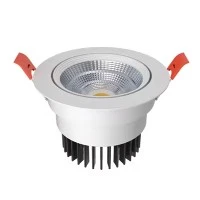
Because temperature controls degradation, the heatsink is the single most important L70 component. A cold-forged high-purity (1070) aluminum heatsink offers roughly 226 W/m·K conductivity, a dense pore-free grain structure, and tall, thin, tightly packed fins that maximize convective surface area in the cramped recessed footprint. By pulling heat out of the COB chip faster, it keeps the case and junction temperatures inside the safe range that the TM-21 projection actually assumes. That is the mechanical bridge between a lab number and a real 50,000-hour life.
Conservative, Right-Sized LED Loading
Premium fixtures deliberately run the COB chip below its maximum current rating - known as derating. An under-driven LED generates less heat per lumen, runs cooler, and reaches L70 later. Pairing a high-CRI COB with an oversized cold-forged sink means the chip never strains to hit target brightness, which is how L70 survives in a hot ceiling rather than on a test board.
Isolated, Flicker-Free, High-Power-Factor Driver
The driver is part of the longevity equation. An isolated constant-current driver with flicker-free output and power factor above 0.95 delivers clean, stable current to the LED, protects against surges, and wastes minimal energy as additional heat in an already hot cavity. Electrical stress on the chip is reduced, and self-heating is minimized - both directly extending time-to-L70.
ADC12 Housing, IP65 And Fire-Rated Build
A rigid ADC12 die-cast aluminum bezel in white, black or silver acts as a secondary heat-spreading path while protecting the core. An IP65 seal makes the fixture dust-tight and water-jet resistant for bathrooms, kitchens and covered outdoor ceilings, and a fire-rated construction satisfies recessed-ceiling building codes - provided the sealing is engineered so the cold-forged sink still breathes. When protection is designed around the thermal path rather than bolted on afterward, IP65 and fire ratings add safety without shortening L70.
Optical And Assembly Quality
Precision anti-glare reflectors in 24°, 38° and 60° beam angles (fixed or tilt-adjustable) extract and direct photons efficiently, so the LED need not be overdriven to reach target brightness. Quality thermal interface materials and a flat, pore-free sink base minimize contact resistance between board and sink. Together, these small details are what let a manufacturer stand behind L70 at 50,000 hours in real installations.
LED Binning And Batch Consistency
Even the best heatsink cannot rescue a poorly sorted LED. Premium programs select tightly binned COB chips - grouped by luminous flux, forward voltage and chromaticity - so every fixture on a project starts at the same brightness and color. When chips from different bins are mixed, some units age faster than others, and a uniformly lit ceiling develops hot and dim spots long before any individual fixture reaches L70. Consistent binning is therefore an invisible but essential part of a 50,000-hour promise: it ensures that the entire lighting system decays in lockstep rather than unevenly, which is what protects the visual quality of a space over the long term.
How To Read And Compare L70 Claims
The Spec-Sheet Checklist
Look for explicit L70 wording - not just "lifespan 50,000h." The claim should name L70, the case temperature it is valid at, and ideally reference LM-80 / TM-21.
Identify the heatsink. "Aluminum body" is meaningless; demand cold-forged 1070 aluminum and fin geometry detail.
Check the driver. Isolated, flicker-free, PF > 0.95 - anything less risks both comfort and longevity.
Confirm protection ratings. IP65 and fire-rated broaden safe installation zones without thermal compromise.
Demand consistency. Consistent LED binning across a project prevents uneven aging and patchy brightness years later.
Questions To Put To Your Supplier
Is the 50,000-hour figure a system L70, or just the LED package's LM-80/TM-21 rating?
At what measured case temperature (Tc) is that L70 guaranteed?
What heatsink material and process - die-cast, extruded, or cold-forged 1070 aluminum?
Is the driver isolated, flicker-free, and what is its power factor?
What are the IP and fire-rating classifications for the recessed ceiling?
Quick Comparison: Two "50,000-Hour" Fixtures
|
Factor |
Budget Fixture |
Premium Platform |
|---|---|---|
|
L70 claim |
"50,000h" with no L70 wording or Tc |
L70 ≥ 50,000h at a stated measured case temperature |
|
Heatsink |
Small porous die-cast body |
1070 cold-forged aluminum, dense fin array |
|
Driver |
Non-isolated, low PF, possible flicker |
Isolated flicker-free constant-current, PF > 0.95 |
|
Enclosure |
Plastic or thin metal, limited ratings |
ADC12 die-cast, IP65, fire-rated |
|
Real-world outcome |
Dims prematurely; early relamping |
Holds near-initial light across the design life |
The Financial Case
Translating Hours Into Years
A true L70 of 50,000 hours translates to roughly 11+ years of 12-hour-a-day commercial operation, or well over two decades of typical residential use. That is the planning horizon a reliable fixture buys you - enough to outlast multiple interior refresh cycles without a lighting replacement.
Maintenance And Energy Savings
Long life means fewer ladder hours, fewer spare fixtures held in inventory, and far less disruption to a shop floor or guest corridor. On a large project with hundreds or thousands of recessed downlights, even a modest relamping cycle involves scheduled closures, contractor call-outs and wasted employee time - costs that recur every few years when the fixture was over-rated and under-built. A true 50,000-hour L70 collapses that cycle from frequent nuisance visits to a single long-planned refurbishment.
Combined with PF > 0.95 efficiency, the fixture also draws less wasteful reactive power, lowering running costs year after year and often easing compliance with commercial building energy requirements. The higher upfront price of a cold-forged, IP65, fire-rated platform is recovered through avoided maintenance and avoided re-replacement - which is why total cost of ownership, not unit price, is the right purchasing metric. Two fixtures quoted at the same "50,000 hours" can differ by a factor of several times in their real lifetime cost once relabor, disruption and early replacement are counted.
Ideal Applications
This longevity architecture is purpose-built where long operating hours and high visual standards meet: retail and shop accent lighting, hotel lobbies and corridors, restaurants and hospitality, museum and gallery display, and premium residential recessed ceilings - especially bathrooms, kitchens and covered outdoor zones where IP65 and fire-rated compliance are required.
Conclusion
"50,000 hours" is not a guarantee; it is a projection - one derived from LM-80 testing, extrapolated by TM-21, and only as trustworthy as the fixture that carries it. Real L70 at 50,000 hours comes from keeping the LED junction cool: a cold-forged 1070 aluminum heatsink, conservatively loaded high-CRI COB, an isolated flicker-free driver above 0.95 PF, a rigid ADC12 housing, and a properly engineered IP65 / fire-rated build. When you next compare downlights, read the fine print behind the number - the L70, the case temperature, and the heatsink grade. That is where years of dependable light, and genuine project value, are actually engineered in.
Spec fixtures whose L70 you can trust. Explore the cold-forged 1070 aluminum COB recessed downlight - IP65, fire-rated, isolated flicker-free driver with PF > 0.95, rated L70 ≥ 50,000 hours, with 24° / 38° / 60° beam angles and fixed or tilt-adjustable options for retail, hospitality and premium residential projects.
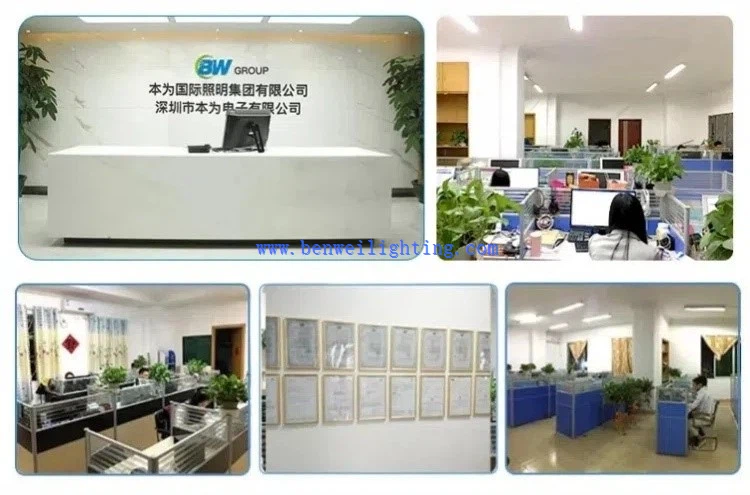
How To Cooperate With Us?
We are happy to have total control over the manufacturing process and the calibre of our products since we have our own facilities. Since we are producers rather than just brokers, we are dedicated to providing our customers with the best pricing. Since we are certain that the price and quality of our products are clear, we invite customers to see our samples first. Our commitment to quality and customer satisfaction drives us to continuously provide top-notch goods.
Our address
3rd Floor, 5th Building, Hebei Industrial Park, Hualian Community, Longhua District, Shenzhen, China