What distinguishes recessed lighting from LED downlights?
LED downlights and recessed lights are two common options in the world of contemporary lighting that frequently lead to misunderstandings among customers, architects, and interior designers. They have different features in terms of technology, design, installation, operation, energy efficiency, and applications, even though the names are occasionally used interchangeably. Planning lighting solutions for commercial, industrial, or residential environments requires an understanding of these distinctions in order to make well-informed selections.

Definition and Fundamental Ideas
LED Dimming
The primary characteristic of an LED downlight is its light-emitting technology. Light-Emitting Diodes (LEDs) are used as the light source, as the name implies. LEDs are semiconductors that, when an electric current flows through them, emit light. LED downlights are made to focus light primarily downward, producing a beam of light that is frequently strong. They are renowned for their long lifespan, energy economy, and capacity to generate a broad spectrum of color temperatures, including cool white, warm white, and, in certain specialist versions, colored light.
Lighting in Recesses
Conversely, the physical design and installation technique of recessed lights characterize them more so than the light source. The housing, the trim, and the lamp-which may be an LED, fluorescent tube, halogen, or incandescent bulb-are the three primary parts of a recessed light fixture. Only the trim is visible from the room below since the housing is set up inside the ceiling hollow. This style is a popular option for modern and minimalist interior designs because it produces a sleek, flush-mount look that reduces visual clutter and may blend in smoothly with the ceiling. Various light sources may be utilized with recessed lights, and if an LED is used for the bulb, the fixture can be classified as both an LED downlight and a recessed light.
Light Source and Technology
Technology for LED Downlights
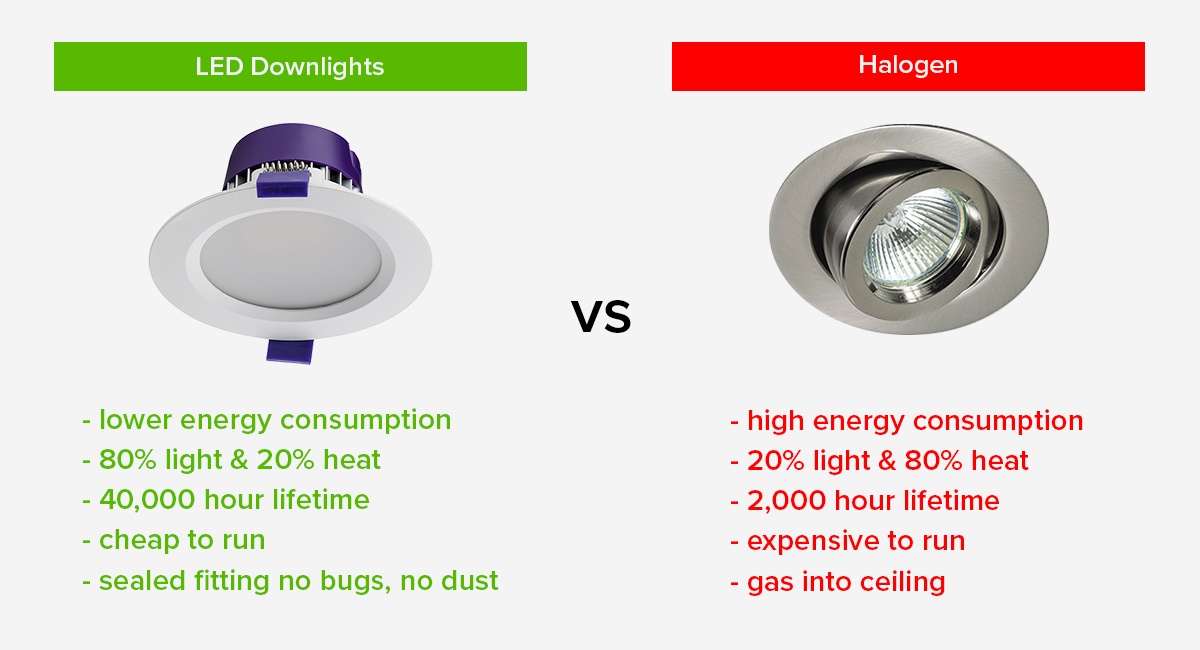
LED downlights make use of LEDs' cutting-edge technology. Unlike conventional incandescent bulbs, which waste a large proportion of electrical energy as heat, LEDs convert a large percentage of electrical energy into light, making them extremely efficient. For example, an LED downlight may convert up to 80–90% of electrical energy into visible light, but an incandescent bulb may only convert 10%. since of their efficiency, LED downlights are safer to operate and less likely to harm nearby materials since they consume less energy and produce less heat.
Additionally, LEDs have outstanding color rendering capabilities. In comparison to natural light, a light source's ability to precisely recreate an object's color is measured by its Color Rendering Index (CRI). A CRI of 80 or above is typical for high-quality LED downlights, and some high-end versions may reach 95 or higher. As a result, items lit by LED downlights seem more vibrant and true to color, which is especially crucial in settings where color fidelity is crucial, such art galleries, retail establishments, and houses.
Dimming the lights is another benefit of LED technology in downlights. A lot of LED downlights can be dimmed, so users may change the brightness to suit their needs or the time of day. By lowering the light output when full brightness is not needed, this function not only improves the atmosphere of a room but also helps save energy.
Sources of Light in Recessed Lighting
A range of light sources can be used with recessed lights. Recessed lights used to frequently employ incandescent bulbs. Although they provide a gentle, pleasant light, they are quite inefficient and only last for 750–2,000 hours on average. An improvement over incandescent bulbs, halogen bulbs employ a halogen gas to recycle the tungsten filament, giving them a little greater efficiency and a longer lifespan (about 2,000 to 4,000 hours).
Recessed lighting also often used fluorescent bulbs, such as linear fluorescent tubes and compact fluorescent lamps (CFLs). Mercury vapor is ionized in fluorescent bulbs to create ultraviolet light, which a phosphor coating transforms into visible light. They are less energy-efficient than LEDs, but more energy-efficient than halogen and incandescent bulbs. Fluorescent bulbs also contain mercury, which needs to be disposed of carefully to avoid contaminating the environment.
Because of its exceptional energy efficiency, extended lifespan (25,000 to 50,000 hours or more), and greater color rendering and dimming capabilities, LED bulbs have emerged as the go-to light source for recessed lights in recent years.
Design and Beauty
Design of LED Downlights
There are many different designs for LED downlights. Some are made to be surface-mounted, meaning that the light source is positioned above the ceiling and shines downward. These might be a suitable choice for retrofit projects with restricted access to the ceiling cavities because they are rather simple to install. Like conventional recessed lights, other LED downlights are made to be installed in recessed spaces. In this instance, only the trim or lens is visible from the room below since the LED module is built within a housing that is mounted inside the ceiling.
LED downlight trims come in a variety of styles, ranging from straightforward, minimalistic to more elaborate and ornamental. While some trims are made of metal, such steel or aluminum, which gives them a sleek, contemporary appearance, others may be made of glass or plastic for a more ornamental impact. The distribution of light can also be affected by the design of the trim; for instance, a baffle trim can lessen glare by obstructing direct views of the light source, whilst a reflector trim can improve light output and more accurately direct light.
Design of Recessed Lights
Recessed lighting is renowned for its understated and simple style. The housing has a clean, flush-mount look since it is concealed inside the ceiling hollow. Because of its design, recessed lights may be used in both classic and contemporary architectural designs. Recessed light trim can be chosen to blend in with the room's overall design. For instance, a trim with a decorative finish, like frosted glass or polished brass, might improve the atmosphere in a more traditional, beautiful home, while a basic, metallic trim would be suitable in a modern, industrial-style loft.
To produce a distinctive lighting effect, recessed lights can also be put in a variety of patterns, such as a random pattern in a living room or a grid pattern in a commercial office environment. Recessed lights are a flexible option for both practical and decorative lighting needs because of their ability to blend into the ceiling and their adaptability in trim design.
Setting up
Setting Up LED Downlights
The kind of fixture determines how LED downlights are installed. Installing surface-mounted LED downlights is not too difficult. The mounting brackets that are usually included may be screwed straight onto the ceiling surface. The LED downlight fixture is attached to the brackets by screwing or clipping it in place, and the electrical connections are then completed.
The procedure is more complicated for LED downlights that are put in recessed lighting. First, a hole in the ceiling must be made in accordance with the fixture housing's dimensions. After that, the housing is put into the hole and fastened there, commonly with screws or spring clips that fasten to the ceiling joists. The LED module or bulb is placed inside the housing after it has been mounted, and the trim is then fastened. It is advised that a certified electrician do this procedure, particularly for safety concerns, as it frequently calls for access to the attic or ceiling cavities above the installation location and may include working with electrical wire.
Setting Up Recessed Lighting
When utilizing LED bulbs as the light source, installing recessed lights is comparable to installing recessed LED downlights. However, there may be further factors to take into account if utilizing different light sources, including fluorescent or incandescent bulbs. For instance, a ballast may be necessary for fluorescent recessed lights in order to control the electrical current, and it must be fitted properly.
Marking the holes in the ceiling and figuring out where the recessed lights are located is the first step. For the holes to fit the housing properly, precise cutting is essential. The housing is placed into the ceiling cavity and fastened once the holes have been cut. After that, the trim is put on and the proper light source is placed. Recessed lights require careful handling of electrical components, just as LED downlights, and expert installation is frequently advised.
Light Distribution and Functionality
Functionality of LED Downlights
When it comes to distributing light, LED downlights are quite practical. Their ability to generate varying beam angles dictates how broad or narrow the light spread will be. With beam angles ranging from 15 to 30 degrees, narrow-beam LED downlights are perfect for accent lighting applications, which call for a concentrated light beam to draw attention to a particular object, such a sculpture, artwork, or shop display. For general illumination in smaller areas, such a closet or bathroom, medium-beam downlights with beam angles between 30 and 60 degrees are appropriate. With beam angles of 60 degrees or more, wide-beam downlights may cover a wider area and are frequently utilized in bigger spaces or places that need more diffused lighting.
Additionally, a lot of LED downlights include heads that can be adjusted, enabling users to aim the light in various directions. This capability is especially helpful in areas where lighting requirements may vary, such a home office where light may need to be focused on a desk or a reading nook.
Functionality of Recessed Lights
The light-distribution properties of recessed lights can also vary based on the trim and light source. Recessed lights, like certain LED downlights, may provide a more intense and focussed beam of light when a reflector trim is applied. Accent lighting or task lighting may benefit from this. A diffuser trim, on the other hand, can be used to soften the light output and provide a more uniform and ambient lighting distribution in the space.
Recessed lights are frequently combined to give a room general lighting. For instance, to make sure that the whole space is well-lit in a big living room, a grid pattern of recessed lights can be put. However, recessed lights may produce harsh shadows or inconsistent illumination in some places if trims and light sources are not carefully chosen.
Cost and Energy Efficiency
Cost and Energy Efficiency of LED Downlights
Because LED downlights use very little energy, they may save a lot of money over time. LED downlights use a fraction of the energy and produce the same amount of light as incandescent or halogen downlights. For instance, an 8 to 10-watt LED downlight that offers comparable brightness can be used in place of a 60-watt incandescent downlight. In addition to lowering electricity costs, this energy conservation also lessens the total demand for energy on the power system, which promotes environmental sustainability.
LED downlights are often more costly up front than conventional incandescent or halogen downlights. But the longer lifespan and energy savings make up for the greater initial cost. LED downlights reduce the need for regular replacements, which lowers maintenance expenses, because they may last up to 50,000 hours or more. Additionally, as less heat needs to be evacuated from the space, LED downlights' lower heat output might result in lower air conditioning expenses.
Cost and Energy Efficiency of Recessed Lighting
The light source that is employed has a significant impact on the cost and energy efficiency of recessed lighting. Because of their high energy consumption and limited lifespan, incandescent and halogen recessed lights are less energy-efficient and therefore more costly to operate. Although they are still less energy-efficient than LED-based recessed lights, fluorescent recessed lights are more energy-efficient than halogen and incandescent ones.
LED-based recessed lights combine the energy-saving advantages of LEDs with the elegant appearance of recessed lighting. The long-term energy and maintenance savings make them a cost-effective option, even if they could cost more up front than fluorescent or incandescent recessed lights.
Uses
Applications for LED Downlights
There are many different uses for LED downlights. When concentrated task illumination is needed over counters and cooking areas, they are frequently utilized in kitchens in domestic settings. LED downlights may be utilized in bedrooms for both general lighting and accent lighting to draw attention to ornamental or architectural details. Because their moisture-resistant variants can give bright, steady illumination, they are also popular in restrooms.
LED downlights are frequently used in commercial settings to offer effective and pleasant lighting in workplaces, art galleries, and retail establishments to emphasize merchandise. They are appropriate for establishing certain ambiances and satisfying the various lighting requirements of various business settings due to their capacity to generate a variety of color temperatures and beam angles.
Applications of Recessed Light
Additionally, recessed lights are utilized in both business and residential settings. They are frequently used to create general ambient lighting in living rooms, dining rooms, and corridors in homes. They are a popular option for open-concept floor designs when a continuous ceiling effect is required due to their inconspicuous nature. Recessed lights can be put in huge quantities to provide consistent and effective illumination in commercial facilities, such as offices, hotels, and restaurants.
In conclusion, there are clear distinctions between LED downlights and recessed lights in terms of technology, design, installation, functioning, energy efficiency, and applications, even if they do have certain similarities, particularly when looking at LED-based recessed lights. Recessed lights are distinguished by their installation technique and simple design, but LED downlights are distinguished by their sophisticated LED technology, energy efficiency, and adaptability in light distribution. By being aware of these variations, customers, designers, and architects may choose the best lighting option for a space while balancing cost-effectiveness, energy efficiency, aesthetics, and usefulness.
More detials :https://www.benweilight.com/industrial-lighting/led-stadium-light/ultra-slim-18w-led-recessed-ceiling-downlight.html