There are numerous surface mount device (SMD) varieties available for LED illumination, each of which is designated by a four-digit number. The width of the container is denoted by the first two digits, while its length is denoted by the last two numerals. The efficacy and characteristics of LED lighting are significantly influenced by these SMD varieties. SMD 2835 and SMD 3030 are two of the most frequently employed. For instance, the SMD dimensions of a 3030 LED strip are 3.0mm x 3.0mm. This article will delve into the distinctions between SMD 2835 and SMD 3030, examining their specifications, applications, and benefits.
What are SMD 2835 and SMD 3030?
What does SMD mean?
Let's first understand what SMD is before we get into the specifics. SMD stands for "surface mount device," which is an electronic part that is made to be attached directly to the PCB's surface. A lot of different electronic products use SMD parts, such as LED lighting systems.
With SMD LEDs, you can place a small light-emitting diode right on a PCB without any leads or wires. People like them because they are small, bright, and use little energy.
What does SMD 2835 mean?
The SMD 2835 is a 2.8mm x 3.5mm LED chip that is shaped like a rectangle. There is only one LED chip in each unit because it is a single-chip LED package. These chips are often used in LED lighting goods because they work well, are cheap, and are efficient. In LED strips, light bulbs, and other lighting devices that need a lot of small, efficient LEDs, this style is popular. Many times, SMD 2835 chips are cheaper than bigger, more powerful LED chips because they are easier to make and don't take up as much space.
What does SMD 3030 mean?
The SMD 3030 is a 3.0mm x 3.0mm square LED chip. It is a multi-chip LED package that has several LED chips in one unit, grouped in a grid pattern on a base to improve light output and efficiency. Because they last a long time, use little power, and produce a lot of light, SMD 3030 LEDs are often used in a wide range of lighting devices, from industrial to street to flood to home lighting.
SMD 2835 VS. SMD 3030: Features and Specifications
SMD 2835 and SMD 3030 are the most common LED SMDs. We'll compare these two SMD types' features and technical specs to help you choose.
Resources
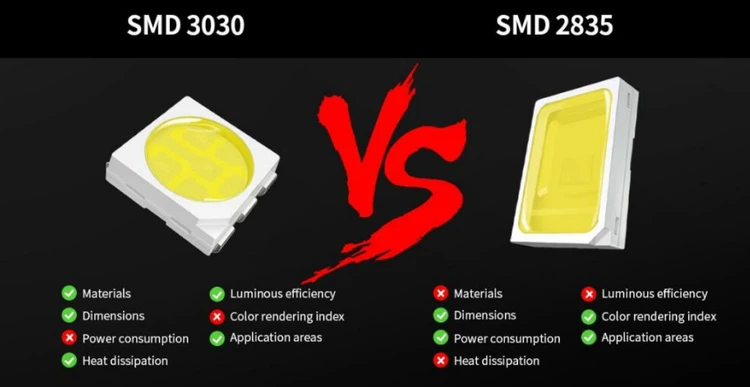
LED patches' quality and durability depend on their materials. The 2835 chip uses a PCT bracket, whereas the 3030 uses an EMC bracket. EMC brackets are created using a die-top approach, which is cheaper, but PCT material has poor fluidity, making injection molding difficult and requiring stamping. EMC can receive 3W, whereas PCT can only get 1W. Therefore, the 3030 chip has better thermal conductivity and temperature resistance than the 2835 chip.
Measurements
SMD LED size is important for installation and compatibility with present lighting fixtures.
SMD 2835 LEDs are small compared to other SMD types, with a typical rectangular size of 2.8 × 3.5 mm. Compact and adaptable, SMD 2835 LEDs may be used in many lighting applications.
In comparison, the SMD 3030LED is larger at 3.0 x 3.0 mm square. They have better cooling and power management but take up more space.
The difference may appear little, but it might affect space-constrained applications.
Use of power
The SMD 2835 is known for its low power consumption. They use less power and operate at lower voltages than other SMDs. This makes them ideal for energy-efficient lighting. Because of their size and brightness, SMD 3030 LEDs may require more electricity.
PCT brackets reflect more than EMC. Most high-efficiency mining and industrial lights, including 200 lm/W types, use 2835 chips.
Effective illumination
Luminosity efficiency is light generated per unit of power. This must be considered while evaluating LED lights.
Due to its 120–150 lumens per watt (lm/W) luminous efficiency, the SMD 2835 can convert electrical energy into light. produces a lot of light for its size and power.
Due to its high luminous efficiency (150–180 lm/W), SMD 3030 LEDs convert electrical energy into light better than SMD 2835 LEDs. Due to their size, they are suitable for floodlights and high-power LED bulbs.
Heat loss
LED lights' lifetime and functioning depend on heat dissipation. If an LED generates too much heat without enough dissipation, its lifespan and performance may suffer. SMD 3030 LEDs dissipate heat better than 2835 LEDs. SMD 3030's larger package size improves heat dissipation, decreasing LED operating temperature and increasing lifetime. SMD 2835's ceramic base effectively transfers heat from the LED chip, ensuring stable operation and extended life.
Color rendering index
A light source's color rendering index (CRI) compares to natural light to determine how effectively it captures an object's color.
Higher CRI is possible with SMD 2835 LEDs, up to 95. Standard CRI is Ra>80, and color tolerance is <5. This shows their excellent color rendering. Ideal for art galleries and shops that need accurate color representation. SMD 3030 LEDs have a CRI of 70–90.
Application areas
SMD 2835 LEDs are utilized in LED bulbs, strip lights, downlights, panel lights, bay lighting, LCD screen backlighting, signage, and automotive illumination due to its compact size and low power consumption.
When selecting LED chips, it's important to understand why the 2835 chip is often the best choice. Below are its key benefits for buyers and designers:
Unmatched versatilityWorks with a huge range of products, including LED strip lights, T8 tubes, panel lights, downlights, and more.
High efficacy & brightnessDelivers outstanding luminous efficiency (120–150 lm/W), for energy-saving performance.
Excellent color rendering (high CRI)CRI up to 95, making it ideal for retail, hospitality, and display applications that demand accurate color representation.
Great cost-performance ratioProvides an excellent balance between performance and cost, perfect for budget-sensitive projects without sacrificing quality.
Stable, widespread supplyAs a well-established, mass-produced standard component, the 2835 chip ensures a reliable supply chain and consistent quality across the industry.
SMD 2835 remains the top choice for applications that require high density, uniform light, strong reliability, and competitive pricing.