

 Elena manages the cold-chain section of a regional supermarket chain, and every winter she dreads the same phone call. It usually comes at five in the morning, right after the defrost cycle: the lamps in the frozen-food aisle are flickering, two have gone out, and a third has a film of water on the inside of its cover. Her team replaced those fixtures only eight months ago. They were ordinary LED strips with a good brochure and a "long life" label, bought because the price per metre looked unbeatable. Each replacement means opening a cabinet at −18°C, emptying a shelf, and paying a technician for an hour of cold-room labour. By the third round of repairs, the cheap strips have cost more than a properly specified cold storage lamp would have.
Elena's problem is not bad luck. A freezer is a hostile place for electronics, and the hostility comes from three directions at once: cold, moisture and the heat that the lamp itself adds. Understanding each one, with real figures, is the fastest way to specify lighting that survives the first winter.
Enemy one: the cold, and what really breaks first
Commercial cabinets cover a wide temperature range. According to the Carbon Trust's commercial refrigeration guide, professional cabinets hold chilled food between −1°C and 5°C and frozen food between −18°C and −15°C, and display cabinets span frozen food at −18°C through chilled food at 5°C and 10°C. Research on retail freezers published by Italy's CNR notes that EU rules specify −18°C for retail cabinets, with fluctuations tolerated up to −15°C or −12°C.
| Application | Typical temperature | Margin above the lamp's −40°C lower limit |
|---|---|---|
| Frozen food display / storage | −18°C (may drift to −15°C or −12°C) | 22°C |
| Chilled food display | −1°C to +5°C | 39°C or more |
| Chilled beverage cabinets | +10°C to +12°C | 50°C or more |
Temperature figures: Carbon Trust (UK) and the CNR frozen-food study linked above. The lamp's rated working range of −40°C to +50°C is taken from the product specification.
The LED chip itself is not the weak point. It is a semiconductor, and a lower junction temperature generally helps rather than hurts: lighting specialists such as OakLED point out that falling junction temperature raises relative luminous flux and slows light decay. The weak point is the driver. Many low-cost drivers rely on electrolytic capacitors, and the same source explains that below about −25°C their performance falls sharply and capacitance drops, which causes start-up faults, flicker or failure to start. A cold-storage lighting guide from Hyperlite adds that a fixture advertised for a wide range may still struggle with cold starts if the driver is not built for it. Cold-start capability and the lamp's rated minimum temperature therefore matter more than the chip brand.
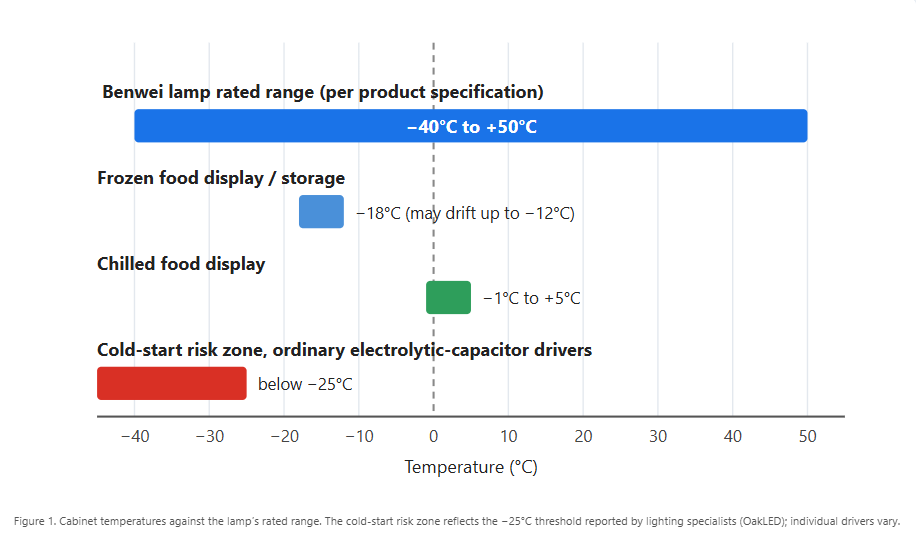
The chart shows why a rated minimum of −40°C is not an academic number. A frozen cabinet at −18°C sits comfortably inside the range, and even a deeper freezer has room to spare, while a driver designed only for "normal" indoor temperatures is already in its risk zone once the air gets colder than −25°C. Door openings, defrost cycles and cabinets that run colder than their setpoint all push real conditions toward the edge of the envelope.
Enemy two: moisture, the silent killer
Frost and condensation are the real reason Elena's lamp had water on the inside of its cover. Every time a cabinet door opens, warm and moist store air gets in. An energy study of supermarket display cases lists moist air infiltration among the main sources of refrigeration load, and the CNR paper links greater air movement to early frosting caused by moisture entering through the cabinet opening. Then the defrost cycle melts that frost, and meltwater and mist land on everything in the case, including the lamp.
This is where an IP rating becomes practical rather than decorative. The IP code comes from IEC 60529, and the two digits mean different things. For IP65, the first digit 6 means dust-tight. The second digit 5 means protection against water jets, tested with a 6.3 mm nozzle delivering 12.5 litres per minute at 30 kPa from about three metres for at least three minutes, as summarised by Bopla and TR Fastenings. Compare that with the neighbouring ratings:
| Rating (2nd digit) | What it is tested against | Nozzle | Water flow | Pressure |
|---|---|---|---|---|
| IPX4 | Splashing water, any direction | Oscillating / spray | ≈ 10 L/min | – |
| IPX5 (the "5" in IP65) | Water jets, any direction | 6.3 mm | 12.5 L/min | 30 kPa |
| IPX6 | Powerful water jets | 12.5 mm | 100 L/min | 100 kPa |
Source: IEC 60529 summaries from the TR Fastenings and Bopla pages linked above. IPX4 flow is the figure quoted for the splash test; check the standard for full test conditions.
In plain terms, an IP65 lamp is tested against a continuous jet of roughly 12 litres per minute from any side, which is far more water than a cabinet's drip, mist and condensation will ever deliver, and it is fully sealed against dust and frost debris. One honest caveat helps you specify properly: IP65 does not mean immersion. Hyperlite's guide also notes that when a lamp switches off in a freezer, the air inside cools and contracts, so the quality of the seals and the cover matters over thousands of cycles. That is why a milky PC cover on an aluminium body, with a continuous sealed structure, is a better choice than a bare strip with open ends.
Enemy three: the heat your lamp adds to the compressor
The third enemy is the least obvious. In a refrigerated cabinet every watt of lighting becomes heat that the refrigeration system must remove. The same OSTI study lists lights among the internal loads that add to the cabinet's refrigeration load while also consuming electricity directly. That means a lamp costs you twice: once on its own meter reading and again at the compressor.
The table below shows the effect for the five power options of the Benwei IP65 LED refrigerator light. We assume 12 hours of lighting a day (4,380 hours a year), an efficacy of 115 lm/W (the middle of the 110–120 lm/W range) and a refrigeration coefficient of performance (COP) of 1.5, which is a simple planning assumption for a low-temperature system.
| Lamp power | Approx. light output | Lamp energy (kWh/yr) | Extra refrigeration energy (kWh/yr) | Total (kWh/yr) |
|---|---|---|---|---|
| 5W | ≈ 575 lm | 21.9 | 14.6 | 36.5 |
| 10W | ≈ 1,150 lm | 43.8 | 29.2 | 73.0 |
| 15W | ≈ 1,725 lm | 65.7 | 43.8 | 109.5 |
| 20W | ≈ 2,300 lm | 87.6 | 58.4 | 146.0 |
| 25W | ≈ 2,875 lm | 109.5 | 73.0 | 182.5 |
Formula: lamp kWh = watts × 4,380 ÷ 1,000; extra refrigeration kWh = lamp kWh ÷ COP (1.5). Real COP varies with the evaporating temperature, so treat the last two columns as a planning estimate.
Under these assumptions, each 1 W of lighting costs about 1.67 W of electricity once the compressor's share is counted. A frozen aisle with twelve 10W lamps would use roughly 876 kWh a year, and a third of that is the refrigeration penalty. This is the real reason efficacy matters in a freezer: a lamp that delivers the same light at a lower wattage saves energy at the lamp and at the compressor. It also explains why choosing the smallest power option that meets the brightness target is better than over-specifying.
What to check before you buy cold storage lamps
Elena's experience suggests a short checklist that applies to any supplier, not only ours:
- Rated minimum temperature and cold-start proof. Ask for the lowest working temperature of the whole lamp, not just the chip, and confirm it starts at that temperature.
- IP65 or better on the finished lamp. The rating must apply to the complete fixture, including cable entries and end caps.
- Power supply that matches the cabinet. Confirm whether your cabinets run on mains or on 24V DC before ordering. This series accepts AC85–220V or 24V DC, so one range can cover both retrofit and new-build projects.
- The right cover and colour. A milky cover softens glare on glass and packaging, and 6000K–6500K cool white with CRI of 80–83 keeps meat, dairy and produce looking natural and fresh.
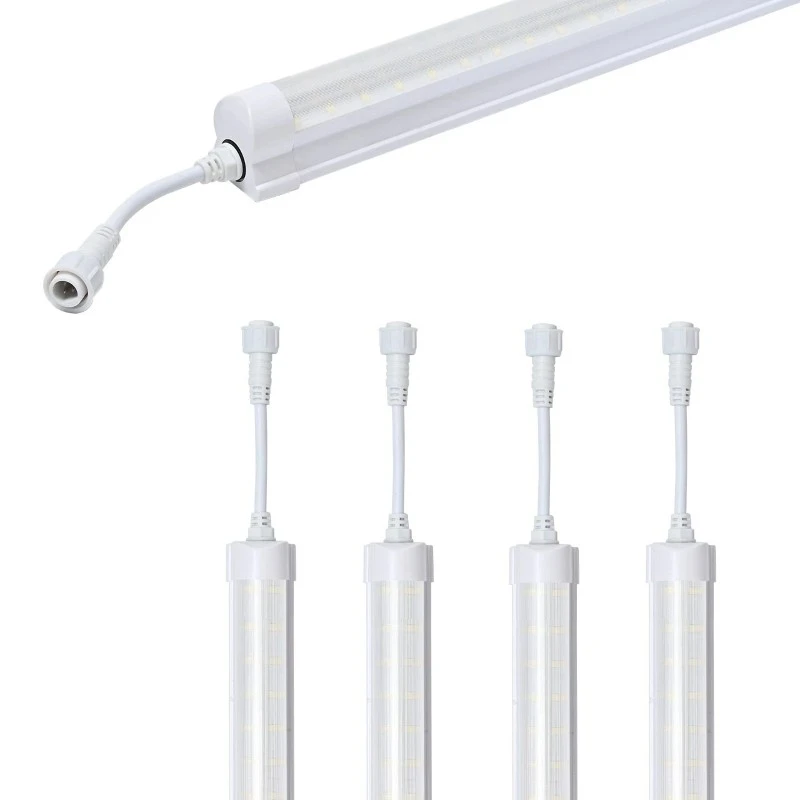
The Benwei LED refrigerator light is built around these points: an aluminium body with a shatter-resistant PC cover, IP65 sealing, 5W to 25W options, a 50,000-hour lifespan and a 3-year warranty. For projects that want a longer warranty or adjustable colour temperature, our freezer lighting model with a 5-year warranty is worth comparing.
Tell us about your cabinets, and we will match the lamp
Every cabinet is different. Door type, shelf depth, lamp position and power supply all change which wattage and length you need. If you send us your cabinet dimensions, operating temperature, supply voltage (AC or 24V DC) and the quantity you are planning, we will recommend a model and prepare a quotation, with sample support for new projects and OEM options for distributors.


