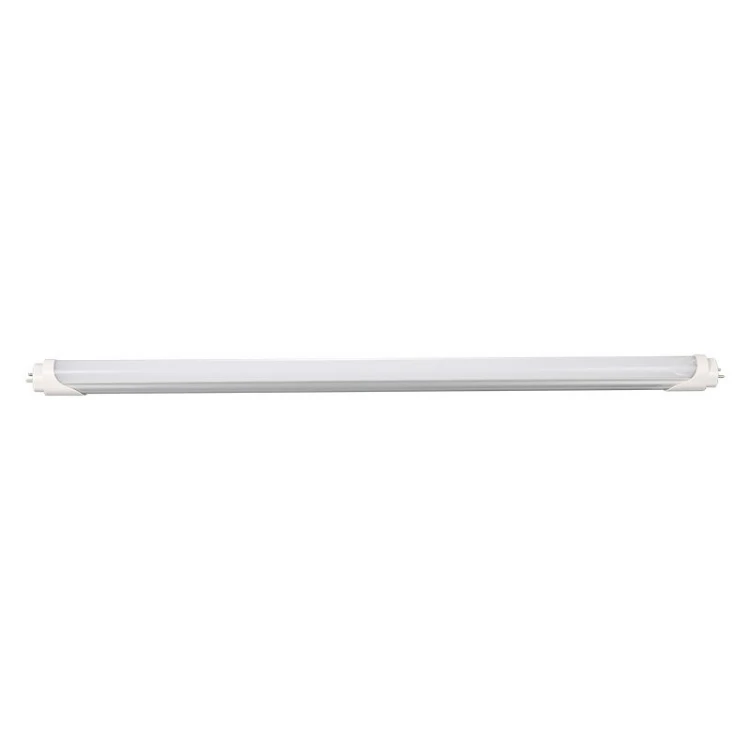
When procuring or selecting LED lighting for commercial projects, a common question arises: are LED tubes with a Color Rendering Index (CRI) of 90 or higher necessarily dimmer and less energy-efficient than standard tubes with a CRI of 80? This concern is not entirely unfounded. Early high-CRI products often suffered from lower luminous efficacy, leading many procurement professionals to believe that "better color rendering inevitably comes at the cost of brightness and energy efficiency." However, technology has advanced significantly in recent years. This article breaks down the issue to help you make more informed decisions during the selection process.
Why is high CRI often associated with a "sacrifice in luminous efficacy"?
This perception stems from the fundamental operating principle of LEDs. White-light LEDs are typically created by using a blue-light chip to excite a phosphor coating. To achieve a higher CRI, more red-light components must be added to the phosphor mix, resulting in a more complete and continuous spectrum.
The challenge is that the human eye has very low sensitivity to red light-especially deep red light (wavelengths approaching 650nm and above). While this energy improves color accuracy, it contributes very little to perceived brightness and is largely excluded from lumen calculations. Furthermore, red phosphors generally have lower conversion efficiency than yellow-green phosphors and tend to generate more heat.
Therefore, from a physical standpoint, there is indeed a trade-off between high CRI and luminous efficacy; the claim is not merely a fabrication.
How much does luminous efficacy actually decrease?
The key question is: by how much? Taking common T8 LED tubes as an example, the comparison generally looks like this:
Tubes with a CRI of around 80: Luminous efficacy typically ranges from 130–170 lm/W.
Tubes with a CRI of 90 or higher: Luminous efficacy typically ranges from 110–140 lm/W.
In other words, for products of the same grade, a high-CRI version will generally have a luminous efficacy that is 10%–20% lower. This figure can vary depending on the specific LED chip, phosphor composition, and driver design; for precise data, always refer to the manufacturer's test reports. In terms of power consumption, a high-CRI lamp may draw an additional one or two watts to achieve the same level of brightness. While this difference is negligible for a single lamp, it becomes a significant factor in large-scale projects involving hundreds or thousands of units, where electricity costs must be factored into the overall assessment.
The Reality of Brightness (Luminous Flux)
Many people conflate "luminous efficacy" with "brightness," but they are two distinct concepts.
Luminous efficacy refers to the number of lumens produced per watt-a measure of energy efficiency. Brightness (luminous flux), on the other hand, refers to the total number of lumens emitted by the lamp-a measure of how bright the light actually is.
At the same power rating, a high-CRI lamp will typically have a slightly lower luminous flux. For instance, an 18W lamp with a CRI of 80 might produce 2,400 lumens, whereas a version with a CRI of 90 might produce 2,000–2,100 lumens. However, if this is accounted for during the design phase-by selecting a slightly higher-wattage model or increasing the number of fixtures-the actual illuminance can be kept consistent.
Furthermore, a point often overlooked is that under high-CRI lighting, colors appear more saturated and contrasts sharper; consequently, the human eye perceives the space as "brighter" than the raw data might suggest. This distinction is particularly noticeable in settings such as retail displays and restaurants.
Key Factors Influencing the Energy Efficiency of High-CRI Lamps
Even among lamps with a CRI of 90, luminous efficacy can vary significantly between manufacturers, depending on the following factors:
Chip Quality: High-efficiency blue LED chips serve as the foundation; superior chips can help offset some of the energy loss caused by the phosphor layer.
Phosphor Formulation: Advanced narrow-band red phosphors or optimized spectral designs can maintain high performance-such as a strong R9 value-while minimizing energy waste.
Driver Efficiency: The conversion efficiency of the LED driver typically ranges from 85% to 93%; a difference of just a few percentage points directly impacts the overall luminous efficacy of the lamp.
Thermal Management: High-CRI lamps tend to generate more concentrated heat. Inadequate heat dissipation can accelerate lumen depreciation and reduce luminous efficacy over time.
Optical Design: The light transmittance of the diffuser and the light distribution pattern also influence the final luminous efficiency.
Therefore, one cannot simply claim that "high CRI inevitably leads to low energy efficiency." Differences in manufacturing quality often have a greater impact than the CRI value itself.
Scenarios Where Investing in High CRI Is Worthwhile
Not every space requires high CRI lighting. In the following scenarios, the additional cost is generally justified:
Retail (clothing, jewelry, fresh produce): Accurate color rendering directly influences customer purchasing decisions.
Art galleries and exhibition halls: True-to-life color reproduction of exhibits is essential.
Printing, textile, and painting/coating facilities: High precision is required for color matching and quality control.
Medical and beauty/aesthetic clinics: Accurate light sources are necessary for assessing skin tones and tissue conditions.
High-end offices and hotels: Enhanced visual comfort and a premium sense of space add significant value.
Conversely, in areas where color accuracy is less critical-such as warehouses, parking lots, or standard corridors-CRI 80 lighting is sufficient, and the extra expenditure is unnecessary.
Practical Tips for Purchasing High CRI LED Tubes
Look at R9, not just Ra: For a tube with an Ra of 90, the R9 (saturated red) value could be as low as 10 or exceed 50-a difference that significantly affects visual perception.
Demand both luminous efficacy and CRI specifications: Do not rely solely on efficacy figures; verify the CRI value associated with those test results.
Request third-party test reports: For example, an LM-79 photometric test report helps ensure that the stated specifications are accurate and not exaggerated.
Determine power requirements based on actual illuminance needs: Calculate the required lumen output first, then select the product-rather than comparing options based on wattage alone.
Pay attention to color temperature and the spectral power distribution (SPD) curve: Even among products with a CRI of 90, the smoothness of the spectrum can noticeably affect how light is perceived.
Consider lumen depreciation and warranty: A high-quality, high-CRI LED tube should maintain a high lumen maintenance rate even after 30,000 hours of operation.
Conclusion
Returning to the initial question: Do high-CRI LED tubes compromise brightness or energy efficiency?
The answer is: There is a slight trade-off, but it is generally not as significant as many people assume. Compared to similar products, the luminous efficacy is typically 10%–20% lower, and the luminous flux may also be slightly reduced; however, with proper component selection during the design phase, the desired lighting performance can still be fully achieved.
More importantly, this "trade-off" results in more accurate color reproduction and a superior visual experience. For environments where color precision is critical, this is well worth it; for more general applications, you can weigh the benefits based on your specific needs. Choosing the right supplier and focusing on key technical parameters is far more important than fixating solely on the CRI figure itself.
Are you looking to select the right high-CRI LED tubes for your project?
We offer LED tubes with CRI ratings of 80, 90, and 95+. Based on your specific application, illuminance requirements, and budget, we can provide a solution that balances luminous efficacy with color rendering-complete with LM-79 test reports and product samples.
Please leave a message or send us an email with details about your project type and the required quantity. We will respond within 24 hours with a quote and technical recommendations.
https://www.benweilight.com/lighting-tube-bulb/special-t8-led-tube/high-cri-t8-led-97ra-95ra.html