Why Does 395nm Look Brighter, but 365nm Is the True "Deep Ultraviolet" King?
With the increasing popularity of UV LED applications – from curing, counterfeit detection, to medical testing – the two wavelengths 365nm and 395nm are often compared. Many first-time users notice that 395nm LEDs appear significantly brighter to the naked eye and are cheaper, while 365nm LEDs look dimmer and cost more. Is this a matter of "brightness" illusion or the truth about wavelength? This article explains the core principles of UV LED selection from three perspectives: human vision, chip physics, and practical application efficiency.
1. Wavelength Defines "Identity": UVA vs. Visible Light Boundary
According to the CIE (International Commission on Illumination), ultraviolet is divided into UVA (315–400nm), UVB (280–315nm), and UVC (200–280nm). Both 365nm and 395nm fall under UVA but are very close to the visible light boundary.
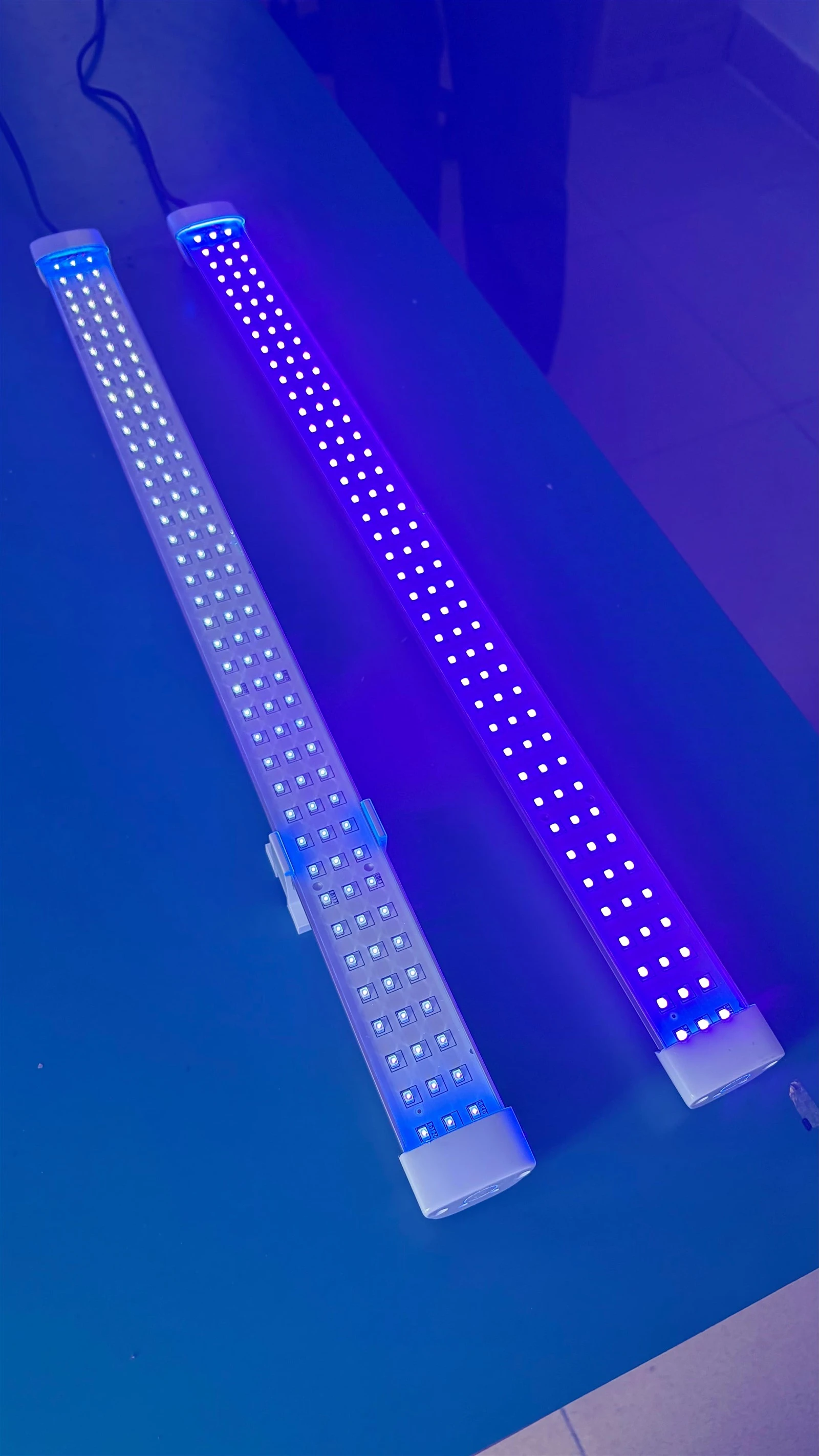
- 365nm: A typical long‑wave ultraviolet. The human lens is almost opaque to light below 400nm, so only a tiny fraction (<1%) of 365nm light is perceived by the retina, appearing as a faint blue‑white glow.
- 395nm: Falls into the transition zone between UV and visible light. Its spectrum naturally extends to about 410nm, which falls into the visible violet range, making it clearly visible as a bright purple light.
Terminology reminder: True "ultraviolet" light is generally considered to be below 380nm. A 395nm LED emits a significant amount of visible violet light; strictly speaking it should be called a "near‑UV / violet LED", though the market often groups it under UV LEDs.
2. Core Technology Difference: External Quantum Efficiency (EQE) Determines Intrinsic Performance
Why are 365nm LEDs more expensive and harder to make in high power? The answer lies in the LED chip's material system and luminous efficiency.
| Parameter | 365nm LED | 395nm LED |
|---|---|---|
| Core material | AlGaN (high Al composition) | InGaN (low In composition) |
| External quantum efficiency (EQE) | ~30–45% | ~70–80% |
| Typical drive current | 350mA (mainly low power) | Can exceed 3A (high power) |
| Package thermal resistance | High, demanding heat dissipation | Lower, relatively forgiving |
| Cost (same power) | 3–5× that of 395nm | Low |
Explanation: EQE reflects the efficiency of converting electrical energy into optical energy (including invisible UV). 365nm requires high‑Al‑content AlGaN, which is difficult to grow and contains many defects, leading to significant non‑radiative recombination and lower efficiency. In contrast, 395nm is an extension of the mature InGaN blue LED technology, with well‑established processes, high yield, and easily achieves high efficiency.
3. "Visible Brightness" Is Not Equal to "UV Output Intensity"
This is the most common misunderstanding in the industry. Users often judge UV lamp performance by their eyes and mistakenly think that a brighter 395nm product is "more powerful".
The truth:
- A 3W 365nm LED may have a UV radiant flux (in mW) of only about 300mW, the rest being converted into heat.
- A 3W 395nm LED may achieve a total radiant flux of 1000mW, but about 600mW of that is actually visible violet light.
Conclusion: Although the total radiant power of a 395nm LED is higher, the proportion of "effective UV" that triggers fluorescence or initiates photopolymerization is very low. In applications requiring pure ultraviolet (e.g., anti‑counterfeiting detection, precision coating curing), the visible light from a 395nm source can cause misjudgment or incomplete curing.
4. Application Scenarios Decide the Choice – No Absolute Winner, Only the Right Fit
✅ Choose 365nm when:
- Fluorescence detection / counterfeit detection / forensics: Requires high contrast and minimal visible light to avoid masking weak fluorescent signals. 365nm maximally excites fluorescent materials while keeping the background extremely dark.
- UV curing adhesives (UV glue): Many photoinitiators have their peak absorption near 365nm. Using 395nm may result in insufficient cure depth or a tacky surface.
- Semiconductor / precision cleaning: Requires no visible light contamination to avoid accidental exposure of photosensitive materials.
- UV radiometry / calibration: As a standard UV source.
✅ Choose 395nm when:
- General UV glue curing (non‑precision): When cure depth and precision are not critical, 395nm offers obvious efficiency and cost advantages.
- Stage blacklight / special effect lighting: Needs an eye‑catching violet ambiance while still exciting some fluorescent materials (e.g., fluorescent paints).
- Plant supplemental lighting (inducing disease resistance): Some plants respond to light in the 390–400nm range, and 395nm provides high efficiency with low heat.
- Photocatalysis / air purification: Photocatalysts like TiO₂ respond to the entire UVA band, so 395nm works well at lower cost.
5. Selection Pitfall Guide
- Don't be fooled by "brightness": Check the datasheet's "radiant flux (mW)" and "peak wavelength (nm)", not "luminous flux (lm)". For UV LEDs, luminous flux is almost meaningless.
- Confirm the center wavelength tolerance: Low‑end 395nm LEDs may actually peak at 405nm – well into the visible range, losing UV functionality. Choose reputable suppliers or ask for a spectral test report.
- Pay attention to thermal management: Although a single 365nm chip may not be high power, heat is concentrated. An aluminum PCB + active cooling is essential, otherwise efficiency drops sharply. High‑power 395nm chips also need good heat sinking.
- Cost‑benefit trade‑off: If the application does not demand high UV purity, 395nm can significantly reduce BOM cost. If 365nm is absolutely required, consider using an array of small‑power chips or add a bandpass filter.
6. Future Trends: The Evolving Boundary Between Longer‑Wavelength and Shorter‑Wavelength UVA
With ongoing improvements in AlGaN material technology, the efficiency of 365nm chips is gradually increasing (some manufacturers already achieve >60%), and costs are falling. Meanwhile, 395nm LEDs can incorporate phosphors or optical filters to suppress visible light components, moving them closer to "365nm‑like" functionality. However, due to fundamental differences in material systems, both wavelengths will coexist for the foreseeable future.
Summary
A 395nm UV LED looks brighter because it emits a large amount of visible violet light along with ultraviolet. A 365nm LED looks dim because it concentrates its energy into a band that the human eye cannot see. In the field of UV LED technology, understanding the difference between "brightness" and "radiant intensity" is the first step in making the right choice. We hope this article helps you make a science‑based decision – whether you need a "visible effect" or the "invisible power of UV" – for your real‑world application.