Picture two identical guest rooms on the same corridor. Same bed, same carpet, same ceiling height. In the first, the downlights are a cool 4000K; in the second, they are a warm white. A guest who opens each door for ten seconds will rarely be able to explain the difference, yet most will say the second room feels more expensive, more private and somehow quieter. Hoteliers have known this for decades, which is why "warm white" appears in nearly every hospitality lighting brief.
The guest never sees the downlight. They only feel what it does to the room.
The trouble starts when a brief that says "warm white" reaches a purchasing desk. Warm white can mean anything from 2200K to 3500K, from 1,000 to 4,000 lumens, and from CRI 70 to CRI 95. This article puts numbers behind the phrase so that a buyer, a designer and a contractor can all be talking about the same light.
What the published guides actually recommend
There is no single global rule for hotel colour temperature, but the specification guides used by hospitality designers are in broad agreement. The table below summarises figures from Naura Dika's hotel lighting specification guide, Homestyler's hospitality lighting article and Relight Depot's hospitality guide.
| Hotel zone | Colour temperature | Illuminance | Min. CRI |
|---|---|---|---|
| Guest room, general light | 2700K–3000K | 150–300 lx | 90 |
| Bedside reading | 2700K–3000K | 300–500 lx | 90 |
| Bathroom vanity | 3000K–3500K | 400–600 lx | 90 |
| Corridor | 3000K | 100–150 lx | 85 |
| Lobby, ambient layer | 2700K–3000K | 200–300 lx | 85–90 |
| Restaurant dining | 2700K–3000K | 150–200 lx (intimate) / 300–400 lx (casual) | 90–95 |
Values compiled from the three guides above. Guides differ at the margins; some give 50–100 lx for general guest-room light, so always confirm with the project's lighting designer.
Two things stand out. First, nearly every guest-facing space lands between 2700K and 3000K, which is the band most people describe as "warm white". Second, the illuminance column is surprisingly low: a corridor needs only 100–150 lx, and a lobby 200–300 lx. Hotels feel luxurious partly because they use less ambient light, spread more evenly, with higher quality. That is also why dimming matters; the same fixture has to serve a bright housekeeping pass and a dim evening mood.
The number that quietly pays for the project
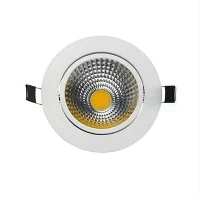
Colour temperature creates the mood, but efficacy decides whether the hotel can afford to light it for 24 hours a day. Halogen downlights were the traditional warm source, and their efficacy is low. A US Department of Energy note puts halogen incandescent lamps at roughly 15–20 lm/W, and the US Energy Information Administration gives about 20 lm/W for a typical halogen. The Benwei warm white downlight is specified at 140 lm/W, seven times the halogen figure.
To see what that means in practice, take one light point that needs 1,000 lumens and be generous to the halogen by using the top of its efficacy range (20 lm/W):
| Annual energy per light point (1,000 lm) | Halogen, 20 lm/W (50 W) | LED, 140 lm/W (≈7.1 W) | Saving |
|---|---|---|---|
| Guest room, 4 h/day | 73.0 kWh | 10.4 kWh | 85.7% |
| Restaurant or bar, 12 h/day | 219.0 kWh | 31.3 kWh | 85.7% |
| Corridor or lobby, 24 h/day | 438.0 kWh | 62.6 kWh | 85.7% |
Calculated: halogen watts = 1,000 ÷ 20; LED watts = 1,000 ÷ 140; annual kWh = watts × hours × 365 ÷ 1,000. The 20 lm/W halogen figure is deliberately favourable to halogen, so real savings are usually higher.
The saving is constant at 85.7% because it depends only on the efficacy ratio, but its size depends on burning hours. The chart scales the same comparison to a hundred light points, so you can see how quickly the gap opens in the public areas that never switch off.
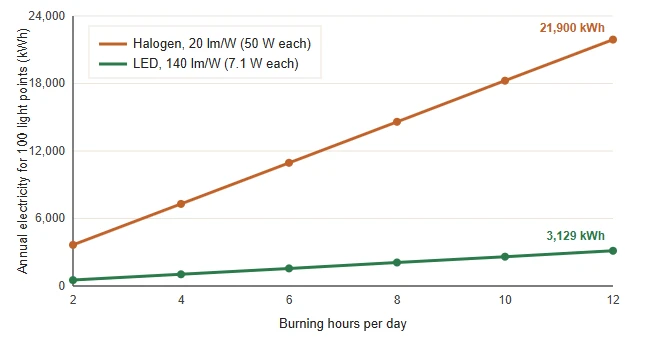
If you run a corridor lighting circuit around the clock, the same hundred points would use 43,800 kWh with halogen and about 6,257 kWh with LED, a difference of roughly 37,500 kWh every year before you count the air-conditioning load that halogen heat adds. It is the quiet reason owners approve a retrofit even when the decorative brief is not their priority.
About temperature and moisture: read the spec for what it really says
Hotels are tougher on fixtures than most buyers expect. One hospitality specification guide notes that hotel fittings see more handling, temperature fluctuation and environmental stress than residential ones. A recessed downlight sits in a ceiling void that can run hotter than the room, while unheated service corridors, entrance lobbies in cold climates and plant-adjacent areas can run colder.
The Benwei downlight is rated for an ambient temperature of −20°C to +50°C, a 70°C window. The low end matters because low-temperature trouble in LED drivers tends to start at the electrolytic capacitors, which OakLED reports lose much of their capacity below about −25°C. A −20°C rating keeps the lamp on the safe side of that figure, and the aluminium body with a PC cover helps carry heat away from the driver on the warm side.
A note on wet areas. This model is specified for indoor use and the product page does not list an IP rating, so it should not be treated as a waterproof fixture. For shower zones, steam rooms, spa areas or open terraces, tell us the location and we will confirm which IP-rated option is suitable rather than guess from the spec sheet. Bathrooms with a ceiling outside the splash zone are usually a conversation about the layout, not just the fixture.
Three questions hotel buyers ask before ordering
- How much light does one downlight actually give?
- At 140 lm/W the power options translate to roughly 700 lm (5W), 1,260 lm (9W), 2,100 lm (15W), 2,800 lm (20W) and 4,200 lm (30W). The model comes in eight sizes from 5W to 30W, so ceiling height and spacing, not wattage alone, should drive the choice.
- Can it be dimmed for evening scenes?
- The product page highlights smooth dimming. Dimming compatibility depends on the controller, so send us the dimmer model or protocol for the project and we will check it on a sample before you commit to a full order.
- What about warranty and maintenance?
- The product is listed with a 50,000-hour life and a 5-year warranty. For a corridor running 24 hours a day, 50,000 hours is about 5.7 years, which is why warranty terms deserve as much attention as the lumen figure.
-

Show us the room, and we will show you the sample
Because warm white is a range and not a single number, the quickest route to a good result is a sample in the actual room. Tell us the zone (guest room, lobby, corridor or restaurant), the ceiling height, the target colour temperature and CRI, the dimming method and the quantity, and we will propose a wattage and a layout. Free samples are available, and our ceiling lighting range includes alternatives if the design calls for a different trim or beam.
Contact the Benwei team through the inquiry page, by email at bwzm88@benweilighting.com. You can also browse completed installations on our project page before you write to us.