When purchasing outdoor LED lights such as street lights, flood lights, wall washers and garden lights, most buyers only focus on one core parameter: IP waterproof rating. They believe high IP65 or IP66 waterproof performance is enough to guarantee long-term stable outdoor operation. However, numerous outdoor lighting project cases show that most outdoor LED failures are not caused by rainwater infiltration. Long-term ultraviolet radiation from sunlight and chemical corrosion from rain, fog, salt spray and industrial exhaust destroy outdoor lamps far faster than water leakage. Waterproofing only prevents liquid water from entering fixtures, while corrosion resistance and UV resistance protect lamps from long-term outdoor environmental aging. This article explains why waterproof protection is never sufficient for outdoor LEDs, reveals hidden outdoor damage risks, and provides an intuitive failure cause chart and full protection comparison table for outdoor lighting selection.
Three Harsh Outdoor Environmental Threats to LED Lights
Indoor LED lights only face temperature fluctuation and stable power grid interference, while outdoor fixtures work in fully exposed harsh environments all year round. There are three major irreversible threats: rainwater moisture, long-term strong UV radiation, and atmospheric corrosive substances including coastal salt spray, industrial acid rain and urban dust.
Standard waterproof structure can block rainwater effectively, but it cannot resist ultraviolet ray aging or electrochemical corrosion. Many high-IP waterproof outdoor lamps still suffer lens yellowing, shell rust, circuit board oxidation and rapid light decay within 1-2 years, simply because manufacturers only add waterproof design but omit anti-corrosion and UV-resistant materials.
Visual Chart: Real Failure Causes of Outdoor LED Lights
This pie chart counts after-sales failure data of 2,800 outdoor LED fixtures working over 2 years, showing the real proportion of different environmental damages:
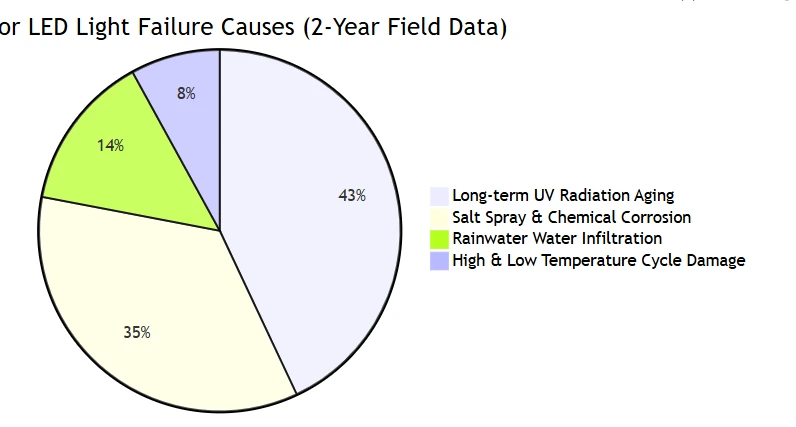
The field data overturns common procurement cognition: only 14% of outdoor LED failures are caused by rainwater leakage. In total, 78% of premature outdoor lamp failures come from UV aging and chemical corrosion. Pure waterproof design solves less than one-fifth of outdoor environmental risks, proving waterproof function alone is far from enough for outdoor lighting systems.
Three Core Protections Comparison Table for Outdoor LED Lights
This table compares working principles, damaged symptoms, material requirements and applicable scenarios of waterproof, anti-corrosion and UV-resistant functions, helping buyers distinguish three key outdoor protections clearly:
|
Protection Type |
Core Protection Function |
Common Damage Symptoms Without This Protection |
Required Premium Materials |
High-Risk Application Scenarios |
|---|---|---|---|---|
|
Waterproof Protection (IP Rating) |
Block rainwater, snow and condensed liquid water from entering lamp interior |
Internal short circuit, driver burnout, water fog inside lens |
Silicone sealing rings, integrated sealed housing |
Rainy areas, snowfield outdoor environments |
|
UV Resistance |
Resist strong sunlight ultraviolet rays to prevent material aging |
Lens yellowing & light transmittance drop, shell fading, material brittleness |
UV-stabilized PC lens, anti-UV outdoor coating |
Open roads, square floodlights, no shade outdoor areas |
|
Corrosion Resistance |
Resist salt spray, acid rain, industrial gas electrochemical corrosion |
Aluminum shell rusting, internal circuit board oxidation, wire corrosion fracture |
Anodized aluminum housing, anti-corrosion spray paint, sealed driving cavity |
Coastal cities, chemical parks, heavy industrial zones |
Specific Hazards of Ignoring UV Resistance and Corrosion Resistance
1. Damage caused by long-term UV exposure
Unfiltered ultraviolet rays in direct sunlight break the molecular structure of plastic lenses and lamp housing materials. Low-quality ordinary PC lenses will turn yellow significantly within one year, reducing light transmittance by 15%-25% permanently. Meanwhile, UV rays accelerate the aging of internal driver rubber wires and sealing rings, leading to hidden waterproof failure even if the initial IP rating meets standards. Unlike sudden water damage, UV aging is slow and invisible, gradually cutting outdoor lamp brightness and overall lifespan.
2. Damage caused by atmospheric chemical corrosion
For coastal projects, sea breeze carries high-concentration salt spray; for industrial zones, acid rain and corrosive exhaust gas are common. These corrosive substances attach to lamp surfaces and penetrate tiny housing gaps. Common unprotected aluminum shells will oxidize and rust quickly, damaging overall heat dissipation structure. More seriously, corrosion erodes internal circuit boards, causing intermittent flicker, unstable current and complete lamp failure eventually. Sealed waterproof design cannot block gaseous corrosive molecules at all.
3. Synergistic aging effect of three environmental factors
Water, UV rays and corrosion do not work separately. Moisture accelerates corrosion speed, and UV radiation makes housing materials more vulnerable to chemical erosion. Once one protection function is missing, the other two protective structures will fail rapidly in a chain reaction. That is why lamps with qualified IP waterproof rating still fail massively in coastal and industrial outdoor environments.
Common Outdoor Lighting Procurement Mistakes
Over-reliance on IP waterproof rating only
Most buyers take IP65/IP66 as the sole outdoor selection standard and ignore anti-UV and anti-corrosion parameters. Manufacturers cater to this market demand by upgrading waterproof sealing while using cheap ordinary lenses and uncoated aluminum shells to cut costs, resulting in short actual service life of outdoor lamps.
Confusing indoor waterproof lights with outdoor dedicated lights
Some purchasers use indoor waterproof LED lamps for outdoor installation to save budget. Indoor waterproof lamps only focus on water resistance, without any UV-resistant coating and anti-corrosion surface treatment, which will age and fail within half a year in open outdoor environments.
Professional Selection Guide for Different Outdoor Scenarios
Ordinary urban outdoor areas (parks, residential roads): IP65 waterproof + basic UV resistance is sufficient, conventional anti-rust aluminum housing meets daily demand
Strong sunlight open areas (squares, stadiums): Must upgrade high-grade UV-stabilized lens to avoid lens yellowing and brightness attenuation
Coastal & heavy industrial zones: Full three protections required: high IP waterproof, full anti-UV treatment, and thickened electrostatic anti-corrosion coating for whole lamp housing
Conclusion
Waterproof protection is only the most basic requirement for outdoor LED lights, not all-round outdoor protection. Long-term ultraviolet aging and atmospheric corrosion cause nearly 80% of outdoor lamp premature failures, far exceeding damage caused by rainwater infiltration. High IP waterproof rating only blocks liquid water, but cannot resist sunlight UV rays and gaseous corrosive substances. When selecting outdoor LED lighting, buyers should comprehensively check waterproof grade, UV resistance and corrosion resistance performance simultaneously instead of only focusing on IP rating. Matching complete three-dimensional environmental protection can maximize outdoor LED lamp lifespan and reduce frequent maintenance and replacement costs for outdoor lighting projects.
Shenzhen Benwei Lighting Technology Co., Ltd.
Tel/WhatsApp: +86 18681294064
Website: www.benweilight.com
Address: 3rd Floor, 5th Building, Hebei Industrial Park, Hualian Community, Longhua District, Shenzhen, China