Why You Can't Just Use Any "Yellow Tube" in a Photolithography Cleanroom
In LED export sales, I often get inquiries like this: "We use yellow light tubes for photolithography/PCB processes - will a regular yellow tube work?"
The answer is: No. And this "no" is likely the hidden reason behind many lithography and PCB customers' persistently unstable yield rates.

Ordinary Yellow Tubes: They Only Look Yellow
Most cheap yellow tubes on the market use a simple approach - applying a yellow-tinted coating on the tube housing or diffuser, so the light appears yellow to the naked eye once it passes through.
The problem is: color can fool your eyes, but it can't fool the spectrum.
This surface-tinting method only filters out part of the visible light spectrum to shift the overall tone toward yellow - it provides essentially no physical blocking of UV and short-wave blue light below 500nm. In other words, the tube looks yellow, but it's still emitting a significant amount of short-wave light that's invisible to the human eye.
Photoresist and dry film are extremely sensitive to light below 500nm. Even minimal residual short-wave exposure, over time, can cause premature exposure of the photoresist, leading to:
- Line width shifts and pattern distortion
- Uneven exposure
- Poor batch-to-batch consistency, making root-cause tracing difficult
Many factories report "yield fluctuates for no clear reason" - and in many cases, the real cause is simple: the workshop is using tinted yellow light, not genuine anti-UV yellow light.
What Actually Makes a True Anti-UV Yellow Tube Different?
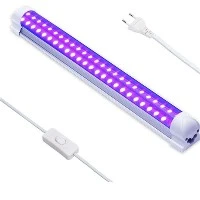
Take our T8 Yellow LED Tube – Anti-UV as an example. The key difference from ordinary yellow tubes isn't "how yellow it looks" - it's whether short-wave light is physically blocked rather than just visually dimmed.
1. Physical Filtering, Not Surface Tinting
This tube uses a special optical-grade tube material that physically blocks 100% of wavelengths below 500nm, rather than relying on surface coloring to change the visual appearance. Whether it's UV or short-wave blue light, it's genuinely filtered out before reaching the work surface - not just "reduced."
2. Stable Dominant Wavelength Around 590nm
The dominant wavelength is controlled at around 590nm - the wavelength range widely recognized as safe for photolithography and PCB yellow-light rooms, effectively preventing accidental exposure of photosensitive materials.
3. Spectral Test Reports Available
Since lithography workshops require high consistency in light sources, we support batch-by-batch spectral sampling and can provide test reports for process validation and supplier auditing.
4. Plug-and-Play, No Major Rewiring Needed
The tube uses a standard G13 base and fits existing T8 fixtures. In most cases, it can be installed directly without major rewiring. Both single-end powered and integrated aluminum housing versions are available to match your existing wiring setup.
5. Fully Certified for Export
For EU and other export markets, we can provide LVD, EMC, RoHS, and DoC (Declaration of Conformity). ErP test documentation is also available upon request, to support customs clearance and end-customer audits.


The Bottom Line
An ordinary yellow tube solves the question of "does it look yellow enough?"
A true anti-UV yellow tube for lithography/PCB use solves the question of "does it actually protect photosensitive materials from unwanted exposure?"
For precision manufacturing environments, this isn't an optional upgrade - it's a direct factor in your yield and process stability.
If your facility is currently using yellow tube lighting but experiencing unstable yield or unexplained exposure issues, it's worth checking one thing first: is your current tube genuinely anti-UV, or just tinted yellow?
We can recommend the right specification - wattage, tube length, and installation type - based on your workshop's lux requirements, and provide a spectral test report for reference. Free samples are also available for side-by-side testing.
Feel free to send us your requirements (wattage range, tube length, installation type), and we'll get back to you with a quotation and technical proposal within 24 hours.