Certainly! The choice between 365nm and 395nm UV light depends heavily on your specific application, as each wavelength has distinct properties that make it suitable for different tasks. Here's a detailed comparison to help you decide which is better for your needs:
Technical Comparison at a Glance
| Aspect | 365nm UV Light | 395nm UV Light |
|---|---|---|
| Wavelength Type | UVA (closer to UVC) | UVA (closer to visible light) |
| Energy Level | Higher energy | Lower energy |
| Penetration Depth | Deeper penetration into materials | More suitable for surface applications |
| Visible Light Emission | Minimal visible light, appears dimmer to the naked eye | More visible purple/blue light |
| Heat Output | Generally low, but can be higher than 395nm in some systems | Lower heat output, "cooler" operation |
| Common Applications | Fluorescent inspection, deep curing, forensic analysis | Surface curing, printing, counterfeit detection |
| Cost | Typically more expensive | Generally less expensive |
Detailed Analysis
1. Energy and Penetration
365nm UV Light: Emits higher-energy photons. This allows it to penetrate materials more deeply and is more effective at exciting a wider range of fluorescent materials. This makes it superior for applications like detecting hidden cracks, deep-layer curing of specific resins, and authenticating security features that require high sensitivity .
395nm UV Light: Its longer wavelength means lower energy and less penetration. It's easily absorbed at the surface, which is actually beneficial for tasks like curing UV inks and adhesives without affecting underlying layers .
2. Application-Specific Suitability
Fluorescence & Inspection: For critical inspection tasks (e.g., forensic investigation, quality control detecting material defects, or authenticating documents and currency), 365nm is often the preferred choice. Its higher energy excites a stronger and broader range of fluorescent responses, making hidden details easier to see .
Industrial Curing: The best choice depends on the material's cure requirements.
Choose 365nm for deep curing of high-performance adhesives, coatings, or resins used in electronics and medical device manufacturing, where maximum penetration and bond strength are critical .
Choose 395nm for efficient surface-level curing, such as in printing, varnishes, and bonding plastics. Its closer proximity to visible light also offers a safety benefit, as the visible purple glow helps operators align the light source correctly and avoid direct exposure to the "invisible" more harmful UV 369.
Specialized Fields:
Beauty & Skincare: Some professional skincare devices use low-power 365nm light for its purported antibacterial effects to target acne-causing bacteria and aid in skin analysis by revealing subsurface skin issues like excess oil or pigmentation .
Medicine & Biology: 365nm is commonly used in scientific and medical settings for DNA analysis, blood stain detection, and observing biological samples under fluorescence microscopy .
3. Cost and Efficiency
395nm LEDs are generally less expensive to manufacture and are often the more cost-effective choice for high-volume, less specialized applications like basic curing and printing .
While 365nm LEDs might have a higher initial cost, they provide unmatched value for specialized, high-precision applications where their performance is essential .
4. Safety Considerations
Both wavelengths are in the UVA spectrum and pose similar potential risks with prolonged, unprotected exposure, such as skin damage and eye irritation. 365nm, having higher energy, may pose a marginally greater risk.
Crucially, 395nm light's visible purple glow acts as a natural warning, while 365nm's relative invisibility can lead to unintentional exposure if proper safety protocols (e.g., wearing UV-blocking safety glasses and gloves) are not strictly followed .
How to Choose: Which One is Better for You?
The question isn't which is universally "better," but which is better for your specific task.
You should choose 365nm UV light if:
Your work involves scientific research, forensic investigation, or high-security authentication.
You need to cure materials deeply or require the highest energy for a photochemical reaction.
Cost is a secondary concern to achieving the highest level of performance and accuracy.
You should choose 395nm UV light if:
Your primary application is surface curing in printing, coatings, or adhesives.
Cost-effectiveness and energy efficiency are important factors for your project.
The visible light beam is beneficial for operator safety and precise alignment in your setup.
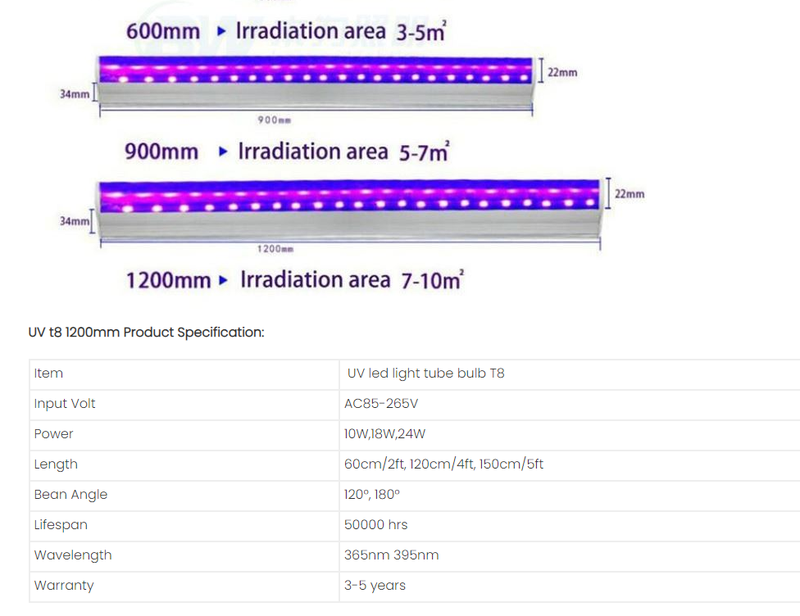
In summary, always base your decision on the specific requirements of the materials and processes you are working with. For tasks demanding high energy and deep penetration, 365nm is superior. For surface-level applications, cost-sensitive projects, and where visible light is an advantage, 395nm is the excellent choice, you can know more information on https://www.benweilight.com/lighting-tube-bulb/high-lumen-t8-led-tube/uv-t8-1200mm.html