If you are searching for "are split-type T8 LED tubes any good" or "integrated vs split T8 LED tube-which is better," chances are you are not specifying lighting for a brand-new build. You probably have a batch of aging fluorescent fixtures waiting for a tube swap. That is the most realistic demand scenario in today's lighting retrofit market: not installing lighting from scratch, but keeping light fixtures that have already served for more than a decade in service while replacing only the light source.
The problem is that many T8 LED tubes on the market are integrated designs-driver built in, whole tube replaced as one unit. They install quickly and look compact, but in retrofit projects this "replace the whole set" logic can make you pay repeatedly for things you do not need. Split-type T8 tubes take a different path: keep the existing fixture, replace only the tube, and use an external driver that can be maintained separately. Which is more cost-effective? The answer depends on your project stage, not on which product is inherently more "advanced."
After Fluorescent Tubes Are Phased Out by Regulation, Do Existing Fixtures Have to Be Torn Out and Reinstalled?
Not necessarily-and in most cases, they should not be. The EU's revised Mercury Regulation has set production and export ban timelines for mainstream linear fluorescent lamps, and the U.S. Department of Energy's 2024 final rule significantly raises the efficacy threshold for general service lamps, with compliance deadlines falling in 2028. This means that in the coming years, a large number of T8 fluorescent tubes still in operation will face a situation where "you cannot buy the original tube anymore," while the fixtures themselves are far from the end of their service life.
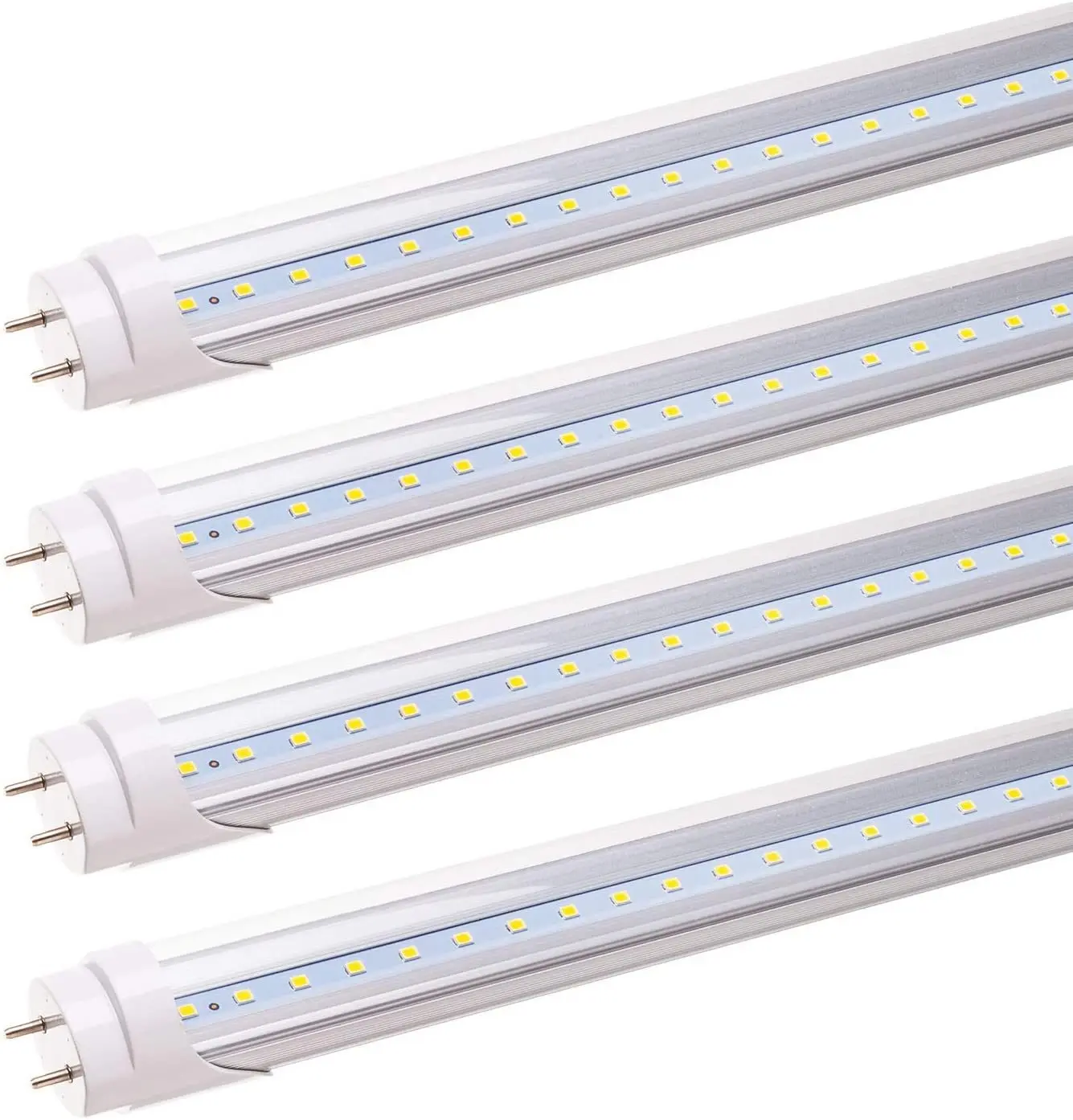
The U.S. market still has 2 billion to 3 billion linear fluorescent sockets in operation, heavily concentrated in offices, schools, retail, and industrial spaces. The vast majority of these sockets are embedded in existing fixtures and luminaire housings. For retrofits, the most economical logic naturally favors keeping the fixture and replacing only the light source. Split-type T8 tubes are designed for exactly this logic: G13 bi-pin caps at both ends, direct replacement of the original fluorescent tube, no need to remove the old fixture, shorter retrofit downtime, and no fixture procurement or removal labor. Integrated tubes are convenient for plug-and-play in new-build projects, but in old-fixture retrofits, "whole-luminaire replacement" amounts to prematurely discarding fixture assets that still have a long service life.
Where Exactly Does the Lifespan Gap Between Split-Type T8 and Integrated T8 Come From?
It comes from the location of the driver. Integrated tubes pack the driver inside the aluminum tube cavity. In high-power models, heat is concentrated, and the electrolytic capacitors in the driver sit in a high-temperature environment for long periods, so their lifespan is the first to be discounted. With a split design, the driver is external, so the tube and driver each dissipate heat independently, and thermal stress on both is reduced. Industry data shows that external-driver solutions can achieve roughly 1.5 to 2 times the operating life of internal-driver tubes-not because the LEDs are more durable, but because the heat-sensitive driver components are moved out of the heat source.
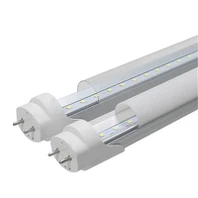
This is even more evident in high-efficacy products. Leading split-type T8 systems now reach the 180 lm/W range. The higher the efficacy, the greater the heat density per unit area, and the more critical the thermal design becomes. Take Benwei's split-type T8 solution as an example: 1.2 mm thick 6063 aluminum housing, 19 mm widened PCB, external driver with Rubycon capacitors, Epistar 2835/5730 chips, nominal efficacy of 180 lm/W, and full certification including CE, RoHS, TUV, ETL, and SAA. Taken together, these specs are essentially trading structure for junction-temperature margin-and junction-temperature margin directly determines the lumen depreciation curve and long-term reliability.
What matters even more is what happens after a failure. When an integrated tube's driver fails, the whole tube is scrapped; with a split design, you can replace the driver alone or the tube alone, so maintenance spending lands precisely on the failed component. For factories, warehouses, or parking garages with hundreds or thousands of tubes, this "component-level maintainability" can save more in O&M costs over five to ten years than the difference in initial purchase price.
Which Projects Suit Split-Type T8, and Which Suit Integrated?
There is no need to set the two against each other. A clearer decision framework is this: new-build projects, shelf and display case lighting, and retail orders that prioritize fast installation and complete delivery are better served by integrated tubes; existing fluorescent fixture retrofits, large-area factory lighting, and projects where long-term O&M cost comes first are better served by split-type retrofit tubes.
Split-type T8's fit is concentrated in the most "practical" segments of commercial and industrial lighting: parking garages, low-bay production facilities and warehouses, supermarkets and shops, stairwells, and corridors. These places share common traits: long operating hours, limited maintenance windows, sensitivity to downtime, and large fixture counts. Under these conditions, a maintenance model of "replace one tube, reuse the fixture" has more operational value than "compact, attractive whole-luminaire replacement." If your project is exactly this kind of existing-fixture retrofit, prioritizing a split-type solution at the specification stage is usually the right call.
Still Looking Only at Electricity Savings for Payback? You May Be Missing the O&M Account
The economics of T8 LED retrofits still hold, but the calculation needs updating. The traditional estimate is the power difference between fluorescent and LED multiplied by operating hours; for split-type solutions, add another layer: fewer maintenance labor hours and lower whole-luminaire replacement frequency thanks to replaceable drivers and replaceable tubes. Industry data shows T8 LED retrofit payback typically ranges from 15 months to 3 years, and can be compressed to under 6 months in high-electricity-price scenarios or where utility rebates are available. But the true total cost of ownership for a split-type solution includes an easily overlooked line item: when the driver becomes an independently replaceable unit, the tube body's "theoretical lifespan" is more likely to be fully realized. LED chips themselves can reach 50,000 hours or more, yet the internal driver's lifespan shortfall often retires the whole luminaire early.
In addition, compliance capability is becoming an entry barrier. DLC listing has become the de facto eligibility gateway for North American utility rebates, and certification testing, ballast-compatibility documentation, and circular-design qualifications are replacing mere assembly scale as the basis for supplier stratification. When choosing split-type T8 tubes, certification completeness and traceability of driver matching deserve as much attention as efficacy figures.
Ask About Project Stage First, Then Product Form Factor
Split-type T8 LED tubes are not "more advanced than integrated." They are simply a form factor that better fits the asset life cycle in a commercial and industrial lighting market dominated by retrofits and long-cycle O&M. After fluorescent tubes are accelerated off the shelves by regulation, the tube left in the fixture needs to withstand the ledger test of the next decade. If your project is an existing-fixture retrofit with large tube counts and tight maintenance windows, split-type T8 deserves priority evaluation; if it is a new-build or fast-delivery order, integrated still has its efficiency advantages. Before choosing, clarifying the project stage will save you more money than agonizing over "which is better."