Introduction: The Hidden Cost of Replacement
The Maintenance Nightmare of High-Bay Lighting
In modern warehouses and manufacturing plants, high-bay fixtures are mounted at elevations of 12 to 15 meters. Accessing these fixtures for maintenance or replacement is a complex, expensive, and hazardous operation. It requires the rental of scissor lifts or bucket trucks, the labor of certified electricians, and the disruption of adjacent production lines.
Industry data consistently shows that the cost to replace a single high-bay fixture-factoring in equipment, labor, and downtime-is typically three to five times the original purchase price of the luminaire itself. Therefore, a fixture that fails in two or three years is not an inexpensive light; it is a recurring financial liability.
The Industry's Open Secret: Lumen Depreciation and Power Derating
Why do so many LED fixtures fail prematurely or become dim within a few years? The answer lies in two widespread industry practices: poor thermal management and power derating.
Cheap fixtures often use low-grade LED chips and generic drivers. To prevent these inferior components from burning out immediately, manufacturers program the drivers to under-drive the LEDs. While this artificially extends the chip's life, it severely compromises brightness. Furthermore, inadequate housing materials (like stamped steel or plastic) trap heat, causing the LED phosphor to degrade and the driver's capacitors to fail. This results in severe lumen depreciation-the gradual fading of light output-followed by total fixture failure.
Redefining Longevity: The Paradigm of the "Lifelong" Fixture
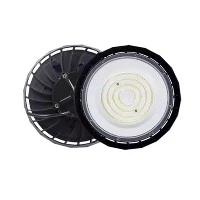
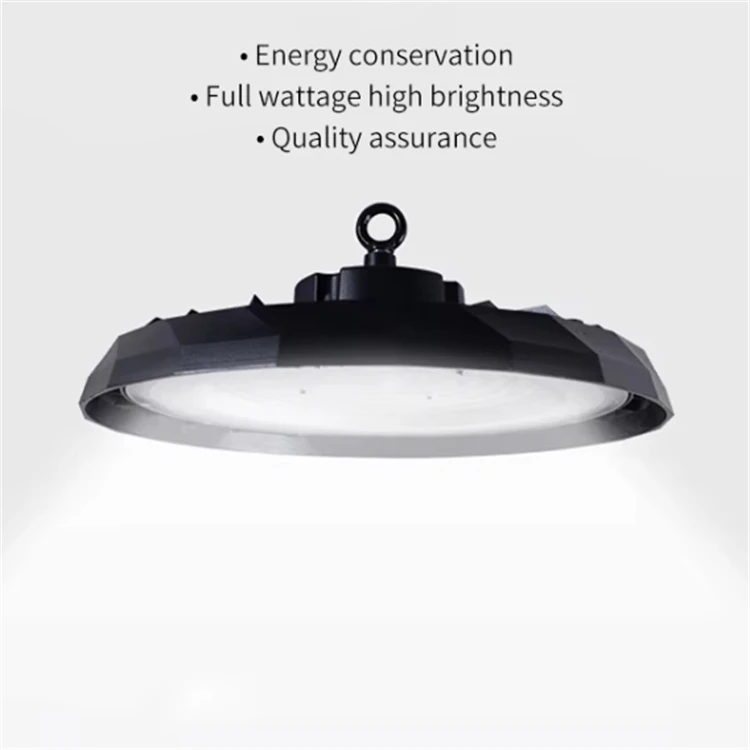
To break this cycle, a premium industrial light must be engineered for absolute endurance. It must deliver High Efficiency (maximizing the lumens produced per watt of electricity) and exhibit Low Lumen Depreciation (maintaining near-original brightness over tens of thousands of hours). This UFO High Bay Light is designed precisely to these specifications, integrating a genuine Philips driver and a monolithic die-cast aluminum housing to achieve an operational lifespan so long that replacement becomes a rarity.
High Efficiency: Maximizing Every Watt
The Physics of Luminous Efficacy (lm/W)
Luminous efficacy is the ultimate measure of a fixture's electrical efficiency. It is the ratio of light output (lumens) to power consumption (watts). The higher the efficacy, the more light you get for every dollar spent on electricity.
This UFO High Bay Light achieves an efficacy of approximately 130 to 140 lm/W. In contrast, legacy metal halide systems operate at 60 to 90 lm/W, and derated budget LEDs often struggle to reach 80 to 100 lm/W. A higher efficacy means the facility can achieve the required illuminance (lux) levels using fewer fixtures or lower wattage, directly reducing the total kilowatt-hour (kWh) consumption.
The Philips Driver: The Core of Electrical Efficiency
The efficiency of the LED chips is only half the equation; the other half is the driver. This fixture utilizes a Genuine Philips Drive Power Supply. Philips drivers are engineered to the highest electrical standards, featuring a Power Factor (PF) of ≥ 0.95 and a Total Harmonic Distortion (THD) of < 20%.
A high Power Factor means that over 95% of the AC power drawn from the grid is converted into usable work, minimizing reactive power waste and avoiding utility penalties. Low THD ensures that the driver does not introduce harmful harmonics back into the facility's electrical network, protecting other sensitive equipment. The driver's advanced topology ensures that maximum electrical energy is transferred to the LEDs, rather than being lost as heat in the conversion process.
Full-Wattage Output vs. The Derating Trap
Many manufacturers mask the inefficiency of their fixtures through power derating. They label a fixture as "150W" but internally configure it to run at 100W to reduce heat and prevent premature failure. This is a deceptive practice that leaves facilities dimly lit and forces them to buy more fixtures.
This premium UFO High Bay Light is engineered for True Full-Wattage Brightness. It draws exactly the specified wattage and drives the high-efficiency LED array at its optimal capacity. There is no hidden derating. The result is a massive, uniform flood of light that meets the advertised lumen output, ensuring maximum energy efficiency per fixture.
The Optical Efficiency of the Circular Array
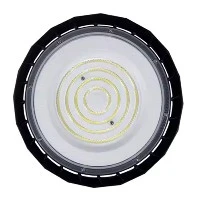
The fixture utilizes a Circular LED Chip Array combined with a high-transmittance PC Lens. The circular layout distributes the light sources across a wide surface area, transforming the fixture into a "surface emitter." The lens is micro-structured to diffuse the light, maximizing transmission while eliminating harsh glare. This optical design ensures that the light is projected deep into aisles and across the factory floor, reducing the number of fixtures required and further enhancing the overall energy efficiency of the lighting system.
Low Lumen Depreciation: The Engineering of Endurance
The "10-Degree Rule" and Junction Temperature (Tj)
The lifespan and brightness retention of an LED are dictated by its junction temperature (Tj). The fundamental rule of LED physics is that for every 10°C increase in operating temperature, the lifespan of the chip is halved, and the rate of lumen depreciation accelerates.
To maintain low lumen depreciation, the heat generated by the LED array and the driver must be rapidly and continuously removed. This is the thermal bottleneck where most budget fixtures fail.
Integrated Die-Cast Aluminum: Zero Interfacial Resistance
This UFO High Bay Light solves the thermal challenge through its Integrated Die-Cast Aluminum Shell (ADC12 alloy). Aluminum features a thermal conductivity of approximately 96-120 W/m·K, which is more than double that of stamped steel and hundreds of times greater than plastic.
Crucially, the housing is a one-piece, monolithic casting. The LED mounting base, the central body, and the exterior fins are molded as a single continuous piece of metal. This eliminates the interfacial thermal resistance (the microscopic air gaps) found in fixtures where the heat sink is bolted onto the housing. Heat flows seamlessly from the LED junction to the exterior environment.
The Chimney Effect: Passive Air Convection Cooling
To dissipate the heat without relying on dust-clogging mechanical fans, the housing leverages the physics of Air Convection Cooling. The exterior features deep, radial fins, and the center of the fixture is hollow.
As the fixture operates, the air inside the central cavity heats up and rises rapidly, escaping out the top (the Chimney Effect). This creates a negative pressure zone that forcefully draws cooler ambient air inward across the deep radial fins. This passive, self-sustaining cooling loop ensures that the LED junction temperature remains exceptionally low, preventing the phosphor degradation that causes lumen depreciation.
The PC Lens: Resisting Thermal Yellowing
The optical lens is also a critical component in the fight against lumen depreciation. This fixture uses a Polycarbonate (PC) Lens rather than PMMA or glass. PC boasts a high thermal tolerance, withstanding continuous temperatures up to 120-130°C.
In a high-wattage fixture, PMMA or cheap plastics will warp, yellow, and lose light transmission over time. The UV-stabilized PC lens retains its optical clarity and dimensional stability over decades, ensuring that the full-wattage light output is transmitted to the factory floor without degradation.
The Result: A Fixture You'll Barely Replace
Understanding L70 and L80 Metrics
The longevity of an LED fixture is measured by its L70 or L80 lifespan. L70 means the fixture retains 70% of its initial brightness. L80 means it retains 80%.
Cheap, derated fixtures often suffer severe lumen depreciation, reaching L70 within 15,000 to 25,000 hours-sometimes within just two to three years of industrial operation. This UFO High Bay Light, thanks to its exceptional thermal architecture, is rated for L70/L80 lumen maintenance beyond 50,000 hours. In a facility operating 12 hours a day, this equates to over a decade of consistent, bright illumination without a noticeable drop in light levels.
The 100,000-Hour Driver
The most common point of failure in an LED fixture is the driver. The Philips Drive Power Supply utilized in this luminaire has a Mean Time Between Failures (MTBF) exceeding 100,000 hours at maximum case temperature. This means the electrical heart of the fixture is designed to outlast the operational planning horizon of the facility. With built-in surge protection (4-6 kV) and intelligent thermal derating, the driver is fortified against the electrical and thermal stresses of industrial grids.
The Elimination of Maintenance Costs
By combining a >100,000-hour driver with a thermally optimized, low-depreciation LED array, the fixture drastically reduces the need for maintenance. The cost of a single lift rental and electrician labor often exceeds $300 to $500. Over a 10-year period, avoiding just one or two replacement events per fixture saves the facility tens of thousands of dollars, making the premium initial purchase price a highly profitable investment.
Procurement Framework: How to Verify Longevity and Efficiency
Demand Verifiable Data (LM-79 and LM-80)
Do not accept marketing claims. When evaluating a high bay light, procurement officers must demand LM-79 and LM-80 test reports.
LM-79 verifies the actual lumen output and efficacy (lm/W) of the fixture. Ensure the actual input wattage matches the labeled wattage.
LM-80 measures the lumen depreciation of the LED chips over time, which is then used in TM-21 projections to calculate the L70/L80 lifespan.
Inspect the Thermal Architecture
To ensure the fixture will maintain low lumen depreciation, inspect the physical construction:
Material: Confirm the housing is integrated die-cast aluminum (ADC12), not stamped steel or plastic.
Design: Look for the hollow central chimney and deep radial fins designed for passive air convection.
Weight: A solid, weighty die-cast housing is a sign of adequate thermal mass, whereas an ultra-light fixture is likely thin-walled and thermally inefficient.
Calculate the Total Cost of Ownership (TCO)
Compare the 10-year TCO of the fixtures being considered, not just the sticker price. Include:
Purchase Price
Energy Costs (Total watts × Operating hours × Utility rate)
Maintenance and Downtime Costs (Lift rental, labor, and lost production)
The premium, high-efficiency UFO High Bay will demonstrate a payback period of 1.5 to 2.5 years, followed by nearly a decade of pure savings and uninterrupted illumination.
Conclusion: The Last Light You'll Ever Need to Buy
In the demanding world of industrial lighting, longevity is the ultimate metric of value. A light that dims quickly or fails prematurely is a costly liability.
This High-Efficiency, Low-Depreciation UFO High Bay Light is the definitive solution to the industrial lighting challenge. By integrating the electrical fortress of a Philips Drive Power Supply, the thermal brilliance of an Integrated Die-Cast Aluminum Housing, and the optical stability of a PC Lens, it delivers uncompromised full-wattage brightness that endures for over a decade.
For facility managers and procurement officers, the choice is clear. You can continue to buy disposable, derated fixtures that demand constant maintenance and drain your energy budget, or you can invest in a luminaire engineered for absolute endurance. Choose this UFO High Bay, and secure a future of brilliant, safe, and highly efficient illumination that you'll barely ever need to think about again.
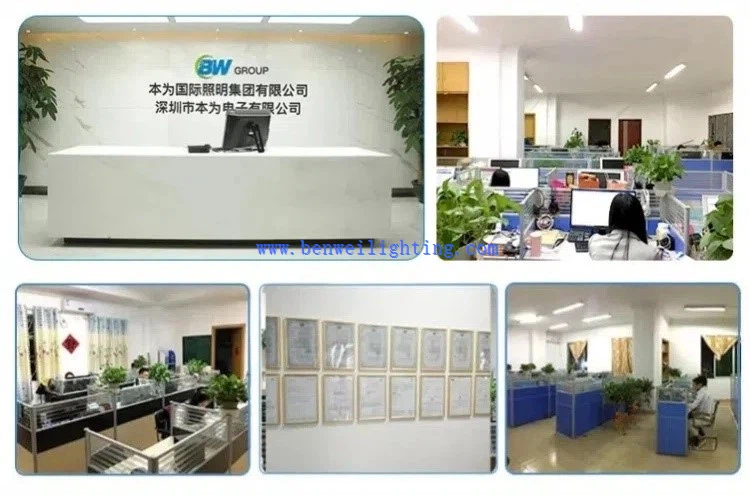
How To Cooperate With Us?
We are happy to have total control over the manufacturing process and the calibre of our products since we have our own facilities. Since we are producers rather than just brokers, we are dedicated to providing our customers with the best pricing. Since we are certain that the price and quality of our products are clear, we invite customers to see our samples first. Our commitment to quality and customer satisfaction drives us to continuously provide top-notch goods.
Our address
3rd Floor, 5th Building, Hebei Industrial Park, Hualian Community, Longhua District, Shenzhen, China