Before buying LED flood lights, here are 8 specifications you should never ignore
LED flood lights are the most widely used outdoor lighting fixtures for building facade illumination, stadium lighting, yard lighting, billboard lighting and industrial area floodlighting. Most international buyers and contractors tend to simplify procurement standards, focusing only on wattage, price and IP rating. However, flood light failures such as lens yellowing, brightness attenuation, flicker, corrosion and short-circuit burnout rarely result from insufficient wattage. Instead, they are caused by ignored hidden parameters and cut-corner configurations. For professional outdoor lighting projects, superficial parameters cannot guarantee long-term stability. This article summarizes 8 non-negotiable specifications for LED flood light procurement, explains common selection mistakes, and provides a visual weight distribution chart and detailed specification checklist to help buyers avoid unqualified products and project disputes.
Why Basic Parameters Are Not Enough for Flood Light Selection
Outdoor flood lights face complex environmental tests including long-term UV radiation, rain erosion, salt spray corrosion, temperature cycles and unstable grid voltage. Simply checking wattage and IP grade can only meet basic waterproof and brightness requirements, but cannot resist long-term outdoor aging. Many low-cost flood lights look identical in appearance but omit core configurations such as high-efficiency drivers, UV-stabilized lenses and anti-corrosion housing treatment, leading to massive failures within 1–2 years. Professional procurement requires full-dimensional parameter verification rather than superficial judgment.
Visual Chart: Weight of 8 Key Specifications for Flood Light Durability
This pie chart shows the impact weight of each specification on the long-term service life and stability of LED flood lights, helping buyers prioritize inspection items:
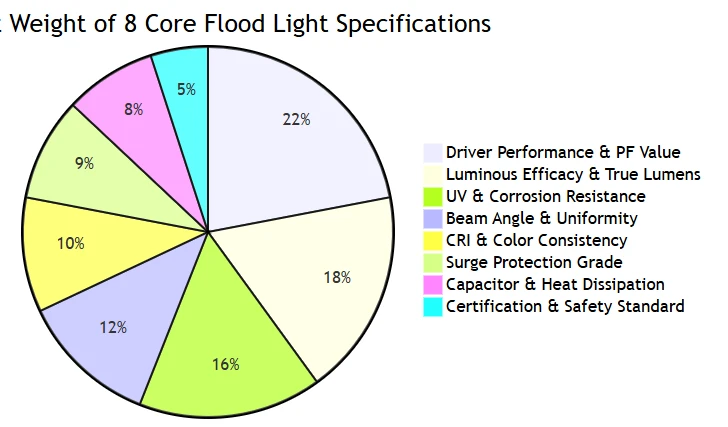
The data clearly shows that driver performance, real luminous efficacy and environmental resistance occupy the largest proportion of product quality. These three hidden parameters determine 56% of flood light lifespan and stability, far more important than visible wattage and appearance.
8 Must-Check Specifications: Full Comparison & Procurement Guide
This table comprehensively explains the definition, qualified standard, common cutting-corner behavior and practical engineering impact of the 8 core specifications, serving as a direct pre-order inspection checklist:
|
No. |
Key Specification |
Professional Qualified Standard |
Common Low-Quality Cutting-Corner Method |
Practical On-Site Consequence |
|---|---|---|---|---|
|
1 |
Driver Type & Power Factor |
Isolated constant-current driver, PF ≥ 0.95, constant current accuracy ±3% |
Non-isolated cheap driver, PF below 0.8, unstable current output |
Severe flicker, rapid light decay, easy burnout under voltage fluctuation |
|
2 |
True Luminous Efficacy & Lumens |
Genuine 130–140lm/W, no virtual power, actual lumen matches label |
Fake high wattage, low efficacy 80–100lm/W, inflated lumen data |
High power consumption but insufficient actual brightness, failing illuminance standards |
|
3 |
UV & Corrosion Resistance |
UV-stabilized PC lens, anti-corrosion electrostatic spray housing |
Ordinary lens without UV protection, thin paint and unprocessed aluminum shell |
Lens yellowing, light transmittance drop, shell rust and oxidation |
|
4 |
Beam Angle & Lighting Uniformity |
Optional precise beam angles (15°/30°/60°/120°), uniformity ≥ 0.8 |
Single universal angle, chaotic light distribution, serious central hotspot glare |
Uneven floodlighting, dark edges, unable to meet large-area lighting requirements |
|
5 |
Color Rendering Index (CRI) |
Ra ≥ 80 for general projects, Ra ≥ 90 for landscape and architectural lighting |
Low CRI Ra 60–70, severe color distortion |
Faded building colors, poor landscape presentation, unqualified commercial lighting |
|
6 |
Surge Protection Level |
≥4KV lightning & surge protection, suitable for unstable outdoor grids |
No surge protection circuit, basic anti-interference omitted |
Easily damaged by thunderstorms and grid spikes, high failure rate in rainy seasons |
|
7 |
Capacitor Grade & Heat Dissipation |
105℃ high-temperature resistant capacitor, thickened aluminum heat sink |
85℃ ordinary capacitor, thin lightweight heat sink with poor heat conduction |
Internal overheating, capacitor aging and bulging, shortened overall lifespan |
|
8 |
Certification & Safety Compliance |
CE, RoHS, FCC compliant, complete safety insulation design |
Fake or expired certifications, insufficient insulation protection |
Customs clearance failure, electric leakage risk, unable for local official use |
The Most Overlooked Flood Light Procurement Myths
1. Higher wattage equals better floodlighting effect
Most buyers prioritize high wattage while ignoring luminous efficacy and optical design. Many high-wattage flood lights have low light efficiency and scattered light distribution, resulting in serious light waste. Low-wattage high-efficiency models with professional beam angle design can achieve wider and more uniform floodlighting effects.
2. IP65 waterproof equals full outdoor adaptability
IP65 only guarantees dust and water splash resistance. Without UV-stabilized lenses and anti-corrosion housing treatment, flood lights will still age rapidly under long-term sunlight and coastal salt spray. Waterproof is only the most basic protection, not the full outdoor protection standard.
3. New-looking appearance means high quality
Suppliers usually retain fine appearance workmanship but cut costs on internal drivers, capacitors and heat dissipation structures. Appearance cannot represent internal configuration. Only verifying core parameters can avoid "beautiful-looking but short-lived" flood lights.
Scenario-Based Parameter Matching Rules for Flood Lights
Landscape & Building Lighting: Prioritize high CRI (Ra≥90), UV resistance and precise beam angle to ensure color restoration and long-term appearance stability.
Stadium & Large-Area Yard Lighting: Focus on uniformity, high luminous efficacy and surge protection to meet long-hour continuous working demands.
Coastal & Industrial Zone Lighting: Must verify anti-corrosion coating, salt spray resistance and full isolated driver to resist harsh environmental erosion.
Ordinary Urban Outdoor Lighting: Standard high PF driver, 105℃ capacitor and IP65 protection are sufficient for stable daily operation.
Conclusion
Purchasing LED flood lights only by wattage, price and IP rating is the main cause of premature failure and project dissatisfaction. The 8 core specifications including driver performance, real luminous efficacy, environmental resistance and optical parameters determine the actual quality, stability and service life of flood lights. For international buyers and engineering contractors, abandoning superficial judgment and adopting full-dimensional parameter inspection is the key to selecting reliable outdoor flood lighting products, reducing after-sales risks and achieving long-term cost-effective lighting solutions.