Introduction: Three Words That Are Also Three Specifications
Why Bright, Dimmable, and Waterproof Are the Real Specification
Catalogue copy describes products in adjectives that no one can verify: premium, advanced, innovative. None of those words can be measured, tested, or rejected. The three words in this title can be. Bright is a photometric claim: it can be checked against delivered illuminance and maintained lumen output. Dimmable is an electrical claim: it can be checked against the dimming curve, the low-end floor, and flicker behaviour. Waterproof is an ingress claim: it can be checked against the IP rating and the sealing construction that produces it.
That is why this collection is introduced through those three words rather than through a list of features. They are the attributes a buyer will actually evaluate on the job, and they are the attributes that determine whether the fixture still performs in year four.
How the Three Words Connect to One Another
The three attributes are not independent. Brightness that is achieved by overdriving the LED at the expense of heat produces a fixture that is dim within two years. Dimming that is achieved with a mismatched third-party driver produces flicker and an unstable low end. Waterproofing that is achieved with a single compressed gasket produces condensation inside the optical chamber once the seal relaxes. In each case the headline claim is true on day one and false by year three.
This collection was engineered so that all three claims hold simultaneously and hold over time - which requires the housing, the thermal path, the driver, and the sealing architecture to be designed as one system rather than as separate features bolted onto a common shell.
Bright: High Lumen Output Without the Glare
The COB Engine and Why Output Density Matters
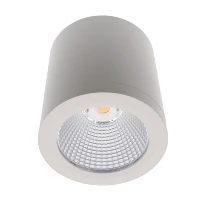
The light engine is a chip-on-board (COB) array, and the choice is deliberate. A COB package concentrates a large number of dies into a single, compact emission area, which allows substantial lumen output from a physically small aperture. In a surface cylinder, aperture size is fixed by the design, so output density is the variable that determines whether a fixture can light a room convincingly at a modest mounting height.
COB architecture also gives the optical designer something a multi-die array does not: a single emission surface that the reflector can control precisely, with no visible LED dots and no colour separation between discrete emitters. The result is a beam that reads as one source rather than as an assembly of sources - a critical difference in fixtures mounted close to the occupant, where individual emitters would otherwise be visible.
The Faceted Anti-Glare Reflector: Brightness You Can Sit Under
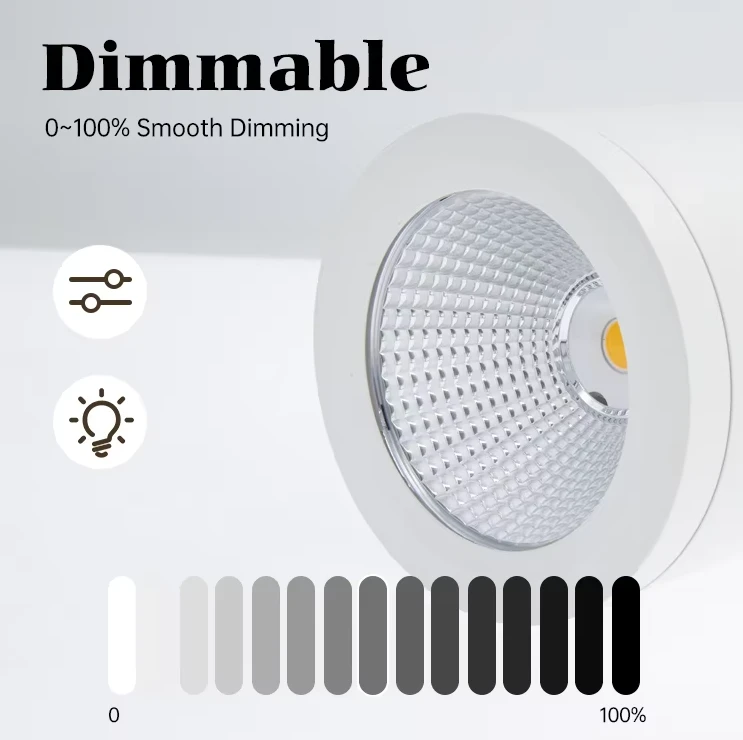
Delivering high output is only half the task. A very bright fixture that puts a hot spot on the floor and a visible emitter in the occupant's eye is not a good product; it is a photometric number that fails the room. Behind the front ring of this collection sits a deeply faceted, metallised reflector cone with a fine prismatic structure, which performs two functions at once.
Optically, the faceting mixes the COB output across the beam so that illuminance is smooth from centre to edge, without striation, colour shadowing, or scalloping on the lit surface. Visually, the depth of the cone sets the emitter back from the aperture so that the source is not directly visible from normal viewing angles. Comfort, in other words, is engineered into the geometry rather than added as a diffuser accessory - and a diffuser would cost light that this collection is explicitly designed to deliver.
Beam Quality, Colour Consistency, and Even Illuminance
Brightness that is uneven is perceived as lower brightness. The human eye adapts to the brightest area in the field of view, so a beam with a hot centre and a soft edge reads as dimmer than an evenly distributed beam of the same average illuminance. That is why the reflector geometry matters as much as the lumen figure: consistent illuminance across the lit surface, and consistent colour temperature across a production batch, are what the occupant actually experiences.
Colour consistency is controlled at the light engine level through binning, which is why units from this collection can be installed side by side in a long corridor without the visible tint differences that appear when fixtures are sourced from different production runs.
Maintaining Brightness Over Time
A lumen figure quoted at commissioning describes the first day, not the fifth year. Brightness is maintained only if the junction temperature is controlled, and that is a function of the housing. The die-cast aluminium body provides a thick, continuous conduction path from the COB substrate to a large external surface, and the cylindrical form presents that surface unobstructed on every side. Surface mounting means the entire body is exposed to room air rather than confined in a ceiling void.
The rated lifespan of 40,000 hours is the expression of that thermal margin. Without it, "bright" is a temporary condition.
Dimmable: 0–100% That Actually Behaves
Why the Low End Is the Real Test
Almost every LED downlight on the market claims dimming. Very few dim well. The difference is almost entirely at the bottom of the range. A fixture that drops out at fifteen percent, steps visibly at ten, flickers below eight, or shifts to a greenish tint as it dims is a fixture that cannot be used in the way dimming is actually used.
In residential, hospitality, and premium retail lighting, the operating point for most of the evening sits between twenty and forty percent output. That range - not the top end - is where the product spends its life. This collection is engineered for continuous, stable control across the full 0–100 percent range, with a usable low-end floor and colour behaviour that remains consistent as output falls.
Driver–Engine Matching and Flicker
The reliability of the low end comes from architecture, not from luck. Because the driver and light engine are matched and tested as a pair inside one housing, the current control at low output is designed against the specific load it drives, rather than inherited from a generic driver selected on paper. This is also the reason flicker is controlled: flicker at low dimming levels is typically a consequence of a driver operating outside its comfortable regulation range, and matching removes that condition.
Integrated architecture adds two practical benefits. There is no external driver box to mount, no gear tray to cable, and no additional heat source concealed in a ceiling void. And because the driver sits inside the thermally managed aluminium housing rather than in a sealed plastic enclosure, its own operating temperature is controlled - which is the single most common cause of premature dimming failure in the market.
Control Compatibility and Specification Notes
Compatibility with mainstream leading-edge, trailing-edge, and DALI-type control schemes is available depending on configuration. Because control infrastructure differs significantly between projects and markets, the correct practice is to confirm the dimming protocol at order stage against the system specified for the building, rather than after delivery.
Choosing a fixture family with a documented control interface is a durable decision: buildings acquire sensors, scene controllers, and building management integration over time, and a luminaire with a known interface can be absorbed into those systems instead of being replaced by them.
Dimming in Real Applications
In a hotel room, dimming is what separates a comfortable evening from a bright one. In a restaurant or bar, it is the mechanism that carries the room from lunch to late evening without changing the lamps. In a showroom, it allows the same fixture to light a display at full output during a presentation and at thirty percent during a quiet hour. In a home, it is simply the difference between lighting a room and illuminating it. Throughout all of those scenarios, the requirement is the same: a smooth, quiet, stable low end with no visible artefacts. That is what this collection provides.
Waterproof: The Sealing Architecture Behind IP65
What IP65 Actually Protects Against
The flagship configuration of this collection is rated IP65, meaning protection against dust ingress in harmful quantity and against low-pressure water jets from any direction. For a surface downlight, that rating is not a badge; it is the difference between a fixture that can be specified in a bathroom, a commercial kitchen, a laundry, a food preparation area, a car wash, a covered terrace, a soffit, or a coastal project - and one that cannot.
It is also a maintenance property. A sealed fixture can be cleaned by wiping and, where appropriate, by washing, without the installer needing to reason about where water might travel. In environments with high dust or grease load, that is a daily operational advantage rather than an occasional one.
Three-Point Sealing: Front Ring, Lens Interface, and Cable Entry
Waterproofing fails at interfaces, not at surfaces. A housing can be perfectly sealed in the middle and still admit moisture at the aperture, at the lens, or at the cable entry. This collection seals all three independently.
The front ring gasket closes the aperture and holds compression through the life of the fixture because the die-cast body does not relax or distort under heat. The lens-to-reflector interface protects the optical chamber separately, so that any moisture reaching the housing wall cannot enter the reflector cavity. The cable entry is sealed at the terminal region, protecting the driver chamber. Because the optical and electrical chambers are separately protected, a single compromised interface does not flood the electronics.
Choosing Between IP65 and IP54
An IP54 variant is also available for installations where splash resistance is sufficient and cost optimisation is the priority - covered external soffits, utility areas, and general interior use in dry environments. The correct approach is to match the rating to the exposure of the actual installation position, not to the rating printed largest on the catalogue. Specifying IP65 everywhere is a defensible choice when a single product family is wanted across the whole building; specifying IP54 selectively is a defensible choice when the budget is tight and the zones are well understood. Our sales team can advise on zone-by-zone selection for a given project layout.
Where Cheap Fixtures Fail the Waterproofing Test
The typical failure pattern in low-cost products is a single gasket at the aperture, a steel or polymer housing that distorts slightly under lamp heat, and an unsealed cable entry relying on a friction fit. The fixture passes its ingress test at commissioning and begins to admit moisture within a year, particularly in ceilings subject to temperature cycling, steam, or cleaning. The visible symptoms are a fogged lens, a discoloured reflector, and a driver that fails without explanation.
The reason this collection avoids that pattern is structural: die-cast aluminium holds the geometry that the seals depend on, and the sealing is distributed across the points where water actually enters.
The Body That Makes All Three Claims Possible
Die-Cast Aluminium as the Shared Foundation
Brightness maintenance, dimming stability, and ingress protection all depend on the same component: a housing that stays dimensionally accurate and conducts heat effectively. Aluminium die-casting delivers both. It provides a thick conduction path from the COB substrate to the external surface, it holds the front ring, reflector, bracket, and seals in alignment for the life of the installation, and it accepts a uniform powder coat that survives humidity and cleaning chemicals.
The external form matters as much as the material. The cylinder presents an unobstructed surface for convective and radiative exchange on every side, with no recessed cavity trapping heat and no dependence on a ceiling void. In thermal terms, surface mounting is an advantage rather than a compromise.
Two Finishes, One Design Intent
The collection is offered in matte white and matte black as standard. White lets the fixture merge into painted ceilings in residential and hospitality work; black allows it to be placed deliberately on dark ceilings, exposed concrete, and retail installations. Both use a low-sheen, fine-texture powder coat, which suppresses specular reflection of the light source - a defect that reads as a highlight on camera and as a flaw in person - and holds appearance better than thin-applied coatings.
The geometry is a pure cylinder with even wall thickness, a matched front ring, and no visible hardware from any normal viewing angle. No taper, no flange, no decorative groove: nothing that ties the fixture to a passing trend or competes with the architecture.
Installing and Servicing a Fixture That Behaves
Bracket Mounting and Terminal Access
The mounting system is a bracket plate that carries the terminal block and the driver connection, engaged by spring-loaded clips. The terminal is a push-in, three-pole design, marked for live, neutral, and earth, sized for standard cable gauges with space for loop-in wiring. The installer can pre-wire the bracket on the ceiling, test the supply, and then seat the luminaire in one movement.
On a fifty-unit ceiling, this workflow difference is measured in hours - and it is the difference between a product contractors are willing to quote and one they quietly avoid.
Sealed Unit Service Logic
Because the driver is integrated, the luminaire is a sealed unit rather than a system of parts. Service is a replacement, not a diagnosis. There is no remote gear tray to trace, no separate driver to source, and no ambiguity about which component failed. Facility teams hold one part number per finish and output; distributors process returns without second-guessing multi-part systems. For a five-year product, simplicity at the service stage is part of the value proposition, not an afterthought.
Applications: Where All Three Attributes Are Tested
Residential Interiors
In apartments, villas, and renovation projects the collection solves the two recurring residential problems at once: the ceiling often cannot be cut, and the client expects a clean, contemporary result. Matte white cylinders on a painted ceiling, dimmed low in the evening, deliver soft, glare-free light. The IP65 rating then carries the same fixture into bathrooms, kitchens, balconies, and covered terraces without introducing a second product line or a visual mismatch at the boundary between zones.
Hospitality, Retail, and Leisure
Hotels, restaurants, bars, salons, and showrooms need fixtures that look deliberate at close range and behave identically across hundreds of units. The deep faceted reflector keeps the source out of a seated guest's line of sight; the smooth low end allows the room to sit at ambience level for hours; the matte black finish lets a designer place the luminaire as part of the interior. Brightness here is not about maximum output but about clean, even illumination of surfaces and faces at a comfortable level.
Commercial, Industrial, and Semi-External
In commercial premises the value is durability and service access. In semi-external and industrial locations - loading bays, plant rooms, warehouse aisles, car parks, canopies, service corridors - the value is the IP65 seal, the die-cast housing, and the long rated life. In these environments a failed fixture is not merely an inconvenience: it is a maintenance ticket, a safety observation, and an unbudgeted cost. A five-year warranty and a 40,000-hour rating is the correct commercial answer to that exposure.
Warranty, Documentation, and Customisation
40,000 Hours and a 5-Year Warranty
The collection carries a rated lifespan of 40,000 hours and a 5-year warranty. Read together, these describe a design intent. Forty thousand hours at ten hours per day is roughly eleven years of operation; at sixteen hours a day it is nearly seven. A five-year warranty period is therefore a conservative fraction of the rated life - the manufacturer is underwriting the window in which field failures must remain near zero, rather than the full life of the product.
For a distributor, that warranty is a commercial asset: it converts a line of products into a proposition the customer can standardise on, and it reduces the reputational cost of being the party who recommended a fixture that failed in year three.
Testing, Documentation, and Market Compliance
Every unit is subject to an aging test before shipment, with output, colour consistency, and dimming behaviour verified at the end of the run. Photometric and electrical data are documented per production batch, and test reports are available for project submittals. CE and RoHS declarations and the relevant safety and photometric documentation can be supplied on request for the destination market. Because compliance requirements differ between the EU, the UK, North America, Australia, and the Middle East, the required certification package should be confirmed at enquiry stage rather than after the purchase order is placed.
OEM and ODM Programmes
For private-label and specification customers, the collection supports customisation across the parameters that matter in real projects: colour temperature selection, output level, beam distribution, finish tone, and branding on the housing and packaging. Tooling for private-label packaging and printed inserts is available, and our engineering team can advise on the most cost-effective configuration for a given target price point and market.
Specification Summary
| Parameter | Specification |
|---|---|
| Product type | Surface-mounted cylindrical downlight |
| Housing | Die-cast aluminium, powder-coated |
| Finishes | Matte white, matte black (custom tones on request) |
| Light engine | High-output COB with faceted anti-glare reflector |
| Ingress protection | IP65 flagship configuration; IP54 variant available |
| Dimming | 0–100% smooth dimming; control scheme per configuration |
| Rated lifespan | 40,000 hours |
| Warranty | 5 years |
| Mounting | Bracket plate with spring-clip engagement; push-in 3-pole terminal |
| Service model | Integrated driver, sealed unit replacement |
| Customisation | CCT, output, beam, finish, private label (OEM/ODM) |
Configurations, outputs, and options are confirmed at quotation stage against the specific project requirement.
Conclusion: Bright, Dimmable, Waterproof - and Still All Three in Year Five
A downlight is easy to make impressive on the day it is installed. The real engineering question is what remains true after three years of heat, humidity, cleaning, and dimming. This collection answers that question with a die-cast aluminium body that holds its geometry and its thermal path, a COB engine and faceted reflector that deliver high output without glare, a matched driver that dims smoothly down to the bottom of the range, and a three-point sealing architecture that earns its IP65 rating rather than borrowing it.
Bright, dimmable, and waterproof are three claims. Behind them are three disciplines: photometry, electronics, and sealing - supported by one housing that makes all three sustainable. That is why this fixture is a candidate for favourite, rather than merely another option on the schedule.
For samples, photometric data, certification documentation, and volume pricing, contact our sales team with your destination market, quantity, required CCT and output, and control scheme, and we will return a configuration proposal that is ready to quote.
How To Cooperate With Us?
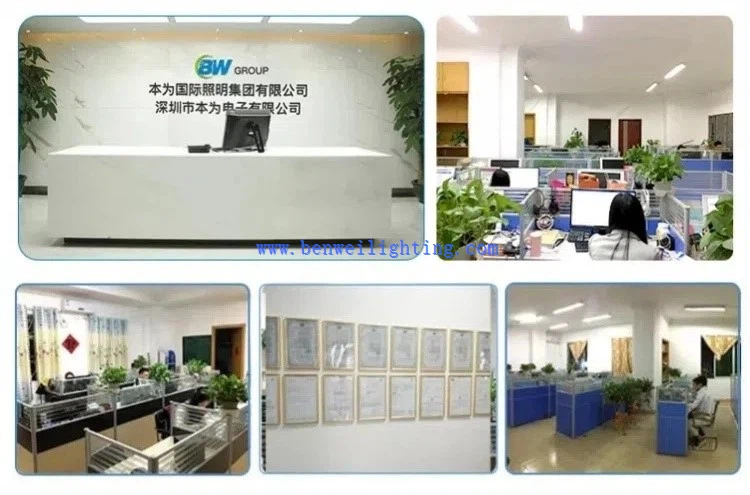
We are happy to have total control over the manufacturing process and the calibre of our products since we have our own facilities. Since we are producers rather than just brokers, we are dedicated to providing our customers with the best pricing. Since we are certain that the price and quality of our products are clear, we invite customers to see our samples first. Our commitment to quality and customer satisfaction drives us to continuously provide top-notch goods.
Our address
3rd Floor, 5th Building, Hebei Industrial Park, Hualian Community, Longhua District, Shenzhen, China