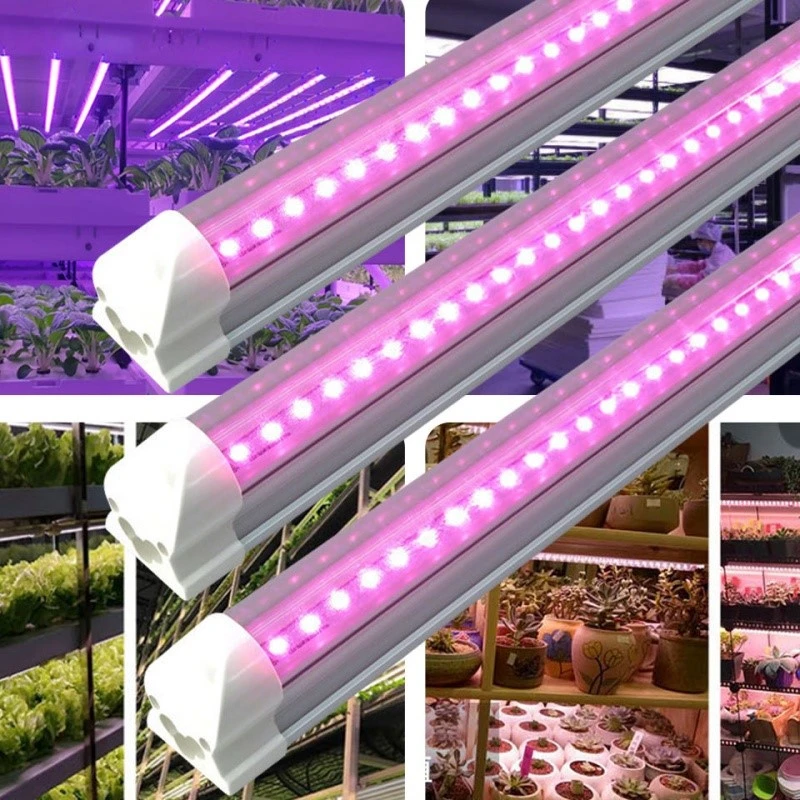
How long should grow lights be left on each day? If they are on for too little time, plants grow slowly and develop thin, spindly stems; if they are on for too long, electricity costs rise, and the leaves may even suffer damage. Some people leave them on 24 hours a day, assuming that "more light is always better"-only to end up with lettuce suffering from "tip burn" (brown, scorched leaf edges) and basil turning yellow.
In reality, there is no one-size-fits-all answer; the ideal duration varies depending on the crop and its specific stage of growth. This article focuses on three types of crops commonly grown at home-lettuce, herbs, and microgreens-and explains how to determine the optimal lighting duration when using plant grow lights.
Understanding why "more light" isn't always better
The total amount of light a plant receives each day is determined by "intensity × duration"-a concept known in the industry as the Daily Light Integral (DLI). You can achieve the same total light exposure by using a more intense light for a shorter period, or a less intense light for a longer period.
• Plants require a period of darkness. While photosynthesis fixes nutrients during the day, plants rely on the night for nutrient transport and respiratory metabolism. Denying plants a dark period often leads to issues like leaf-edge necrosis (death of tissue at the edges) and stunted or imbalanced growth.
• Duration must be balanced with light intensity. If your grow light has a lower output or is positioned far from the plants, extending the duration can help compensate; conversely, if the light is very intense, keeping it on for longer is simply a waste.
• Electricity costs are a real, tangible expense. Leaving lights on for an extra two hours a day can add up to a significant cost over the course of a month, especially when using multi-tier growing racks.
Therefore, the durations provided below are common reference ranges; you should fine-tune them based on the specific specifications of your grow lights.
Lettuce: 14–16 hours per day
Lettuce is one of the best crops for indoor cultivation under grow lights; it has a short growth cycle and responds very clearly to light exposure.
• Standard setting: 14–16 hours. Most indoor growers set their lights within this range, which promotes thick, healthy leaves and uniform growth.
• During the seedling stage, the duration can be slightly shorter. Newly emerged seedlings are quite delicate; 12–14 hours of light is safer. Once true leaves appear, you can gradually increase the duration to 16 hours.
• Avoid exceeding 18 hours. Under long-duration, high-intensity light, lettuce-especially heading varieties and some butterhead types-is prone to "tipburn."
• Regarding the light spectrum, lamps with a red-blue ratio are commonly used. Blue light helps keep the foliage compact, while red light promotes biomass accumulation; generally, either full-spectrum or red-blue lamps will suffice.
Herbs: Significant differences between varieties
Unlike lettuce, herbs cannot be managed with a "one-size-fits-all" approach. Their requirements generally fall into two categories:
• Light-loving varieties (basil, mint, thyme, rosemary): 14–16 hours. Native to regions with abundant sunlight, these thrive under artificial lighting. Basil, in particular, is highly sensitive; insufficient light causes elongated internodes and a loss of aroma.
• Cool-climate varieties (cilantro, parsley, chives): 12–14 hours. Excessive light or high temperatures can cause these herbs to bolt (flower prematurely), which negatively impacts the harvest.
• To enhance aroma, don't simply increase the light duration. Instead of running the lights for 18 hours, try moving the lamps closer and ensuring good ventilation-this often yields better quality.
If you are growing a mix of herbs on the same shelf, setting the lights for about 14 hours is a practical, convenient compromise.
Sprouts and Microgreens: Initial darkness, followed by supplemental light
Sprouts and microgreens have very short growth cycles-typically ready for harvest in 7–14 days-but their lighting requirements differ from other crops.
• Little to no light is needed for the first 2–4 days. After sowing, cover the seeds to keep them in the dark; this allows them to germinate and establish their root systems. Providing light during this stage offers little benefit.
• 12–16 hours of light per day. Once the blackout cover is removed, begin supplemental lighting to help the cotyledons turn green. Most growers set the duration to 12–14 hours; if you prefer deeper-colored, sturdier leaves, you can increase it to 16 hours.
• Keep the lights relatively close. Since microgreens are short, the lights should generally be hung lower than they would be for lettuce or herbs-though take care not to place them so close that they cause localized overheating.
• Large-seeded varieties, such as pea shoots and sunflower sprouts, have slightly higher light requirements. For small-seeded varieties like radish or mustard sprouts, about 12 hours is usually sufficient.
Balancing Light Wattage, Hanging Height, and Duration
A 14-hour light cycle will yield very different results depending on whether you use a 10W or a 20W light fixture.
• If the wattage is low or the lights are hung far away: Aim for the upper end of the recommended duration range-for example, 16 hours for lettuce.
• If the wattage is high or the lights are hung close by: Aim for the middle of the range-around 14 hours-to avoid excessive light exposure.
• When using multiple lights side-by-side: Light intensity will be higher in the overlapping areas. Monitor whether the plants at the edges are growing at the same rate as those in the center, and adjust the spacing between the lights if necessary.
• Opt for lights that are dimmable or linkable; this offers greater flexibility, allowing you to adjust light intensity later without needing to replace your entire setup.
How to Determine If Your Light Duration Is Correct
You don't have to wait until harvest time to find out-the plants themselves will provide signals.
• Insufficient light duration or intensity: Stems become long and thin, leaves appear thin and pale, and the plants exhibit "leggy" (etiolated) growth.
• Excessive light duration or intensity: Leaf edges may scorch, leaves might turn white or curl, the inner leaves of lettuce may die (necrosis), or herbs may flower prematurely.
• Ideal conditions: Compact internodes, rich leaf color, and consistent, uniform growth. It is recommended to change only one variable at a time and observe the results for about a week before making further adjustments; this ensures you can clearly identify which factor is driving the change.
Practical Tips for Setup
• Always use a timer. Relying on manual switching will inevitably lead to forgetfulness, and inconsistent lighting durations can significantly impact your plants.
• Keep daily light-on and light-off times as consistent as possible. A regular day-night rhythm is more important than an extra hour or two of light.
• Adjust in stages. Use shorter durations during the seedling stage, gradually increase them during the vegetative growth phase, and there is no need to add more time before harvest.
• Avoid peak electricity usage hours. If your local utility provider uses time-of-use (TOU) pricing, scheduling the "dark period" during peak daytime hours can lead to significant cost savings.
Summary
Keep two key points in mind: First, ensure there is a "dark period"-do not leave the lights on 24 hours a day. Second, consider the lighting duration in conjunction with the lamp's power output and its hanging height; do not look at the number of hours in isolation.
If you are selecting grow lights for your own cultivation project, or if you are looking to develop customized solutions-varying in length, power, or spectrum-for your clients, please feel free to contact us directly. Simply let us know what crops you are growing, the number of shelving tiers, and your available space dimensions. Our team will help you determine the ideal lamp specifications and provide samples, price quotes, and OEM/ODM support. You can leave a message or send us an email; we typically respond within one business day.
https://www.benweilight.com/professional-lighting/led-grow-light/led-grow-light-for-plants-ip67.html