Brighter is better for cattle shed LEDs?
Wrong – uniformity and anti‑glare are the keys to higher milk production
Understanding scientific lighting design through cow visual behavior
1. Phenomenon: Why are cows "afraid" of light?
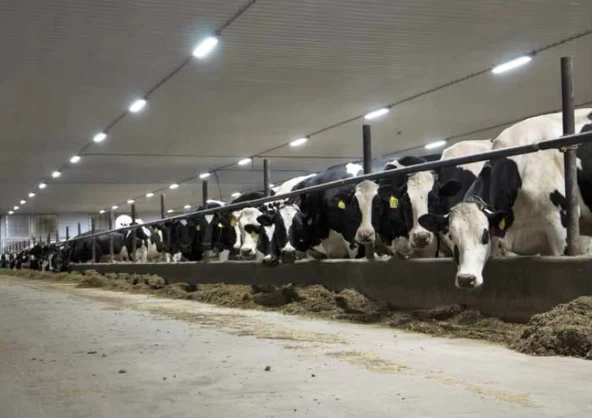
Many farm owners find that after switching to high‑brightness LED lights, cows become restless, spend less time feeding, and lie down ruminating less. This is not because the lights are not bright enough – it is a problem of light quality.
A cow's visual system is very different from a human's:
- Cows have panoramic vision (horizontal field of view ≈330°, with only a 30° blind spot behind them) and are extremely sensitive to changes in light.
- Cows can detect flicker at frequencies up to 80 Hz, much higher than the human threshold of 50–60 Hz.
- Cows lack a natural adaptation to gradual shadows; they perceive sharp light‑dark boundaries as "cliffs" or "obstacles".
When a barn has illuminance uniformity below 0.6, point‑source glare, or flicker above 50 Hz, cows show:
- Frequent head lifting and looking around while feeding
- Reluctance to approach the edge of the feed trough
- Crowding together in "safe" zones
- Milk yield drop of 3%–8%, increased incidence of hoof disease

2. Core concepts: Uniformity and glare
2.1 Illuminance uniformity
Defined as minimum illuminance / average illuminance (U₀) or minimum illuminance / maximum illuminance (U₁). The closer the uniformity is to 1, the more even the light.
| Uniformity level | Rating | Cow behavior response |
|---|---|---|
| <0.5 | Very poor | Clear avoidance behavior, feed intake down 5%–10% |
| 0.5–0.7 | Fair | Mild unease, reduced utilization |
| ≥0.8 | Good | Normal behavior, evenly distributed feeding |
| ≥0.9 | Excellent | No stress, recommended |
Industry standard requirement: According to T/SZFAA 06‑2021 "Technical specification for cattle shed lighting", uniformity around the feed trough must be ≥0.8, and in other areas ≥0.7.
2.2 Glare
Glare is discomfort caused by excessively high brightness or strong contrast in the field of view. Common sources of glare in cattle sheds include:
- Bare LED chips (point‑source luminance >10,000 cd/m²)
- Low mounting height (<2 meters)
- Reflected light (stainless steel feed troughs, standing water)
Glare is evaluated using the UGR (Unified Glare Rating) . For cattle sheds, a UGR ≤22 is recommended.
| UGR value | Glare level | Effect on cows |
|---|---|---|
| >28 | Severe discomfort | Clear avoidance, cows hesitate to lift heads to eat |
| 25–28 | Moderate discomfort | Reduced feeding speed, frequent blinking |
| 22–25 | Mild discomfort | Slight stress, long‑term effect on milk yield |
| ≤22 | No discomfort | Normal behavior, recommended |
3. Data: How uniformity and glare affect milk yield
3.1 Uniformity comparison trial
A 60‑day controlled trial on 200 Holstein cows gave the following results:
| Group | Uniformity (U₀) | Average illuminance (Lux) | Daily milk yield (kg/cow) | Feeding time (min/day) |
|---|---|---|---|---|
| Group A (uniform lighting) | 0.85 | 180 | 34.2 | 312 |
| Group B (non‑uniform lighting) | 0.55 | 180 | 31.5 | 278 |
| Difference | +0.30 | same | +2.7 kg (+8.6%) | +34 min |
Conclusion: At the same average illuminance, raising uniformity from 0.55 to 0.85 increased milk yield by 8.6% – equivalent to about 900 kg more milk per cow per year.
3.2 Effect of glare on cow behavior
| Glare condition | UGR value | Feed trough usage | Lying rumination time (min/day) | Stress indicator (cortisol increase) |
|---|---|---|---|---|
| No anti‑glare design | 28 | 62% | 420 | +32% |
| With anti‑glare lens | 22 | 89% | 495 | +8% |
| Improvement | -6 | +27% | +75 min | -24% |
Conclusion: Adding anti‑glare design increased feed trough usage by 27% and lying rumination time by 75 minutes – cows were calmer and healthier.
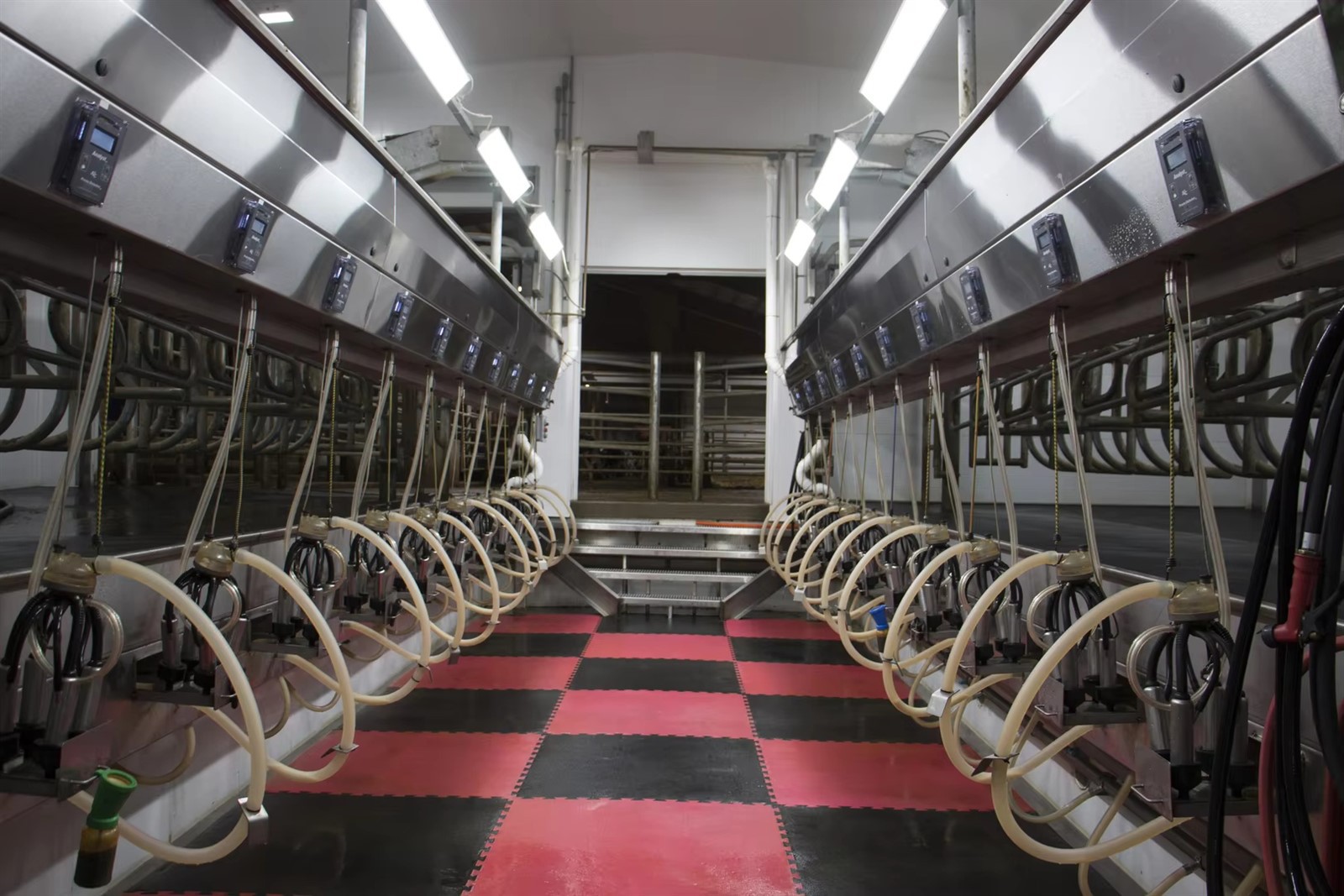
4. How dedicated LED cattle shed lights achieve high uniformity and low glare
| Design element | Technical solution | Performance target |
|---|---|---|
| Secondary optical lens | PC or PMMA material, 120°×120° batwing light distribution curve | Uniformity from 0.5 to >0.85 |
| Anti‑glare grille / honeycomb louver | Limits emission angle, reduces wide‑angle glare | UGR from 28 down to <22 |
| Frosted / opal diffuser | Softens point sources, creates uniform luminous surface | Peak luminance reduced 50%–70% |
| Proper mounting height | 2.2–2.5 meters (not below 1.8 m) | Reduces direct glare, enlarges light spot |
| Flicker‑free driver | Constant current, ripple current <5%, flicker frequency >125 Hz | Cows do not perceive flicker |
| Zoned layout | Independent lighting for feed trough area, auxiliary lighting for walkways | Avoids light shining directly into cows' eyes |
5. Purchasing and installation checklist
When selecting dedicated LED cattle shed lights, verify the following 6 items:
- Uniformity ≥0.8 (Request IES or LDT photometric files, verify with Dialux simulation)
- UGR ≤22 (Should be stated in the product datasheet)
- Flicker frequency >125 Hz, flicker index ≤3% (Request third‑party test report)
- Color temperature 5000K–6500K (Cool white, simulates midday natural light)
- Ingress protection IP65 or higher (IP66 or IP69K recommended for high‑pressure washdown areas)
- Mounting height 2.2–2.5 m, spacing ≤ 1.5 × mounting height (e.g., at 2.5 m height, spacing ≤3.75 m)
6. One‑sentence summary
The core of cattle shed lighting is not "how bright" but "how uniform and how soft". Dedicated LEDs with uniformity ≥0.8, UGR ≤22, and flicker‑free allow each cow to feed 30 minutes more and produce 2.7 kg more milk per day. With the same electricity bill, choosing the right optical design can raise milk yield by another 8% or more. Payback period is typically less than 12 months.
Should you have any requirements for bulk purchasing or customized lighting solutions, please do not hesitate to contact us for a detailed quotation.