Cleanroom or clean room environments are extremely specialized with requirements for each technology brought into the space. Cleanroom lighting is no exception. But what is a cleanroom? Read on to learn more.
What is a Cleanroom?
A cleanroom is a space that maintains very low levels of particles, like dust and debris, and other airborne toxins for the purpose of keeping the environment safe for what it's producing or for activities taking place in the space. Cleanrooms actually have quantifiable particle counts for their air, which are measured frequently and held to high industry standards (more below).
History
Willis Whitfield invented the cleanroom in 1962, circulating air through the cleanroom and taking air out of the cleanroom in a particular way as to not allow almost any particles in.
Airflow
Cleanrooms function by using filters for the air, and by not introducing products or people (people are equipped with specialized garments when in the space) into the space that will bring its contamination measurements beyond the acceptable levels.
Airflow in a cleanroom is either non-unidirectional or unidirectional. Non-unidirectional cleanrooms utilize ceiling filters to push clean air through, and remove contamination in the air through wall, floor, or, sometimes, ceiling extractors. Unidirectional cleanrooms rely more heavily on a lot of air coming from multiple, spaced ceiling filters to flow quickly through the room in a much more unidirectional way and then out the floor or the wall.
Who Uses Cleanrooms?
The following industries might require a cleanroom:
Pharmaceuticals
Medical devices
Food and beverage
Biotechnology
Sterile compounding
Electronics
Standards and Measurement
Cleanrooms are defined and measured based on how many particles are in the air per total air volume. The most utilized and accepted measurement for this is the ISO classification system. In addition, other certifying and regulating bodies are involved in cleanroom standards depending on the specific industry. For instance, the FDA is involved if you are a food and beverage manufacturing plant.
Cleanroom Lighting
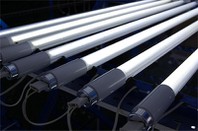
As mentioned, a cleanroom must be constructed using materials that don't introduce or cause contamination in the room. This is why special, industry-tested lighting is needed in these spaces.
IP Ratings and the NSF
Cleanroom lighting usually has to adhere to the Ingress Protection Code (IP Ratings) as defined by the IEC. An IP Rating is two digits, and the first digit refers to a light's protection against solids, like dust and particles, while the second refers to liquids. So, a 00 rating provides no protection from solids or liquids, a rating of 64 would protect against all dust and water splashing, etc. Lower IP Ratings are for indoor, less hazardous use. The scale goes from 0-6 for both solids and liquids, and you will always see that two digit rating.
Cleanroom lighting also adheres to NSF International standards and testing, like their splash zone ratings. You can view a document defining all splash zones here.