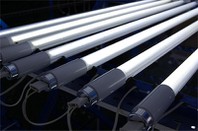
Design and layout of chicken house lighting system
The illuminance can be directly measured with an illuminance meter. The unit of illuminance is lux, which can be abbreviated as lx. For an object that is uniformly illuminated by light, when the luminous flux obtained on an area of 1m2 is 1 lumen, its illuminance is 1lx. In production, you can simply calculate the number and wattage of lighting bulbs according to the following methods. An ordinary light bulb emits approximately 6.15 lumens of light per watt to reach the level of the chicken's back. Assuming that there is a 2000m3 breeding chicken farm that requires 10lx light intensity, a total of 3252 (2000×10/6.15) W bulbs need to be installed. If a 25W bulb is used, 130 bulbs (3252/25) are needed. The height of the installed bulbs is generally 2.0-2.4 meters, and the distance between the bulbs is generally 3 meters. To install more than two rows of bulbs, they need to be arranged crosswise to make the illumination uniform in the house. To keep the bulb clean, replace the broken bulb in time; it is best to add a lamp shade, which can increase the light efficiency by 30-40%. According to the above method, in the first week of brooding, install a 40W light bulb for every 15m2 chicken house. In the second week, the expenses will be gradually staggered and replaced with 25 watt light bulbs. When entering the breeding period, it is enough to gradually switch to 15 watt bulbs.
Artificial lighting equipment, such as high-efficiency energy-saving lamps, is used in the enclosed chicken coop to meet the needs of chickens. In actual production, high-efficiency energy-saving lamps have the characteristics of long life, good energy efficiency, high luminous efficiency, optical fiber suitable for human vision, and high adjustment frequency. They can meet the physiological needs of chickens and are ideal chicken house lighting equipment. The reasonable arrangement of the lighting system in the chicken house is a direct guarantee for the supply of suitable light for the laying hens. In the intensive production of laying hens, stepped and stacked chicken cages are commonly used. In particular, the upper and lower layers of the stacked chicken cages are all overlapped. The net height of the reared chicken cage is nearly 4 meters. Lamps will inevitably affect the lighting of the lower cage. Therefore, the lighting system of the stacked cage chicken house adopts a high and low two-story arrangement. Usually, the lower lamp is 1.8-2.2 meters from the ground, and the upper lamp is 0.2-0.4 meters from the top of the chicken coop. Only in this way can the lighting conditions of each layer of chickens be more uniform.