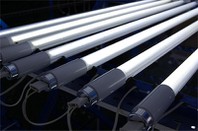
LED and HPS Showdown
Key Interest | Description | Criteria for Street Lights | LED Street Light | HPS Street Light | Verdict |
| Color Rendering Index (CRI) | CRI is how the light source reflects the color of an object, showing its aesthetics and form. | 75-100: Excellent
65-75: Good 55-65: Fair 0-55: Poor | 65 to 95 | 20 to 30 | LED has a pleasing CRI range, which means light can clearly illuminate/project the colors of objects |
| Correlated Color Temperature (CCT) | CCT measures how warm or how cold the lighting is. It is expressed in Kelvin (K). | For Street Lights, AMA recommends a CCT value of around 3000K.
For Flood Lights, it may range from 5000K to 6000K. Basis: 2000K -warm yellow; 3000K -warm white; 6000K -white; 6500K -cool white | 2200K to 6000K | +/-2200K | In term of CCT variety, you have more options with LED than HPS. |
| ON/OFF | Cycling describes how fast the street light responds to being switched on and off.
This is where we account the warm up and cool down of street lights. | Faster warm up time and cool down/restrike time is better. | No warm up or cool down | Short delay in turning off and on | LED street lights are better. |
| Warm Up Time | Instant turn on | 1 to 15 minutes | LED | ||
| Restrike Time | Instant switch off | 4 to 5 minutes | LED | ||
| Dimming | The ability of a street light to adjust in brightness when not in use. | A larger dimming range is preferred as it’s a way of saving on energy consumption at certain times when the street light is not in use at night. | Can have automatic dimming functions from 100% to 30% to 0.5% | Dimming requires a ballast; can be dimmed up to 50% | LED street lights have a larger dimmability range and don’t require special ballasts. |
| Directionality | The ability of light to focus in one direction. | Street light focusing in one direction is highly desirable. | LEDs illuminate light at only 180 degrees. | Sodium lamps emit light in all directions (360 degrees).
Hence, a reflector is needed to redirect the light downward, reducing the light’s illumination efficiency. | Outdoor LED street lights illuminate roads more efficiently than sodium street lights because they are highly directional. |
| Efficiency | It’s the ability of light to illuminate more brightness at less energy and is measured in lumens per watt. | Best to use higher efficiency light types to offset lesser maintenance and operation cost. | 114 to 160 Lm/W | 80 to 140 Lm/W | Integrated LED street lights are more energy efficient. |
| Efficiency Droop | It’s the tendency of lights to lose efficiency at high currents, raising heat emission. | Least efficiency droop is better. You can simply feel this when there is less heat emitted at longer periods of lighting. | Has low efficiency droop up to its end of life. The lowest efficiency of LED is only at 80%. | At half of its life (12,000 hrs), HPS emit 90% of its efficiency. At the near end of its life (24,000 hrs), HPS emits 80% of its efficiency. | LED and HPS perform well up until the end of their lifespans.
But remember, LED lights have a longer lifespan than HPS lights. |
| Foot Candles | Foot candle describes the intensity of a uniform lighting or illuminance of source reaching a 1ft^2 area.
It gives us an idea if the light is producing uniformity or if unwanted hot spots and dark spots are produced. Foot candle also determines if there is an adequate lighting level for outdoor spaces. | Basis: (lumen/sq.ft)
Freeways: 0.6 to 1.1 Local (commercial, residential): 0.4 to 0.8 Pedestrian/bicycle ways: 2 Alleys(commercial, residential): 0.3 to 0.6 Minor Arterials: 0.7 to 1.4 Parking: 5 | LED can better attain the foot candle needed for a desired area at a lesser energy consumption than other traditional lights. | Since HPS street lights are omnidirectional, a large amount of energy needed and redirected just to attain the appropriate foot candle for a desired area. This also means there’s more energy consumed just to attain the proper illuminance of an outdoor area. | LED |
| Visible Light Emissions | The ability of the light emit visible/optical light, safe and healthy for the human eye and animal vision. | The light emission must play along the spectrum of visible light (range of 400–700 nm) without reaching the wavelengths of UV or infrared values. | For commercial LED, the visible light wavelength ranges from 360 to 950 nm. | Visible light wavelength for HPS is near 589 nm. | Both LED and HPS are within the spectrum visible to the human eye, but LED has a stronger light emission. |
| Infrared | none | none | |||
| Ultraviolet | |||||
| Mercury Content | Mercury contributes to the lamps efficiency and lifespan, but is harmful when exposed to the environment. That’s why the RCRA and UWR regulates the proper disposal of lamps at the end of its life. | Ideally, lights should have minimal to no mercury content so waste disposal is more convenient and no harmful chemicals are emitted in the environment. | 0 mg, no mercury content | 6mg per 100 Watts | With LEDs, you can assure there’s no mercury leakage in the environment upon disposal. |
| Heat Emissions | Heat emission is an energy inefficiency of a lighting system. | Ideally speaking, a lighting system is better if it has minimal to zero heat emission. So the lower heat emission, the more energy efficient is the outdoor lighting system. | LEDs do not emit heat as other street light types. This is because it is energy efficient. But it still needs a heat sink like any other electronics to prolong its life. | More heat emission. The ballast may either absorb it or be lost in the environment. 15% are likely to be lost by an HPS street light. | LED |
| Cold Tolerance | The ability of the street light to withstand extremely low temperatures. | High heat tolerance is desirable for cold areas such as Canada, Germany, etc. | -40 Degrees Celsius | -40 Degrees Celsius | LED and HPS can still work at low temperatures, but LED can flick on more instantaneously. |
| Heat Tolerance | The ability of the street light to withstand extremely high temperatures. | High heat tolerance is desirable for deserts and areas with tropical climates. | 75 to 100 Degrees Celsius | 65 Degrees Celsius | LEDs have a higher heat tolerance. This makes it more ideal for desert roadway lighting. |
| Shock Resistance | Indicates how well street lights react to mechanical shocks or wind force. | Since street lights are outdoor lights, they are exposed to harsh conditions. Durable lighting options are therefore preferred. | LED lights are solid state lights (SSLs). Hence they are not easy to damage with any physical shocks. | Fragile as they use glass bulbs | LED |
| Failure Characteristics | This describes the potential failure points of a street lights before the end of its life. | When LEDs dim gradually, it indicates that it’s nearing its end of life. An LED street light usually has a number of emitters in a single luminaire. So when one diode fails, that doesn’t mean the whole LED module should be replaced. | When HPS reaches its cycling phenomenon, the light flickers on and off before failing. | LED | |
| Life Span | Describes the number of hours the light can be rendered useful. | Longer street light lifespans are better to minimize maintenance and operation costs. | 25,000 hours to 200,000 hours | 10,000 hours to 24,000 hours | LED has a longer lifespan, but we cannot ignore the fact that HPS lights have a longer lifespan than other traditional lights as well. |
| Warranty | LED street light manufacturers usually give a 3 to 5-year warranty. | 1 to 4 years typical warranty | LED street lights have longer warranty. | ||
| Upfront Costs | This accounts the cost of installation, maintenance and operation of your street lights. | The lower total cost is of course the more desirable option. | Typical 100W costs $8 to $13 | $5 to $10 for 100W | HPS costs less upfront. |
| Maintenance | No maintenance cost | Frequent equipment replacements accounts for labor cost, and tooling costs and repair costs | LED | ||
| Lifetime Costs | According to our calculation, it can cost you $8990 in 10 years. | According to our calculation, it can cost you $16,710 in 10 years. | LED |