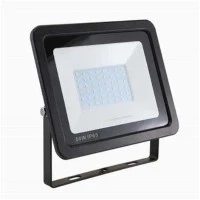
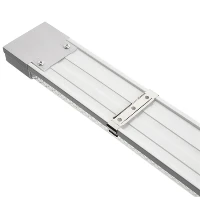
0-10V dimming Explained - What is 0-10 volt dimming? How does it work? Installation of 0-10 volt dimmer switches explained. High output led fixtures and corn light bulbs cannot be dimmed with traditional dimmers that restrict the power.
Dimming high-output LEDs
In traditional dimmers used for incandescent, the power is restricted to the bulb and thus the output goes down. In LEDs, this does not work. LEDs convert AC to DC and need a clean constant power wave. In low wattage this can be done with a transformer in the bulb. (Although not always easily as most of us have had LED bulbs that flicker and hum when dimmed.) As you go up in output, that bulb would require a sizable transformer that isn't realistic or safe. Unfortunately that means that no bulbs above about 15 watts can be dimmed. There are some out there, but they are taking shortcuts that you do not want to take. Maybe a few years from now the tech will be there, but its not yet.
The answer is to use a signal based dimming, this is known as 0-10 volt dimming. At 10volt (10v) the luminaire will go to 100 percent or full light output and at 0 (0v) it should at 0 percent or output which is off. Read further on about how most fixtures do not actually dim to off.
0-10V dimming questions
What is 0-10V dimming?
A: Zero to ten volt (stylized as 0-10v) is actually one of the earliest signaling system invented for lighting control and is also one of the simplest: it uses a control signal of low voltage that ranges from 0 to up to a maximum 10 volts. The amount of volts sent to the LED driver, tells it how bright to be. Send 0 volts and the light is off. Send 10 volts and the light will go to maximum power. The drive will smoothly dim the lights.
In simple terms, 0-10V dimming involves the addition of two additional wires to the driver. These wires transmit a voltage-based signal that instructs the driver to adjust the brightness accordingly. By maintaining a 10V signal, you achieve full brightness, while a 5V signal corresponds to 50% brightness and a 1V signal represents 10% brightness, and so on. The advantage of this method is its effective functionality, requiring only two low-voltage shielded wires of 14-16 gauge. However, the downside is that you need to have the capability to run these two additional wires.
What is the difference between 0-10V and 1-10V dimming?
A: Early 0-10v all were true 0 volt, meaning that they would dim to off. For 2 reasons, most modern LEDs are 1-10v, meaning they only dim to 10%. The first reason was safety, having the light off but power to it raised concerns about having live wires but no lights on. The second was longevity of the LED Driver. Holding a constant power could reduce the lifespan of the fixture. Moving that to the switch that is better suited to handle that should increase lifespan of the fixture. From an install or switch standpoint they are the same. Just do not assume light fixtures will DIM to off.
What is 0-10V low voltage dimming, exactly?
Because it employs 10 volts of DC in the lines, it is referred to as low voltage.
Why is it dimming?
Lighting dimming is one of the simplest and most straightforward ways to lower power consumption. In addition to saving energy, dimming lets you set the mood for your scene. Thirdly, and perhaps most importantly, it enables you to increase the brightness of new lights (when unsure of how bright to go) and then decrease them again. You'll know you have enough light that way.
What makes it superior to conventional dimming systems?
Low voltage dimming is preferred over conventional or hard wire dimming because it is significantly safer and more efficient. A little transformer is required to limit the wattage when using standard hard wire dimmers. Flickering or the inability to dim to low levels are the common results of this. Additionally, standard dimmers can only handle up to 100 watts of LED, which is insufficient for large-scale installations. On a single switch, 0-10volt systems may effortlessly manage thousands of watts. Therefore, you could hypothetically manage 20 quantity LED High Bay Lights at 100 watts each with a single $60 switch (but we encourage more switches than that).
The minimum current demand of 0–10 volts also guarantees that you may run lengthy, thin-diameter cables at a lower cost. With the usage of 0-10V dimming systems, very few issues ever arise and they are simple to deploy, troubleshoot, and comprehend.
Which items are dimmable with this system?
A:0–10V system can be used to dim a lot of products. These include the ability to efficiently dim lights in theaters, retail establishments, buildings, entertainment venues, and any other residential or commercial location. Additional items include LED retrofit kits, parking lot flood lights, and high bays.
How can resistor PWM dimming be applied to LED lights?
A: Dimming from 0 to 10 volts can also be accomplished by pulse width modulation (PMW) or resistor dimming. A single driver LED light might be made 50% brighter by adding a 50K ohm resistor. It would reach 70% at 70k ohm. These would need precise resistors and be kept in a sturdy box. It makes it impossible to vary the light's intensity; a resistor swap is necessary. Only experts should use this kind of dimming. The suggested path is to use a $45 wall switch.
What would I need to dim from 0 to 10 volts?
A: Low voltage wires would have to be run from the light back to the switch. A line voltage switch, which essentially switches the gadget on and off, would be the first class wiring. Class two wiring would provide low voltage dimming control by supplying input that can produce outputs with a minimum of 0V and a maximum of 10V.
a wall switch that works. Look for dimmer switches that are 0–10 volts. Both powered and unpowered dimming variants are available. To find out more, watch the video above. For a good one, it will cost between $40 and $70. The hardware for 0-10v and 1-10v is identical.
There may be a lot of wiring. Many need a powered cable in order to fully utilize the switch. Power will typically require a 12-14 A lighting design, although the low voltage can be 14-18 gauge shielded or something similar. This should go without saying, but consider where you want the switches and potential future uses. You may want to run the cables where you can do more with them later if you plan to add a Dali or Zigbee system. Additionally, they feature motion sensors that can be powered by the 0–10 or any other power lines you may want to add.
The energy-saving benefit lies in low voltage dimming
0-10V dimmers provide an affordable lighting management system that drastically lowers costs related to superfluous lighting, whether you need to dim LED High Bay Lights or run Dimmable LED Parking Lot Lights. Additionally, this system offers a variety of setup possibilities by enabling you to separately regulate several zones. Gaining proficiency in this method will result in significant power bill savings.
For any new high brightness lighting system, 0-10V dimmers are an appealing option because to their executable and user-friendly components.
To locate a dimmable system that suits your needs, give us a call or send us an email right now.


Our address
No. 5-3 Niujiao Road, Yanchuan Community, Yanluo Street, Bao'an District, Shenzhen
Phone Number
+86 18659785153
bwzm04@ledbenweilighting.com