Imagine an engineer with two browser tabs open before a purchase order goes out. Tab one is a supplier guide explaining that 365 nm light cures deeper because it scatters less in pigmented resin. Tab two is another guide explaining that 395 nm is the one that cures through white and coloured ink. Both sound confident, and both are written by people who sell UV lamps.
- Tab 1"365 nm resists scattering by pigments such as titanium dioxide, so it reaches deeper."
- Tab 2"395 nm penetrates heavily pigmented and white inks better than shorter wavelengths."
Both claims exist in published guides, as you can see by comparing Incure's resin-curing article with GoodiUV's technical review. The honest answer is that neither tab is simply wrong. The contradiction is the real lesson, and once you see why it exists, choosing between the 365 nm and 395 nm versions of an industrial UV LED flood light becomes a data question rather than a guess.
Why the guides disagree, and the one rule they all share
Penetration depth is not a property of wavelength alone. It depends on what absorbs the light: the pigment, the filler, the film thickness and, above all, the photoinitiator, the chemical that starts the curing reaction. Where a guide writes about clear resin, shorter wavelengths look aggressive at the surface; where it writes about white ink, longer wavelengths look better. They are describing different materials.
Underneath the disagreement, every source repeats the same rule. The lamp's wavelength has to overlap with the photoinitiator's absorption spectrum. UVNDT's photoinitiator guide notes that phosphine-oxide initiators such as TPO and BAPO are the standard for 385 nm and 395 nm systems because their absorption tails reach into the longer UV-A region. And Incure's matching guide adds that some adhesives still cure at roughly ±20 nm from their main absorption peak, which is useful if you only have a nearby wavelength on hand.
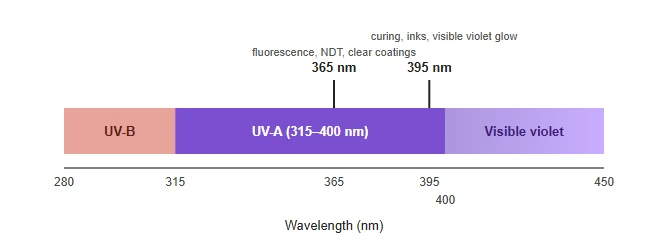
| Property | 365 nm | 395 nm |
|---|---|---|
| Photon energy | 3.40 eV | 3.14 eV |
| UV output from one published 20 W flood light | 8 W (40% of input) | 6 W (30% of input) |
| What the eye sees | Little visible glow, minimal interference with visible light | Obvious violet glow, closer to the visible range |
| Initiators it typically suits | Those absorbing at shorter UV-A; clear and translucent coatings | TPO / BAPO phosphine-oxide systems |
| Typical jobs | Fluorescence inspection, NDT, clear adhesives, electronics encapsulants | General curing, inks, pigmented or thicker layers |
| Cure-depth claims | Guides disagree; depends on the material, so check the resin datasheet | |
Photon energy calculated as 1,240 ÷ wavelength (nm). Output figures are from the Waveform Lighting realUV flood light specification, which is one product, not a universal rule. Appearance and typical uses from Signlite and the UVNDT and Incure guides above.
The number worth asking for: UV output, not watts
Look again at the second row of the table. The same 20 W of electrical input produced 8 W of UV at 365 nm and 6 W at 395 nm in that specification, and the exact ratio will differ between manufacturers and chips. The point is that "50 W" or "100 W" on a UV flood light describes what it draws from the wall, not how much ultraviolet reaches the work. Two lamps with the same wattage can differ by tens of percent in UV output, and the output also depends on distance and beam angle.
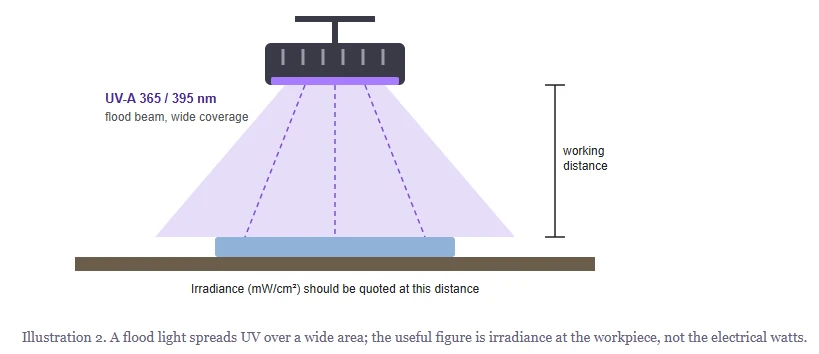
This is why a serious buyer asks for irradiance in mW/cm² at a stated working distance, or the radiant flux in watts, and not only the electrical rating. Curing dose is irradiance multiplied by time, so a lamp that delivers twice the irradiance halves the exposure needed, but it also halves the time it takes to reach an exposure limit for anyone standing nearby. That brings us to the part of UV work that deserves its own chart.
The safety budget: how fast a flood light uses up the exposure limit
Both 365 nm and 395 nm sit in the UV-A band (315–400 nm), which is the least hazardous of the three UV bands but not a harmless one. Published occupational limits for UV-A on unprotected eyes work like this. Under the ACGIH values summarised in SLAC's UV safety procedure, UV-A exposure for periods longer than 1,000 seconds must average below 1 mW/cm², and the radiant exposure in any 1,000-second window must stay below 1 J/cm². Columbia University's policy states the same limit as 10 W/m² and 10⁴ J/m². Australia's regulator, ARPANSA, sets the unprotected-eye limit at 10 kJ/m² within an 8-hour period.
| UV-A irradiance at the eye | Time to reach 1 J/cm² |
|---|---|
| 1 mW/cm² | 1,000 s (about 17 min) |
| 5 mW/cm² | 200 s (about 3 min) |
| 10 mW/cm² | 100 s |
| 50 mW/cm² | 20 s |
| 100 mW/cm² | 10 s |
Calculated as time = 1,000 mJ/cm² ÷ irradiance. Real limits depend on your jurisdiction and exposure pattern; follow your local rules and risk assessment.
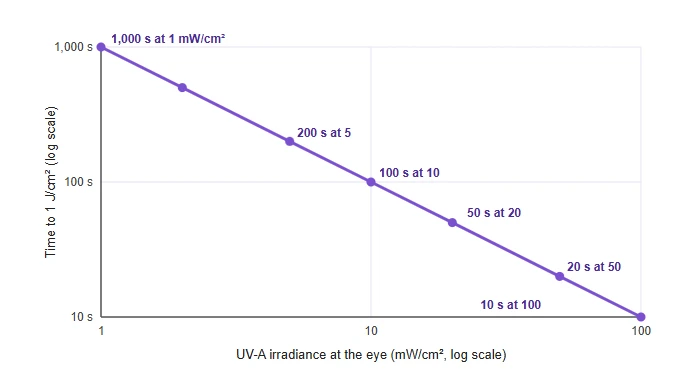
Practical consequence. A flood light is designed to put a lot of UV on a wide area, which means a worker can be exposed without ever looking at it directly. Interlocked enclosures, UV-blocking eyewear and face and skin cover are the normal controls, and the safest installation lights the part only when nobody is in the beam.
Detection is a different job from curing
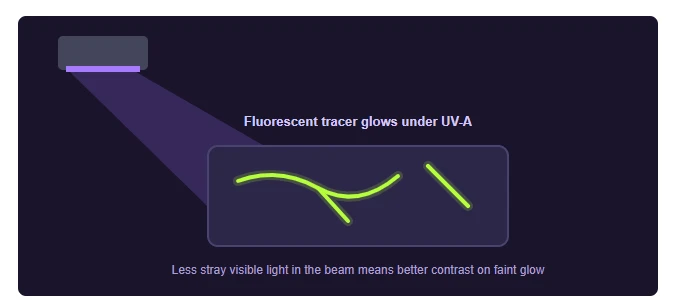
Curing needs a lamp that matches the chemistry. Detection, whether you are checking for oil residue, leaks, counterfeit marks or adhesive coverage under fluorescent tracers, needs a lamp that makes the target glow without drowning the glow in stray light. Here the difference in the "what the eye sees" row matters. A 395 nm source leaks a visible violet glow that can reduce contrast on faint fluorescence, while 365 nm keeps most of its output in the invisible band, which is why 365 nm is the traditional choice for inspection and NDT work. Where the inspector also needs to see the room, or where the fluorescence is bright and the glow is acceptable, 395 nm is often enough and tends to be easier on cost.
A selection guide you can actually use
| If your datasheet or task says… | Start with | Why |
|---|---|---|
| "Cure with 365 nm UV" | 365 nm | Matches the initiator; the supplier's data wins over any general guide |
| TPO / BAPO initiator, or "385–405 nm" recommended | 395 nm | Phosphine-oxide systems absorb into the longer UV-A region |
| Thick, white or pigmented layer | Test both | Guides disagree; a small trial shows which cures through |
| Fluorescence inspection, NDT | 365 nm | Less visible light to reduce the contrast of faint glow |
| General inspection where visible glow is acceptable | 395 nm | Usually cheaper to source and still gives a strong fluorescent response |
| Datasheet gives no wavelength | Ask the resin maker; if unavailable, test both | An hour of testing costs less than a failed batch |
Send the datasheet, and we will match the lamp
The fastest route to the right configuration is to send us what the process actually needs. Please include the resin, ink or adhesive datasheet (or its recommended wavelength), the working distance and the size of the area to be lit, the irradiance you are aiming for in mW/cm², and whether the lamp is for curing, detection or both. We will recommend 365 nm or 395 nm and the right wattage, and we will give UV output figures at your working distance, not only the electrical rating.