When selecting lighting for large spaces-such as warehouses, workshops, parking lots, or sports venues-purchasers often find themselves choosing between two types of products: LED "corn" lights (which resemble an ear of corn) and standard LED bulbs. While both can fit into common bases like E27 or E40 and may appear interchangeable, they perform quite differently in practice. This article skips the abstract theory and focuses on the practical requirements of large-space lighting, comparing the two to help you determine which is better suited for your project.
What are LED corn lights and standard LED bulbs?
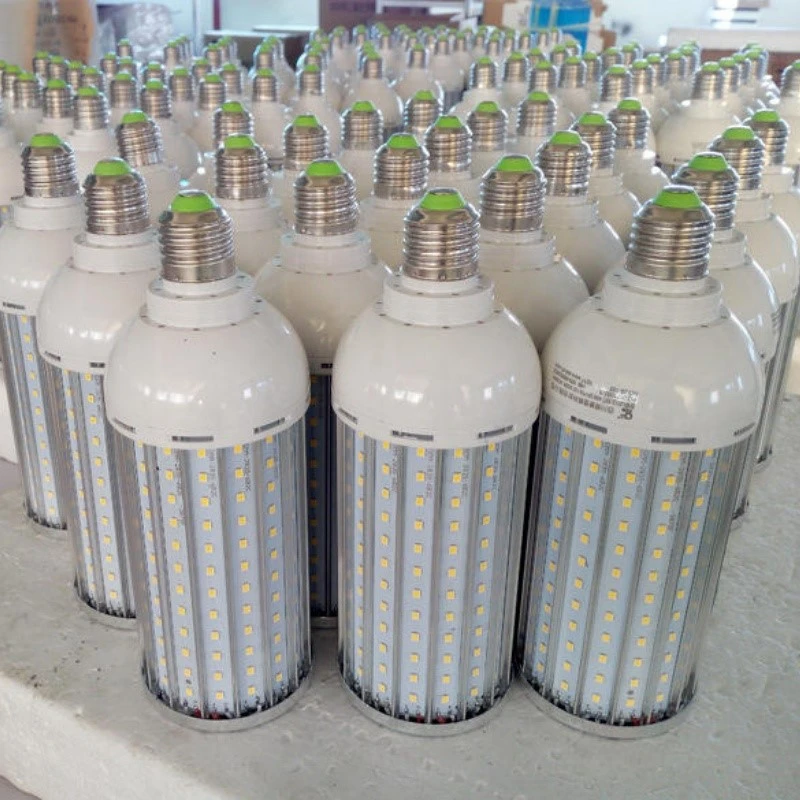
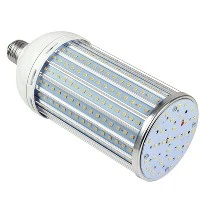
LED corn lights are characterized by a large number of LED chips arranged around the perimeter of a cylindrical body, giving them the appearance of an ear of corn-hence the name. The LED chips are either left exposed or covered by a transparent shield. These lights typically range from 10W to 150W, with higher-wattage versions often utilizing E27, E39, or E40 bases.
Standard LED bulbs, by contrast, follow the form factor of traditional incandescent bulbs. Their LED chips are concentrated on a board located above the base, enclosed by a translucent (milky-white) or clear bulb-shaped cover. These generally range from 3W to 30W and are primarily designed for residential or small-scale commercial spaces.
The fundamental difference between the two lies in the number and arrangement of the LED chips, which dictates most of the other points of comparison.
Wattage and Luminous Flux: Which can illuminate a larger area?
Large spaces require a high total luminous flux (the total amount of light emitted). Due to limitations in size and heat dissipation, standard LED bulbs typically have a maximum wattage of 20–30W, producing a luminous flux of roughly 2,000 to 3,000 lumens.
Because LED corn lights distribute their chips over a larger surface area, they can achieve wattages of 50W, 80W, 100W, or even 150W, delivering a luminous flux ranging from 8,000 to over 20,000 lumens. In other words, a single high-wattage "corn light" (LED corn bulb) can often replace several standard light bulbs.
If you have a space with high ceilings or a large floor area, using standard bulbs would require installing more units, which in turn increases the workload for wiring and installation. In this regard, corn lights hold a clear advantage.
Light Distribution: 360° Illumination vs. Directional Lighting
Corn lights feature LED chips arranged around the body, emitting light in all directions-approaching a full 360° beam angle. This is highly effective in environments that lack reflectors but require broad, uniform illumination, such as open warehouses, aisles between support columns, or semi-open sheltered spaces.
In contrast, standard LED bulbs typically have a beam angle between 200° and 270°; light directed upward is often blocked by the bulb base or the socket, resulting in wasted light.
However, it is worth noting that 360° illumination is not always an advantage. If a light fixture is equipped with a deep reflector, the light emitted from the sides of a corn bulb may simply be absorbed by the reflector walls, reducing overall efficiency. In such cases, it is necessary to use an appropriate fixture or opt for a product with better directional light output.
Heat Dissipation: A Critical Factor for Lifespan
The lifespan of an LED is largely determined by its junction temperature. A higher number of LED chips and greater wattage place a heavier burden on the cooling system.
The advantage of a corn light lies in its large surface area. Many models utilize aluminum heat sinks, often combined with an open or perforated design that facilitates effective natural convection. Some high-end, ultra-high-wattage models even incorporate built-in cooling fans.
Standard bulbs, being more compact, tend to concentrate heat near the base when operating at high wattages; this often leads to noticeable lumen depreciation (loss of brightness) over long periods of use.
It is important to note that if a corn light is installed inside a completely sealed fixture, its heat dissipation will be severely compromised, leading to a shorter lifespan. When purchasing, always verify whether the fixture provides adequate ventilation-a detail that is frequently overlooked.
Lamp Base Specifications and Fixture Compatibility
Common lamp base types for large-space lighting include E27, E26, E39, and E40, with E40 typically reserved for high-wattage applications.
High-wattage "corn" LED bulbs are available with E39 or E40 bases, allowing for direct replacement of existing high-pressure sodium or metal-halide lamps. This eliminates the need for rewiring or replacing lamp sockets-a highly convenient solution for retrofitting older industrial facilities. It is important to note that when performing such a replacement, the original fixture's ballast should either be removed or a ballast-compatible bulb model must be selected.
Standard LED bulbs primarily use the E27 base. Due to this limited variety, they are better suited for lower-wattage applications and offer fewer options for large, high-ceilinged spaces.
Installation Height and Suitable Applications
Based on general practice, the optimal choice varies according to installation height:
Low-ceiling spaces (under 3 meters): Standard LED bulbs are usually sufficient-for example, in small warehouses or corridors.
Medium-height spaces (4–8 meters): Corn-style LED bulbs ranging from 30W to 80W are ideal, providing an effective balance between brightness and coverage area.
High-ceiling spaces (above 8 meters): It is recommended to use corn-style LED bulbs with a wattage of 100W or higher, or to equip fixtures with reflectors to ensure adequate illuminance at ground level.
Common applications for corn-style LED bulbs include warehouses, workshops, underground parking garages, farmers' markets, sports venues, outdoor courtyards, and street lighting retrofits.
Procurement Costs and Long-term Maintenance
While a single high-wattage corn-style LED bulb may have a higher unit price than a standard LED bulb, the total cost of ownership is often lower.
Replacing four or five standard bulbs with a single 100W corn-style LED bulb saves on sockets, wiring, and installation labor, while also significantly reducing the frequency of future replacements and maintenance. In environments requiring work at heights, avoiding even a single replacement saves on the labor costs and risks associated with high-altitude operations. Additionally, the luminous efficacy of corn-style LED lamps is typically around 130 lm/W-with some high-quality models performing even better. While this is comparable to standard LED bulbs, corn-style lamps offer superior stability when operating at high power levels.
Conclusion
Returning to the initial question: Are LED corn lamps better suited for large spaces than standard LED bulbs?
The answer is yes-provided that you select the right model and use it correctly. For smaller areas with lower ceilings, standard LED bulbs remain a simple and practical choice.
Need advice on product selection or a price quote? Please get in touch.
Every project has unique requirements-varying ceiling heights, floor areas, fixture types, and electrical conditions-meaning that a single type of corn lamp may not be ideal for every scenario. If you are currently selecting a lighting solution for a warehouse, factory, parking lot, or sports facility, we can recommend the appropriate power rating and model based on your specific needs, and provide both samples and price quotes. Please leave a message or send us an email; we look forward to working with you.