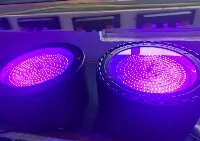
To put it simply, 365nm curing lamps deliver outstanding curing performance across numerous applications, especially those requiring deep curing or involving heat-sensitive materials. However, to achieve optimal results, you need to understand their working principle and the key factors that affect the curing process.

What Is a 365nm UV Curing Lamp?
Let's start with a basic introduction to 365nm curing lamps. The term "365nm" refers to the wavelength of ultraviolet (UV) light, measured in nanometers (nm). Ultraviolet light is an invisible segment of the electromagnetic spectrum, with a shorter wavelength than visible light. In the field of UV curing, different wavelengths serve distinct purposes. The 365nm band is extremely common and particularly well-suited for activating specific types of photoinitiators, enabling the rapid hardening of liquid resins and adhesives.
These curing lamps predominantly utilize LED technology. Compared with traditional mercury lamps, LED lamps offer numerous advantages, including a long service life, low energy consumption, instant on/off operation, and low heat generation. These benefits have made 365nm LED curing lamps increasingly popular in both industrial and daily applications.
How Does 365nm UV Curing Work?
You may wonder why exposure to light can transform a liquid into a solid. This is made possible by an ingenious chemical reaction.
Photoinitiators: The Key Component
Virtually all UV-curable resins and adhesives contain a special chemical compound known as a photoinitiator, which can be thought of as a chemical switch.
Activation by 365nm Wavelength
When illuminated by 365nm UV light, photoinitiators absorb light energy and decompose to generate free radicals or cations.
Initiation of Chain Reactions
These free radicals or cations act like matches. They rapidly react with the monomer and oligomer molecules in the resin, triggering a fast chain polymerization reaction.
Material Curing
As the polymerization reaction proceeds, the initially fluid liquid material gradually cross-links into a rigid solid. This process is remarkably fast, often taking only a few seconds or even less.
The significance of the 365nm wavelength lies in the fact that the optimal absorption wavelengths of many commonly used photoinitiators fall within this range. This means they can be activated most efficiently at this wavelength, enabling high-efficiency curing.
Unique Advantages of 365nm Curing Lamps
What specific advantages in curing performance set 365nm curing lamps apart from alternatives?
Superior Deep Curing Capability
Compared with shorter UV wavelengths (such as 254nm), 365nm UV light boasts stronger penetration. It can effectively penetrate colored or thick adhesive layers, achieving uniform curing from the surface to the interior and eliminating the problem of "surface drying while the interior remains uncured".
Excellent Compatibility with Diverse Photoinitiators
A vast majority of commercially available UV adhesives and resins are formulated with photoinitiators matched to the 365nm wavelength, granting 365nm curing lamps wide-ranging applicability.
Low Heat Generation
LED curing lamps generate significantly less heat than traditional mercury lamps. Additionally, the 365nm wavelength produces relatively low heat during the curing process. This is particularly critical for curing heat-sensitive materials, such as certain electronic components and medical devices, as it reduces the risk of thermal stress damage.
Relatively Low Curing Shrinkage
In select applications, 365nm UV curing allows for better control over curing shrinkage, which is highly beneficial for applications demanding high precision and dimensional stability.
Key Factors Affecting Curing Performance
A 365nm curing lamp alone is insufficient to achieve the best curing results. The following critical factors must also be taken into account:

A Comparison Between 365nm and Other UV Wavelengths
You may ask: are there curing lamps with wavelengths other than 365nm? Absolutely! The most common alternatives are 395nm and 405nm. What are the differences between them, and how should you choose the right one?

If your adhesive is heat-sensitive, demands highly precise and deep curing, and its manufacturer explicitly recommends a 365nm wavelength, then a 365nm curing lamp is an excellent choice.
If your adhesive requires greater penetration or ultra-high curing speed, and is compatible with 395nm, then a 395nm curing lamp may be the more suitable option.
The 405nm wavelength is predominantly used in applications that demand ultra-deep curing or involve specialized materials, such as 3D printing.
Wide-ranging Applications of 365nm Curing Lamps
Thanks to their unique advantages, 365nm curing lamps are widely used across various industries:
Electronics Industry: Bonding of mobile phone camera modules, touchscreen lamination, FPC (Flexible Printed Circuit) reinforcement, micro-speaker assembly, coil fixation, etc. They minimize thermal stress damage to precision electronic components.
Medical Devices: Catheter bonding, needle assembly, endoscopic component lamination, sensor encapsulation, etc. These applications demand exceptional biocompatibility and curing stability.
Optics Industry: Optical lens bonding, fiber optic connector curing, and optical component encapsulation. High transparency and zero post-curing bubbles are critical requirements.
Crafts & Jewelry: UV resin curing, amber and beeswax restoration, and jewelry surface coating. Rapid curing significantly boosts production efficiency.
Nail Art Industry: Curing of nail gel polish. Most nail lamps utilize 365nm or a dual-wavelength combination of 365nm + 405nm.
Scientific Research & Laboratories: R&D and testing of various UV adhesives, and materials science research.
Printing & Coating: Curing of specific UV inks and coatings.
As demonstrated, 365nm curing lamps play a vital role in both high-precision electronics manufacturing and everyday nail art.
How to Pick the Perfect 365nm Curing Lamp
With so many options out there, here's how to find the best 365nm curing lamp for your application:
Power & Intensity: Don't just look at wattage-focus on optical power density (mW/cm² or W/cm²). Match this to your adhesive's requirements, which can range from hundreds of mW/cm² to several W/cm². Also, choose a spot size that fits your curing area.
Heat Management: Good cooling (via fans or heat sinks) keeps the lamp stable and extends its lifespan.
Uniform Light: Make sure the light is evenly distributed to prevent patchy curing.
Smart Controls: Timers, dimmers, or remote control can make your work easier and more precise.
Trusted Brands: Go for reputable manufacturers like Benwei Lighting, a specialist in LED chips with proven expertise. Quality products deliver consistent results and last longer.
Safety First: Look for certifications and essential safety gear like UV-protective glasses.
Budget Wisely: Find the best value for your money without compromising on key features.
Safety Precautions for Using 365nm Curing Lamps
To ensure your personal safety and extend the service life of the curing lamp, please strictly observe the following precautions.
Wear protective goggles
Ultraviolet light is harmful to human eyes. Even the UVA band at 365nm can cause damage if you look directly at the light source for an extended period. Always wear professional UV-protective goggles.
Avoid skin exposure
Although the immediate harm of UVA to the skin is less apparent than that of UVB and UVC, long-term or high-intensity exposure may still lead to skin aging and even more severe health issues.
Maintain ventilation in the working area
Certain UV adhesives may release trace amounts of irritating gases during the curing process. Adequate ventilation is essential for your health.
Cleaning and maintenance
Clean the surface of the lamp regularly, especially the light output window, to prevent dust and adhesive residues from reducing light output.
Proper storage
When not in use, store the curing lamp in a dry and dust-free environment, and protect it from drops and impacts.
Poor Curing Performance?

Q1: Is a 365nm curing lamp harmful to the eyes?
A1: Yes, ultraviolet light poses a hazard to human eyes. 365nm falls within the UVA band. While it does not have the strong germicidal and destructive properties of UVC, direct and prolonged or high-intensity exposure can still damage the retina and even lead to conditions such as cataracts. Therefore, professional UV-protective goggles must be worn during operation.
Q2: The specifications of my UV adhesive indicate a wavelength range of 365nm–405nm. Which lamp should I choose?
A2: This means your UV adhesive can be cured within the 365nm to 405nm wavelength range. In general, 365nm delivers superior deep curing performance, while 395nm or 405nm may offer a faster curing rate. You can make a selection based on your specific application requirements and testing outcomes. For heat-sensitive materials or applications that demand high-precision curing, 365nm is often the more suitable option.
Q3: Can a 365nm curing lamp cure all types of UV adhesives?
A3: No. Although 365nm has broad applicability, UV curing relies on specific photoinitiators, and different photoinitiators exhibit varying levels of sensitivity to different wavelengths. You must select UV adhesives or resins that are compatible with the 365nm wavelength. Always review the technical parameters of the adhesive before purchase.
Q4: Why has the curing performance of my 365nm curing lamp deteriorated after prolonged use?
A4: The decline in performance may be attributed to reduced light intensity caused by LED chip degradation, or dust and adhesive residue on the lamp surface blocking light output. Additionally, poor heat dissipation can impair the performance of the LED chips. We recommend inspecting and cleaning the lamp first. If the issue persists, replacing the LED chips or the entire lamp may be necessary.
Q5: Are 365nm curing lamps identical to nail gel lamps?
A5: Not exactly, though there is considerable overlap. Many nail gel lamps do utilize a 365nm wavelength (or a dual wavelength of 365nm + 405nm), as nail gel polishes are typically formulated to cure under these wavelengths. However, industrial-grade 365nm curing lamps generally feature higher power, a more focused light spot, superior heat dissipation, and a more professional design, to meet the high-efficiency and high-precision demands of industrial manufacturing.


http://www.benweilight.com/professional-lighting/uv-lighting/uv-light-black-light-for-halloween.html