In lighting retrofit projects for offices, schools, warehouses, and retail stores, "glare" is consistently one of the most frequent customer complaints-whether it's the harsh, stinging sensation when looking up at a light, or the eye strain caused by reflections on a screen. When selecting products, many buyers ask us: Are the V-shaped LED tubes-which are becoming increasingly common-actually more effective at reducing glare than traditional, round T8 tubes? The answer isn't a simple "yes" or "no." Let's break this down by examining the structure, optics, and real-world application of these products.
How Glare Occurs
Glare essentially occurs when there is an excessive contrast in brightness within one's field of vision, or when the brightness of a light source is too concentrated, causing visual discomfort. In the lighting industry, this is measured using the Unified Glare Rating (UGR); a lower value indicates less glare. For environments like offices and classrooms, a UGR of 19 or lower is typically required.
For LED tubes, glare generally stems from two factors:
Visible LED "dots": Since LEDs are point light sources, if they are left exposed, the human eye perceives them as distinct, piercing points of light.
Improper beam distribution: Light is directed straight into the viewer's line of sight without being effectively diffused or controlled.
Understanding these points is key to grasping the differences between the two types of tubes.
Light Distribution Characteristics of Round T8 Tubes
The round T8 is currently the most widely used form of LED tube. With a diameter of approximately 26mm, it mirrors the shape of traditional fluorescent tubes, making it easy to install as a replacement.
Its light distribution characteristics include:
A wide beam angle-typically between 270° and 330°-which disperses light in all directions, providing decent uniformity.
LED chips are usually mounted on an aluminum substrate and covered by a milky-white or translucent polycarbonate (PC) diffuser.
The effectiveness of glare reduction depends heavily on the "haze" (diffusion level) of the cover and the density of the LED chips.
To cut costs, low-end products often use covers with high light transmission but low haze. Combined with a wider spacing between the LED chips, this results in clearly visible, glaring points of light when one looks up at the fixture. This is why many people find "T8" tubes glaring; however, this is not an inherent flaw of the circular structure itself, but rather an issue with the materials used and the overall design.
Structure and Light Emission of V-Shaped Tubes
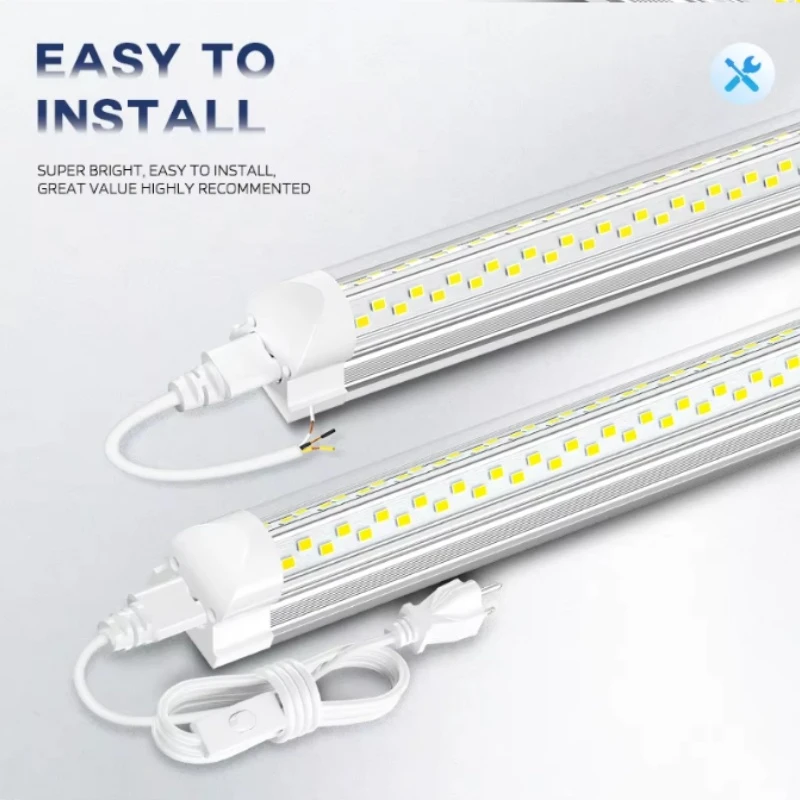
V-shaped tubes (also referred to as "V-Shape T8" tubes) feature a V-shaped cross-section and are commonly found in integrated linear lighting fixtures and certain integrated tube designs. The LED chips are mounted on the two inner slanted surfaces of the V-shaped frame, directing light downward, while the fixture body itself obstructs a portion of the light.
Key structural characteristics include:
The LED chips are not oriented directly upward or toward the sides, which reduces direct exposure to the eyes when viewed from the side.
The light distribution angle is more focused-typically between 120° and 180°-directing the majority of the light toward the target surface.
The slanted sides of the fixture act as "baffles," naturally creating a specific cut-off angle.
In short, V-shaped tubes control light through their physical structure, whereas circular T8 tubes rely primarily on a diffuser (cover) to soften the light.
Core Differences in Anti-Glare Performance
When compared under identical conditions, the differences manifest in the following ways:
Lateral Glare: Because the LED chips in a V-shaped tube are shielded by the slanted sides, the light source is less conspicuous when viewed from an angle, resulting in lower lateral glare. In contrast, circular T8 tubes emit light across nearly 360°, making the light source more visible from side angles.
Direct Viewing: When looking up at the light from directly beneath it, the performance of both types is quite similar; the outcome depends largely on the quality of the diffuser, and a V-shaped design does not necessarily hold an advantage here.
Light Utilization Efficiency: V-shaped tubes concentrate light downward, providing higher illuminance on the target surface. This allows for sufficient brightness without requiring an excessively high light output, which indirectly reduces glare.
Uniformity: Circular T8 tubes generally provide softer, more uniform light. If a V-shaped tube is poorly designed, it may create distinct boundaries between light and shadow, resulting in uncomfortable, high-contrast light spots on the ceiling.
Therefore, while a V-shaped structure is inherently better at controlling glare, this is only true provided that the light distribution design is well-executed.
Other Key Factors Influencing Glare
Beyond the shape of the lamp, several other factors influence the final experience regarding glare; therefore, one should not base selection solely on shape:
Diffuser Material and Haze: A high-quality milky-white polycarbonate (PC) diffuser can effectively diffuse point light sources, whereas a poor-quality one is essentially ineffective.
LED Density and Power: For a given power rating, a higher density of LED chips results in lower brightness per individual point, reducing the "dotted" or granular appearance.
Color Temperature: Higher color temperatures (e.g., 6500K) are perceived as "colder" and harsher; for office environments, a color temperature of around 4000K is recommended.
Installation Height and Fixture Accessories: The use of louvers, reflectors, or frosted diffuser panels can further reduce the Unified Glare Rating (UGR).
Driver Stability: Even with an excellent optical design, a lamp that exhibits significant flickering can cause visual fatigue-a phenomenon often mistaken for glare.
Selecting Lamps for Different Environments
Based on our experience with various projects, the following guidelines can be applied:
Offices, Classrooms, and Conference Rooms: These spaces are sensitive to glare. We recommend V-shaped lamps with well-engineered light distribution, or circular T8 lamps equipped with high-haze diffusers, ideally used in conjunction with louvered fixtures.
Warehouses, Workshops, and Parking Lots: These areas prioritize light uniformity and cost-effectiveness. Circular T8 lamps are the most convenient replacements for traditional fluorescent tubes, and glare requirements are generally less stringent.
Supermarkets and Shopping Malls: These settings require the illumination of vertical shelving. V-shaped lamps, which direct light downward, offer a distinct advantage-though care must be taken to ensure the light does not shine directly into customers' lines of sight.
Retrofitting Existing Fixtures: If the existing fixture is designed for T8 tubes, circular T8 lamps offer better compatibility. For V-shaped lamps, it is usually necessary to verify the specific mounting method and dimensions.
Conclusion
Returning to the initial question: While the structure of a V-shaped lamp is inherently better at reducing lateral glare, this does not mean it is more comfortable than a circular T8 lamp in every scenario. V-shaped LED tubes utilize their structural design to provide shielding and focused light distribution, resulting in reduced side-view glare and high light-utilization efficiency.
Circular T8 tubes rely on a diffuser cover to spread light, producing a soft, diffused glow; while highly versatile, their performance is heavily dependent on the quality of the diffuser.
Ultimately, glare levels are determined by a combination of factors: the haze of the diffuser, the layout of the LED chips, the color temperature, and the overall design of the fixture. When selecting a tube, consider the specific environment rather than focusing solely on its shape.
Need help choosing the right LED tube? Contact us today.
Unsure whether a V-shaped tube or a circular T8 is best for your project? We can provide expert selection advice and samples based on your specific application, installation height, and UGR (Unified Glare Rating) requirements. Whether for office lighting or large-scale commercial procurement, please reach out via message or email. Our technical team will respond within 24 hours with detailed quotations and product specifications.