Exploring the LED Spectrum: What Colors Can LEDs Emit and What Are Their Wavelength Ranges?
From vibrant city neon signs and atmospheric exhibition halls to everyday smartphone screens and indoor lighting, LED lights have long rendered our world in brilliant color.
You might be curious: What colors of light can LEDs actually produce? And why is there a difference between light emitted by different colored LEDs? In reality, the colors emitted by LEDs are not achieved by simply "dyeing" the bulb housing; they are determined by the fundamental "genes" of the semiconductor materials inside. In the realm of optics, the precise "ID card" defining these colors is the wavelength of light (measured in nanometers / nm).
Today, let's explore the colorful world of LEDs using a simple breakdown of LED colors and wavelengths!
Common LED Colors and Wavelength Reference Chart
The human eye can perceive visible light within a wavelength range of approximately 380 nm to 750 nm. By combining different semiconductor materials (such as Gallium Nitride/GaN, Gallium Phosphide/GaP, etc.), LED chips can precisely emit monochromatic light at specific wavelengths.
Here are the most common LED emission colors and their corresponding wavelength ranges:
| LED Color | Typical Wavelength Range (nm) | Common Applications |
| Ultraviolet (UV) | 380 - 400 nm (Near UV) | Adhesive curing, counterfeit detection, sterilization, mineral inspection |
| Violet | 400 - 430 nm | Stage effect lighting, insect trap lights, specialized color rendering |
| Blue | 450 - 480 nm | White LED base, marine/aquarium lighting, indicators, warning lights |
| Cyan | 480 - 500 nm | Full-spectrum enhancement (eye-care lamps), medical testing, aquarium lighting |
| Green | 500 - 565 nm | Traffic signals, stage lighting, plant growth supplementation |
| Yellow-Green | 565 - 575 nm | Traditional electronic indicators, digital display tubes |
| Yellow | 570 - 590 nm | Automotive turn signals, fog lights, caution lighting |
| Orange | 590 - 620 nm | Stage mood lighting, architectural facade lighting |
| Red | 620 - 750 nm | Automotive taillights, plant growth (photosynthesis), medical red light therapy |
| Infrared (IR) | > 750 nm (Invisible) | Security night vision, remote controls, infrared sensing |
The Special Member: What Is the Wavelength of "White Light"?
Observant readers might have noticed: why isn't white light listed in the table above?
Fun Science Fact: > Sunlight and white light are not "monochromatic light"; rather, they are polychromatic light mixed from multiple spectral colors. Therefore, white light does not have a single wavelength value.
Currently, white LED light is primarily produced in two ways:
- Blue Chip + Yellow Phosphor (Most Common): Uses a 450–460 nm blue LED chip to excite yellow phosphor, creating bright white light through color mixing.
- RGB Primary Color Mixing: Combines Red, Green, and Blue LED chips together and mixes them in controlled proportions to produce white light with higher color fidelity.
For white LEDs, we generally measure Correlated Color Temperature (CCT, in Kelvin / K) rather than wavelength-such as 3000K (Warm White), 4000K (Natural White), or 6000K (Cool White).
Why Is Precise Wavelength Selection Crucial for Your Project?
In general lighting projects, a wavelength difference of a few nanometers may not be noticeable to the naked eye. However, in professional applications, a variance of just 5 nm can lead to drastically different results:
- Horticultural Lighting: The most critical wavelengths for plant photosynthesis are concentrated at 450 nm (Blue) and 660 nm (Deep Red). Wavelength deviations can slow plant growth.
- Medical & Beauty: Specific wavelengths (e.g., 630 nm / 850 nm) offer specialized therapeutic effects and subcutaneous penetration capabilities.
- Security & Sensing: 850 nm infrared light offers great concealment with high camera sensitivity, while 940 nm is completely invisible to the human eye, ideal for covert surveillance.
Customize Your Wavelengths for Tailored Optical Solutions
Different projects demand distinct color requirements, wavelength tolerances, and spectral continuity. Selecting the right wavelength not only optimizes lighting performance but also reduces energy consumption and overall costs.
As a professional LED lighting and light source solution provider, we maintain a comprehensive wavelength binning system and advanced photoelectric testing equipment, enabling us to deliver:
- Monochromatic LED chips and fixtures covering the full spectrum (365 nm to 940 nm)
- Customized spectra for specialized fields such as plant growth, medical care, and aquariums
- White light designs with precise CCT and high CRI (Ra > 95 / Full Spectrum)
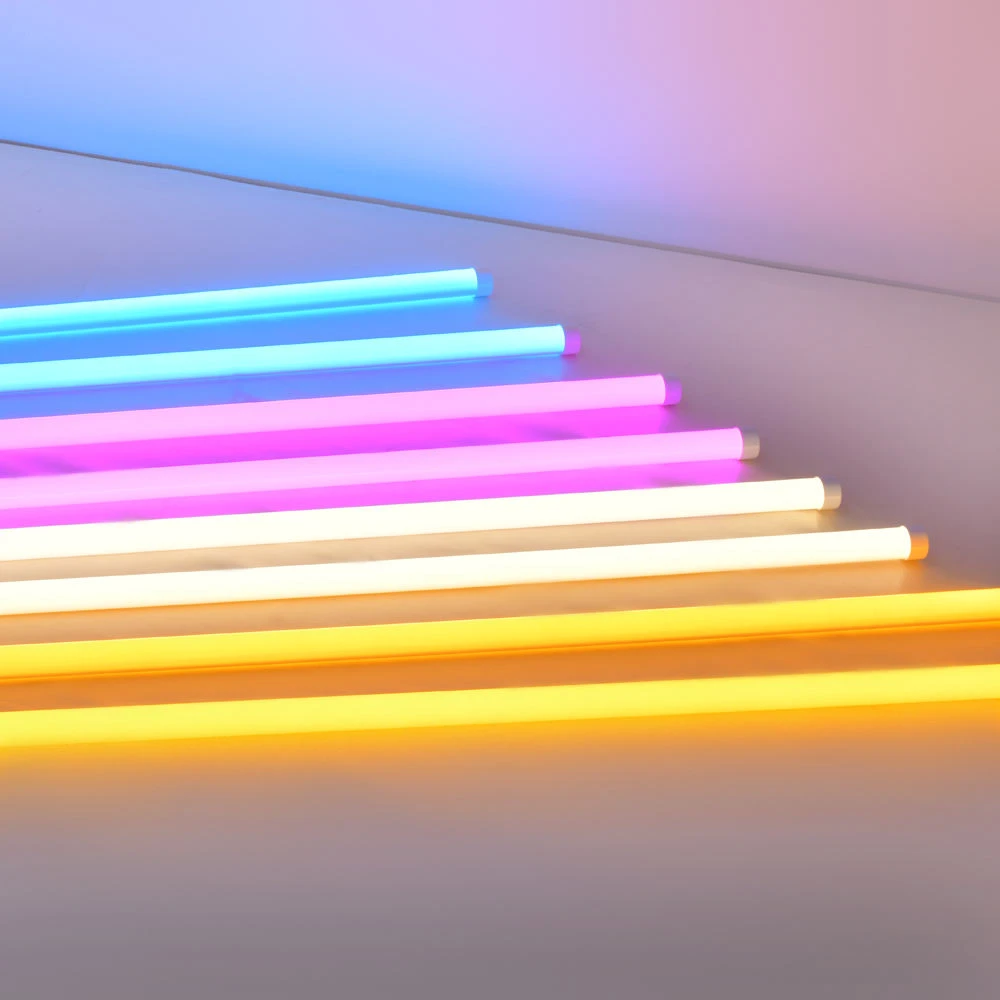
Looking for LED fixtures or modules with specific wavelengths? Need assistance with optical parameter selection?Feel free to contact our professional technical engineers at any time! Click the product links below to submit an online inquiry; we offer free technical consultation, customized solutions, and sample support to help bring your project to fruition quickly!
https://www.benweilight.com/lighting-tube-bulb/special-t8-led-tube/led-tube-light-multicolor-rgb.htm