Guide to Choosing and Planning Your Home Kitchen Lighting

Interior kitchen design is accorded top priority in contemporary homes. Kitchen countertops, cabinets, and hardware are all expertly crafted so that the kitchen can become one of the features of a house. However, even if all of these are done effectively, the kitchen will not function as it should without enough illumination. Without a question, lighting has a big impact on how your kitchen looks as a whole.
In addition to being aesthetically pleasing, the kitchen is also the hub of activity in any house, necessitating effective lighting. Given the variety of options available, selecting the ideal lighting for cooking and dining may be difficult. Here are some suggestions to help you organise your kitchen lighting at home.
Multiple Lighting
To get adequately lighted kitchen, it's vital to use layered lighting by combining ambient, task, and accent lights in the right way.
Background Lighting
The primary source of light in your kitchen, aside from natural light, is ambient light. When you enter your kitchen, it should be the first light you turn on. The major objective is to evenly illuminate your entire kitchen with ambient light, including the corners, to prevent shadows.
Flush mount ceiling lights should work well for ambient lighting. It's inexpensive and straightforward, yet it works. A good option is to coordinate the lighting fixture's design with the style of your cabinets or countertop.
You can also think about hanging lighting for your kitchen. To ensure that it looks natural and not forced, make sure the floor-to-ceiling clearance is sufficient.
In Singapore, track lights have also become a popular replacement for standard lighting. There are track lights with broader beam angles that may evenly spread light over the room while still serving as task lighting. Its ability to distribute light more evenly than a single fixture is its strongest feature.
Effort Lighting
Since ambient lighting is typically located on the ceiling, it might not be able to illuminate every area after all, especially if someone is in the kitchen. Dark patches still exist because shadows will be cast. Task lighting serves its purpose in this situation. Task lighting should be put in places where particular activities, such as cooking, cleaning, and food preparation, are carried out.
As was already said, track lights have a variety of uses, but its primary goal is to provide task illumination. Install it a few feet from your counter, parallel to it, and direct its heads towards the surface. This will be sufficient lighting for your chores.
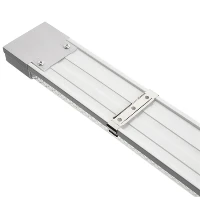
The dark areas under the cabinets can be illuminated with the help of under cabinet lights. The most popular types of under cabinet illumination are LED strips or T5 bulbs. Both offer evenly dispersed lighting throughout the upper cabinets' concealed area. Additionally, puck lights have been in use since the late 1990s. However, it just illuminates specific areas. In order to prevent glare, avoid choosing counter tops with excessive gloss for the best under cabinet lighting impact.
It is very advised to use pendant lighting in larger kitchens with islands. A linear pendant lamp over your kitchen island may give the right lighting, whether the island is used for food preparation or dining. The standard distance between the counter top and the bottom of the pendant light for hanging them over kitchen islands is at least 80 centimetres.
Addition Lighting
The finishing touch for the tiered lighting in your kitchen is accent lighting. Given that your kitchen is adequately lit by ambient and task lighting, accent lighting is supposed to improve the aesthetics of the space.
When it comes to accent lighting for the kitchen, there is no specific guideline. Selecting what looks excellent is more important than making a lot of choices. Lights around the toe-kick of your cabinet create diffused illumination and give the room a dramatic feel. The idea behind cove ceiling lights is the same as this. You can utilise LED strips and T5 lights once more.
Temperature of Colour
The colour temperature of your kitchen depends on its size and whether it is enclosed or not. The layers of light are typically utilised in combination with day light and warm white light. For instance, ambient lighting has a colour temperature of 5700 Kelvin (daylight), whereas task and accent lighting can have a 2,700K (warm-white) colour temperature. Depending on your preference, it can also be switched out. Another aspect to consider is the colour of the walls.
Continuity of Theme
Kitchen lighting should also follow a constant theme. It makes more sense to have a light that complements the architectural style of the house. If your kitchen is decorated in a modern style, you can't just buy an industrial-style lamp. A magnificent chandelier can not look as impressive when used with a simple design. It is not necessary to purchase the greatest lighting fixture on the market. Instead, make sure it complements the interior decor of your kitchen.
Correct Sizes for Lighting Fixtures
A large lighting fixture will look out of place in a small kitchen. It will be too much to handle. It's also unappealing to have a single little lighting fixture in a vast kitchen. It will disintegrate in space. We want to establish the proper balance.