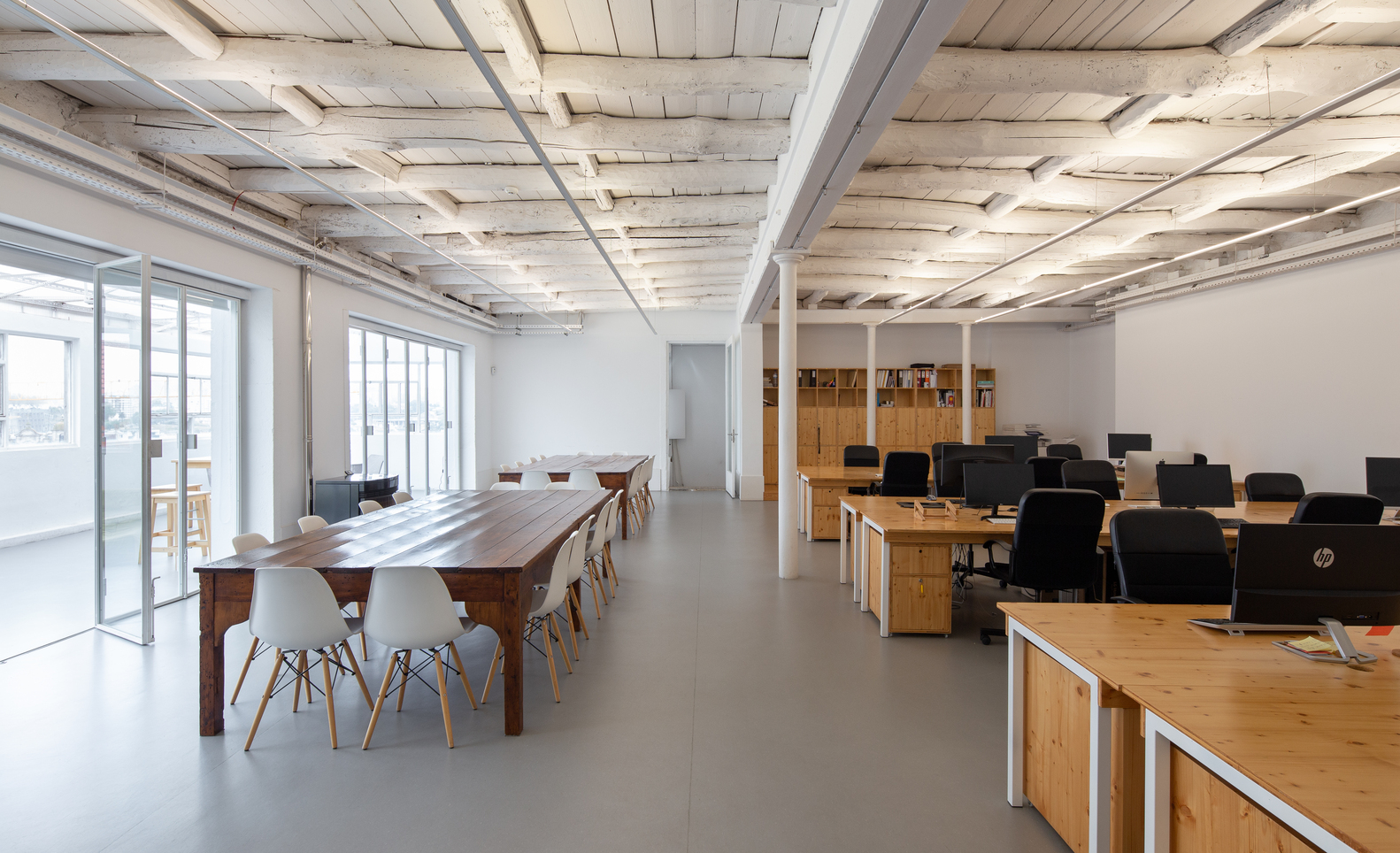
The word office derives from the Latin term officium. This translates in English to “task performance.” For ideal working conditions on any given interior task, whether inside a building, gathering place or home, providing evenly distributed high-CRI LED light with the proper, human-centric lighting controls, is crucial for improved health, mood and quality of work. The post-pandemic workspace may also need to account for a demand among humans who prefer to work in social environments.1
Proper lighting design combined with an understanding of lighting’s effect on the human body can improve worker wellness and efficiency while reducing operating costs.
The guiding principles of lighting design are a starting point. But the ultimate office lighting determinant is the unique nature of the work itself, including any specific task-related habits practiced by the worker.
Begin configuring good office lighting by calculating the number of lighting fixtures needed for the office interior. To determine the average uniform horizontal illumination in foot candles (fc) for an entire room, the Illuminating Engineering Society of North America (IESNA) Lighting Handbook, Ninth Edition advises that you choose “a fixture from a catalog, and then uniformly space the fixtures throughout the room.”
Figuring appropriate light levels for the uniformed workspace, according to the guidebook, means extending lighting power density (LPD) values from lighting a public area using 2 fc to 5 fc, to lighting visual task areas of extremely low contrast and small size using 1,000 fc to 2,000 fc. These recommendations account for factors such as someone’s age, the room surface’s reflectance and background reflectance.
For in-depth reporting on lighting calculations factoring cavity ratios, room size, dimension, light loss and proportion using various methods and formulas, read this article.
Certain lighting fixtures can meet more general, all-purpose demands. For example, suspended or pendant illumination can deliver adjustable, quality light that may accommodate various office inhabitants. A pendant or chandelier design could reduce installation costs and foster an easier repurposing of luminaires when changes become necessary in a workspace.
Recessed lighting can hide, conceal or embed the light fixture away from the worker, so that those working underneath the light are not distracted, letting workers create and work in open space. This can be an especially useful asset to the designer and architect.
Commercial-grade lighting applications may necessitate the use of durable high-traffic illumination that draws attention toward or away from certain product displays, work projects or spaces. The use of indirect uplighting or downlighting with accents, for ambience, general lighting, or for overall brand clarity and consistency can be integrated from design to installation, whether using linear LED lighting of varying lengths or daisy-chained lights to reduce power strain. Consider a variety of adjustable control