How Do UV Disinfection Lamps Kill Germs? Are They Effective? Can You Enter the Room Immediately After Turning Them Off?
As health awareness rises, UV disinfection lamps have gradually become a "new household appliance" in many homes. During seasonal infection peaks, damp rainy seasons, or after a family member has been ill, people often turn on UV lamps in living rooms, bedrooms, or even playrooms as a reassuring ritual. But do you really know how to use a UV lamp for disinfection properly?
1. The "Massacre" of a Bacterium: How Does UV Kill Microorganisms?
Ultraviolet light is divided into three bands: UVA, UVB, and UVC. Among them, UVC with a wavelength of 200–280 nm has the strongest germicidal effect. It is effectively absorbed by the DNA and RNA of microorganisms, damaging their molecular structure and causing photochemical damage.
Household disinfection lamps usually use low‑pressure mercury vapor discharge lamps that emit primarily 253.7 nm ultraviolet light. This wavelength lies within the UVC range and directly affects the genetic material of bacteria and viruses. The UV energy causes adjacent thymine bases on the DNA strand to form dimers – effectively sticking two "lines" of the genetic code together and preventing normal replication. Microorganisms remain alive but lose their ability to reproduce, so they can no longer cause infection or disease.
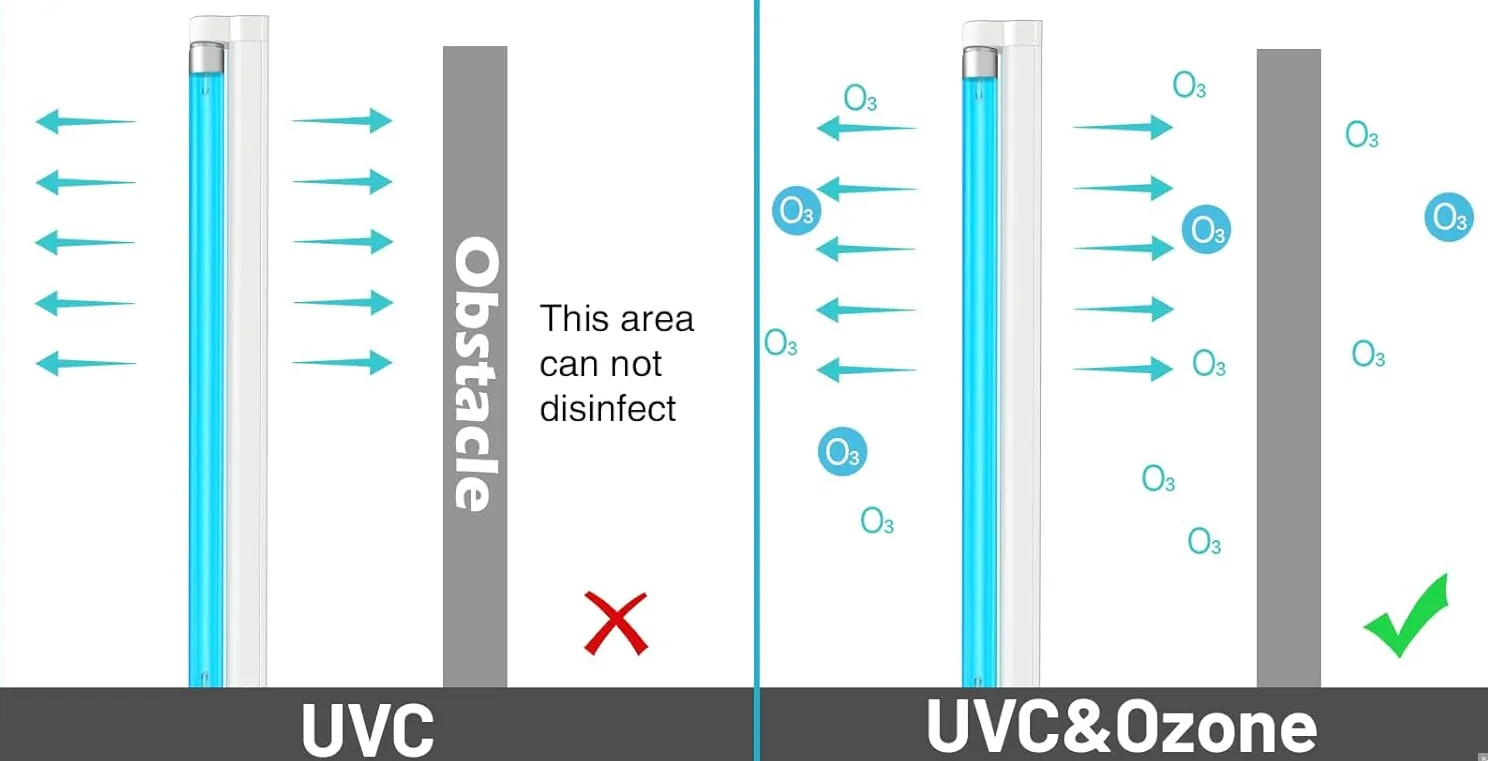
This is a purely physical sterilization process. No chemicals are added, and no residues remain after disinfection. UV also ionizes oxygen in the air to produce ozone, which itself has a strong oxidative bactericidal effect. Ozone generated during use can compensate for the limitations of direct UV irradiation by reaching shaded areas and dead corners.
2. Are UV Lamps Effective? – 265–266 nm Is Strongest, 253.7 nm Is the Workhorse
Scientific experiments show that UV with a wavelength of 265–266 nm has the strongest germicidal effect, which perfectly matches the absorption spectrum of DNA. The 253.7 nm wavelength commonly used in household disinfection lamps is also very close to the absorption peak, showing high disinfection efficiency and controllable dosage.
However, disinfection effectiveness depends not only on wavelength. According to the dose law, the germicidal effect is determined by irradiance × time. A certain threshold must be reached to effectively inactivate target microorganisms. Recent research has revealed another easily overlooked rule: at the same UV dose, increasing irradiance is more effective at killing microorganisms than simply extending exposure time. Experiments have shown that at a fixed dose of 10 mJ/cm², when intensity is increased from 0.5 mW/cm² to 10 mW/cm², the inactivation rate of E. coli rises from 0.5‑log (approximately 68%) to 7.2‑log (>99.9999%).
High‑intensity UV not only causes more physical damage but also disrupts the microorganisms' repair mechanisms and induces oxidative stress, achieving a more thorough germicidal effect.
Reference doses for inactivating common microorganisms (using 253.7 nm UV):
| Microorganism | Dose for 90% kill | Dose for 99% kill |
|---|---|---|
| E. coli | ~3,000 μWs/cm² | ~6,600 μWs/cm² |
| Staphylococcus aureus | ~4,400 μWs/cm² | ~8,500 μWs/cm² |
| Coronavirus | ~3,000 μWs/cm² | ~6,600 μWs/cm² |
| Influenza virus | ~4,400 μWs/cm² | ~8,000 μWs/cm² |
Note: μWs/cm² = μJ/cm²
3. Can You Enter the Room Immediately After Turning Off the Lamp? Two Cases
Whether you can enter immediately after the lamp is turned off depends entirely on the type of lamp: ozone‑free or ozone‑generating.
Case 1: Ozone‑Free UV Lamp
Ozone‑free lamps primarily emit 253.7 nm UV and produce little or no ozone. The germicidal effect relies solely on direct UV irradiation. After the lamp is turned off, the UV radiation stops immediately, so in theory you can enter the room at once.
In practice, however, it is still beneficial to ventilate the room for 5–10 minutes after disinfection. Even with "ozone‑free" lamps, minute amounts of ozone may be produced through UV interaction with air. After prolonged disinfection, it is advisable to ventilate briefly before re‑entry.
Case 2: Ozone‑Generating UV Lamp
These lamps emit 185 nm UV in addition to 253.7 nm, which converts oxygen (O₂) into ozone (O₃). Ozone's strong oxidizing power can reach areas that direct UV cannot, but ozone is a strong respiratory irritant. Even low concentrations can cause coughing, sore throat, and chest tightness.
Therefore, you cannot enter immediately after an ozone‑generating lamp finishes its disinfection cycle. You must wait for the ozone to decompose or disperse. Typically, ventilate the room for at least 30 minutes with open windows. The exact time depends on the amount of ozone produced and ventilation conditions. Under good ventilation, 30 minutes is usually sufficient; if the smell remains, continue ventilating.
4. Safety Reminder: A Disinfection Lamp Is Not an Ordinary "Light Bulb"
UV radiation has well‑known direct hazards to the human body. The International Commission on Non‑Ionizing Radiation Protection (ICNIRP) and the World Health Organization (WHO) recommend a human safety exposure limit of approximately 3 minutes. Direct exposure for 15 minutes can damage the cornea, causing photokeratitis – a painful condition with intense eye pain, light sensitivity, and tearing. Long‑term exposure increases the risk of skin cancer and cataracts.
Mandatory safety practices during disinfection:
- Keep the room unoccupied – all people and pets must leave the room.
- Do not look at the light source – never stare directly at the UV lamp.
- Close doors and windows during operation, and keep the room clean and dry.
- Control the environment – ideal temperature 20–40 °C, humidity below 80%.
- Clean the lamp regularly – wipe the lamp surface weekly with 75% or 95% alcohol; dust and grease reduce UV transmission.