How High Should the Color Rendering Index (CRI) of an LED Light Be to Be "Good Enough"? – Different Thresholds for Home, Commercial, Healthcare, and Art Lighting
Color Rendering Index (CRI) is one of the most cited specifications in LED lighting, yet it is also one of the most misunderstood. A high CRI number is often equated with "good light," but in reality, the "enough" level of CRI depends entirely on the application. A warehouse may work perfectly with Ra80, while a museum or a surgery room would cause serious problems with anything less than Ra95. This article breaks down what CRI actually measures, its limitations, and the practical CRI thresholds you should require for different scenarios – whether you are a B2B buyer sourcing for a project or an end‑user choosing lights for your home.
1. What Is CRI (Ra)? The Average of Eight Standard Color Samples
CRI (Color Rendering Index, often denoted as Ra) was developed by the International Commission on Illumination (CIE) to measure how accurately a light source reveals the colors of objects compared to a reference source (typically daylight or a blackbody radiator). It scores from 0 to 100, where 100 represents perfect color rendering identical to the reference.
The standard calculation uses eight pastel color samples (R1–R8). The average of these eight gives the general CRI, or Ra.
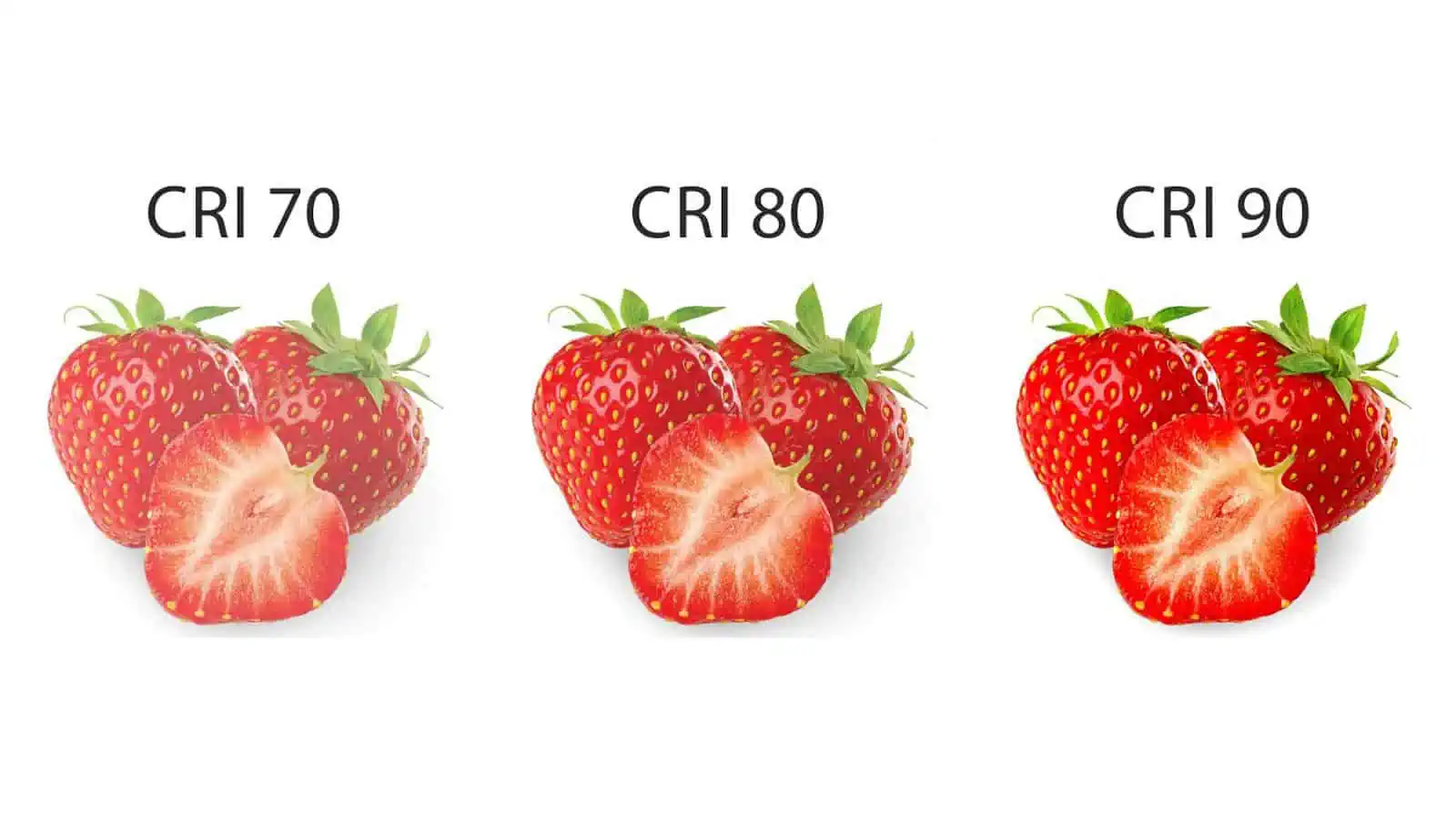
Important limitation: The eight samples do not include highly saturated colors, especially deep red. That is why a lamp can have an Ra of 85 yet render a red apple dull and grayish. The missing red index is labeled R9, which is not part of Ra. This is why professional buyers increasingly look beyond Ra to metrics like CQS, R9, and TM‑30‑18.
2. Minimum Recommended CRI by Application
2.1 General Home Lighting (Living rooms, hallways, storage) – Ra ≥ 80
For corridors, balconies, garages, and storage areas, Ra80 is perfectly adequate. Human eyes are not highly sensitive to color accuracy in these transient spaces. However, for kitchen countertops, dining tables, home offices, and bathroom mirrors, we recommend Ra ≥ 90. Accurate color rendering helps judge food freshness, makeup application, and skin tones.
2.2 Commercial Lighting (Retail, Supermarkets, Hotels) – Ra ≥ 90, and R9 > 0
Retail environments demand higher color quality. Clothing stores, cosmetics counters, and fresh food sections need vivid, true‑to‑life colors to attract customers and showcase products. Studies on meat display cases have shown that raising CRI from 80 to above 90 can increase perceived freshness and boost sales by 10‑15%.
For fresh produce and meat sections, Ra ≥ 90 is the baseline, and R9 (saturated red) must be positive. The higher the R9, the more natural red meat, flowers, and red packaging appear.
Hotel guest rooms aim for a warm, comfortable atmosphere: Ra ≥ 90 with 2700‑3000K color temperature, plus good R9 and R15 (Asian skin tone) rendering.
2.3 Healthcare Lighting (Hospitals, Clinics, Dental) – Ra ≥ 95, with focus on R9 & R13
Doctors and medical staff rely on accurate color perception to assess skin tone, vein locations, wound healing, and tissue contrast. Poor CRI may lead to misdiagnosis. For example, neonatal jaundice requires precise observation of yellowing of the skin – a low‑CRI light can mask subtle changes.
Recommended: Ra ≥ 95, plus separate attention to R9 (red) and R13 (skin tone). Some diagnostic lighting (e.g., dental shade matching) requires Ra > 98 with D65 standard illuminant (5500‑6500K).
2.4 Art & Museum Lighting (Galleries, Exhibitions) – Ra ≥ 96, plus TM‑30‑18
Museums and galleries have the most demanding color requirements. Paintings, textiles, and artifacts are extremely sensitive to color distortion. The International Council of Museums (ICOM) and IES recommend CRI > 96 and, increasingly, the use of TM‑30‑18 metrics: Fidelity (R_f) ≥ 90 and Gamut (R_g) close to 100. UV and IR radiation must also be strictly controlled to prevent damage to exhibits. Typical color temperature is 3000K or 3500K for a warm, authentic presentation.
2.5 Photography & Video Production – CRI ≥ 95 and TLCI ≥ 85
For professional video and photo lighting, color consistency is critical. Standard recommendation: CRI ≥ 95, and also use the TLCI (Television Lighting Consistency Index) with a score of at least 85. TLCI evaluates how a camera sensor responds to the light. Many LED studio panels are rated CRI > 97 and TLCI > 90.
2.6 Industrial Inspection, Printing, Dyeing – Custom requirements, usually CRI > 90 plus spectral match
For color‑critical industrial tasks – paint mixing, textile color matching, proof printing – specialized standard light booths (D50 or D65) are used. These require CRI > 95 and a spectral power distribution extremely close to the CIE daylight curve. In such cases, CRI alone is insufficient; the full spectrum must be validated.
Recommended CRI and Additional Metrics by Application
| Application | Minimum Ra | Recommended Ra | Additional Metrics |
|---|---|---|---|
| Home (hallway, storage) | 80 | 80‑85 | - |
| Home (kitchen, study, makeup) | 90 | 90‑95 | - |
| Retail (fresh food, meat) | 90 | 90‑95 | R9 > 20 |
| Retail (clothing, cosmetics) | 90 | 90‑98 | R9 > 30, R15 > 80 |
| Hotel guest rooms | 90 | 90‑95 | Warm CCT (2700‑3000K) |
| Hospital general wards | 90 | 90‑95 | R9 > 0 |
| Operating rooms / examination | 95 | 95‑98 | R9 > 50, high illuminance |
| Museums, galleries | 96 | 96‑98 | TM‑30‑18: R_f ≥ 90, R_g ≈ 100 |
| Video / photo production | 95 | 95‑98 | TLCI ≥ 85 |
| Printing, color matching | 95 | >95 | D50/D65 standard source |
3. Beyond Ra: R9, CQS, TM‑30‑18 Explained
- R9 (Saturated red) – Red is the most difficult color for many LEDs to render accurately. A positive R9 value is a hallmark of a quality LED. For applications involving fresh meat, flowers, cosmetics, or medical skin assessment, R9 matters greatly. Industry guidelines: R9 ≥ 20 is acceptable; R9 ≥ 50 is excellent.
- R13 (Skin tone) – For hospitality, beauty, and healthcare, good skin tone rendering (R13) ensures people look healthy and natural. R13 > 80 is a plus.
- CQS (Color Quality Scale) – Uses 15 saturated color samples (including red, green, blue, purple). It gives a more balanced assessment of vivid colors. Scores 0‑100. Gradually gaining acceptance alongside CRI.
- TM‑30‑18 – IES's 2018 standard. It provides two key metrics: R_f (fidelity) – similar to CRI but with 99 color samples, and R_g (gamut) – indicates whether saturation is increased or decreased relative to the reference. An ideal light source has R_f ≥ 90 and R_g ≈ 100. For high‑end art and printing, TM‑30 is the preferred tool.
4. Common Misconceptions: High CRI Does Not Always Mean "Better"
- Trade‑off with efficacy – Higher CRI often requires more phosphor layers, which can reduce luminous efficacy by 5‑15%. For offices and warehouses, a balanced Ra80 may be smarter; for art galleries, sacrificing some efficacy for Ra98 is justified.
- CRI is not comparable across different CCTs – The same Ra value at 3000K and 6500K will produce very different color appearances. Always compare CRI at the same or similar color temperature.
- CRI does not measure preference – Sometimes a light with slightly lower Ra but higher R_g (more saturated) can make fruit or meat look "juicier". This is intentional for retail, not color fidelity. For "color enhancement" applications, you may want R_g slightly above 100. Specify clearly whether you need fidelity or enhancement.

5. How B2B Buyers Can Verify CRI Claims
- Request third‑party test reports – Reliable suppliers will provide CRI test reports based on CIE 13.3 or IES LM‑79, including the full spectrum and individual R1‑R15 values, not just a claimed number on a datasheet.
- Perform side‑by‑side comparison – Use a high‑CRI reference light (e.g., halogen or a known good LED) and a sample light to illuminate a color chart or real objects (red apple, skin). Compare visually under similar CCT.
- Ask for R9 and spectral curve – Insist that the supplier provide R9 value and a smooth, continuous spectrum plot. Avoid fixtures with deep gaps or spikes in the spectrum.
- Batch sampling – For volume orders, reserve the right to spot‑check incoming products using a handheld spectrometer to ensure they match the approved sample.
6. Summary
There is no single "good enough" CRI for all applications. The right threshold depends on what you are lighting and why. Setting realistic CRI requirements based on use case helps you balance budget, energy efficiency, and visual performance. Use the table above as a quick reference, and always verify claims with real data.